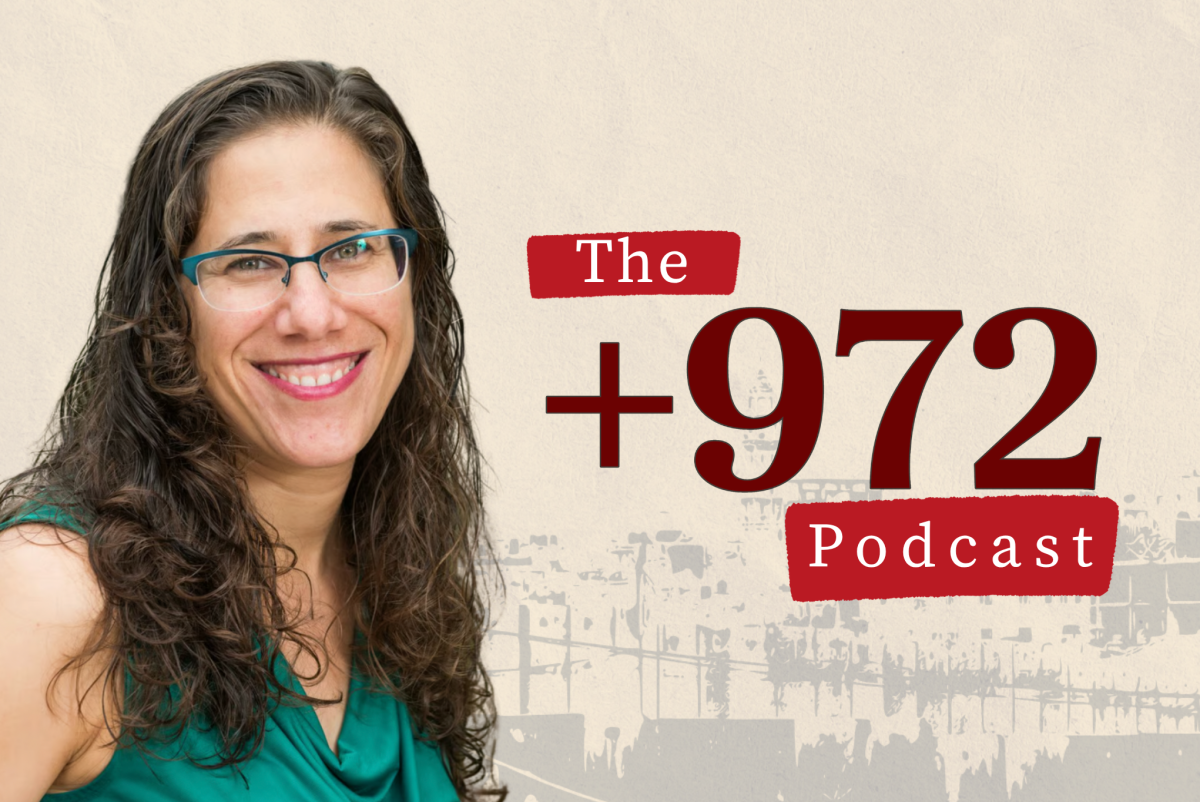
Listen here: Apple Podcasts | Spotify | YouTube
On Tuesday, Israel’s Palestinian citizens could be the decisive voting bloc that brings down the most far-right government in the country’s history. Yet the Jewish-Israeli politicians vying to replace Prime Minister Benjamin Netanyahu have either ruled out governing with Arab parties or set conditions that effectively exclude them from any future coalition.
And one of Palestinian politician won’t even be able to run. Just weeks ago, Sami Abu Shehadeh, chairman of Balad, was forced to drop out of the race over an article he published a day after October 7, in which he analyzed the Hamas-led attack without explicitly condemning the killing of civilians — something he has since done countless times. It was yet another humiliating illustration of the limits of Palestinian political power in a state that prioritizes the rights of its Jewish citizens.
In this episode of The +972 Podcast, we speak with historian Leena Dallasheh about what this election reveals about the meaning and limits of Palestinian citizenship in Israel. Dallasheh sees Abu Shehadeh’s effective disqualification — alongside the expanded power of the far-right, explosive state-backed settler violence in the West Bank, and genocide in Gaza — as a reason for Palestinians to turn out in greater numbers rather than retreat from electoral politics.
Those who imagine that such violence will remain confined to the occupied territories, she warns, would do well to remember that the methods of dispossession and military control now associated with the occupation were first developed against Palestinian citizens inside Israel, under a system of military rule that ended just a year before the occupation began in 1967.
Our conversation also reaches further back to the Nakba of 1948, and the different ways Palestinians responded to their sudden transformation from inhabitants of British Mandatory Palestine into a minority within a Jewish state. These responses, she argues, gave rise to competing political traditions whose legacies are visible today — in the divisions between Mansour Abbas’s pragmatic, Islamist Ra’am and the secular, leftist Joint List, as well as among those who have chosen to abstain from electoral politics altogether.
Yet underlying these diverging political currents, Dallasheh points out, has been a shared imperative: al-baqa’, or remaining on one’s land. In the face of a state determined to dispossess its Palestinian citizens, the struggle to remain has often demanded difficult political compromises, complicating any simple distinction between resistance and collaboration.