


Dozens of family members, friends, solidarity activists, and journalists gathered in the village of Umm Al-Khair on Tuesday to mark the first anniversary of the killing of Awdah Hathaleen. The Palestinian activist and teacher, who was for several years a contributor to +972 Magazine, was shot dead by an Israeli settler who raided his village together with an excavator driver. A year later, Awdah’s killer still walks free.
Awdah was known to many around the world for bringing local and international activists into the nonviolent struggle against Israel’s occupation of the West Bank, and particularly its ethnic cleansing of Palestinian communities in the Masafer Yatta region. The memorial drew Knesset members Ayman Odeh and Ofer Cassif from the left-wing Hadash party, who pledged to continue the struggle Awdah had dedicated his life to and reaffirmed their support for Umm Al-Khair, which stands under constant threat of wholesale demolition.
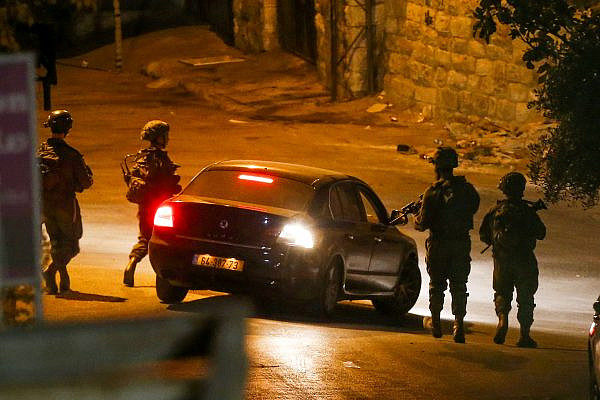
But the commemoration was repeatedly disrupted by Israeli forces, who threw Cassif to the ground, assaulted several activists, and threatened to disperse the gathering by force and expel everyone from the site. Military vehicles repeatedly sped past the crowd, creating loud noises in an attempt to drown out the ceremony.
Despite the intimidation, participants remained until the ceremony concluded. “Today, we do not stand merely to mourn; we stand to honor [Awdah] with unwavering loyalty,” said his brother Aziz Hathaleen. “From this gathering, we raise our voices to demand justice and hold the perpetrator accountable, while reaffirming our steadfast commitment to remain in our village and defend it against all challenges. Justice is not merely a demand — it is the true path to lasting peace.”
Yinon Levi, the internationally sanctioned settler whose bullet pierced Awdah’s lung in front of his small children, appeared in the aftermath of the shooting at a pre-indictment hearing over a possible negligent homicide charge, and was briefly held under house arrest. But an Israeli court quickly ordered his release — before the army had even released Awdah’s body to his family.

One year on, Israeli prosecutors have still yet to decide whether to indict Levi, with a decision expected in the coming days. The Hathaleen family’s lawyer, Eitan Peleg, told +972 that the case was unusual in that regard. “Law enforcement against settlers in the West Bank is extremely rare — almost nonexistent,” he explained. “In this case, however, we have made some progress.
“The prosecution has promised me that a decision on whether to file an indictment against Levi will be made by the end of this month, or at the latest by the beginning of next week,” he continued. “We hope the decision will be positive and that an indictment will indeed be filed.”
A forensic investigation by the Palestinian human rights group Al-Haq, released on July 28 to coincide with the anniversary of Awdah’s death, concluded that Levi unlawfully shot Hathaleen even though he posed no threat and none of the Palestinians present at the scene were armed.
Drawing on eyewitness testimony, legal records, forensic video analysis, open-source research, geospatial mapping, scene reconstruction, and three-dimensional modeling, the investigation found evidence that Levi demonstrated criminal intent before any interaction with residents. It also concluded that Israeli soldiers and police at the scene protected the settlers and failed to take enforcement action against them.
The birth of an outpost
For the residents of Umm Al-Khair, the year since Awdah’s killing has been defined by near-constant violence and the looming fear of displacement. Weeks after Awdah was killed, Israeli settlers established a new outpost overlooking the village — an extension of the settlement of Carmel which had already been encroaching on Umm Al-Khair since it was established in 1980.
Within months, Israeli authorities connected the outpost to electricity, running water, paved roads, and sewage infrastructure. A few dozen meters away, Palestinians in Umm Al-Khair receive running water for only a few hours each week and must store supplies in plastic tanks.

But residents say the disparity in infrastructure and lack of basic services is not their greatest burden. Instead, they describe a steady escalation of settler violence backed by the Israeli army: daily assaults, harassment of women and children, repeated incursions into the village, and attempts to seize privately owned land. These attacks, residents say, are part of a broader process through which settlers are gradually taking control over their land, movement, and daily lives.
The outpost, which today comprises 13 caravans, sits beside the village community center. It also directly borders the home of Awdah’s brother, Salem Hathaleen, a 52-year-old farmer and shepherd who told +972 that his family’s livelihood has been devastated since the start of the war in Gaza.
“Before October 7, I owned around 150 sheep and goats,” he explained. “We lived by grazing our animals and farming our land. Once we were denied access to those areas, I had no choice but to sell almost all of my animals. Today, only a few sheep remain, just enough to provide milk for my children.”
Awdah’s murder deepened that sense of insecurity. “After my brother was killed, I was terrified that someone else in my family might be next,” Salem said. “I sold even more of my livestock because I no longer felt we had any future here.”
According to Salem, the pressure intensified after settlers established the outpost near his home last September, under the protection of Israeli soldiers. Within three months, about five families had moved there from Carmel.
One of the outpost’s first expansions pushed toward a small cemetery beside Salem’s house where 18 infants from the community are buried. “The settlers have become so emboldened that they even dug up the stones marking the graves of our children,” said Khalil Hathaleen, head of the village council. “They removed the barbed-wire fence surrounding the cemetery and displaced the grave markers without any religious, moral, or legal restraint.”

The settlers’ campaign of encroachment has since extended toward Salem’s home and sheep pen.
In early June, a settler from the new outpost confronted Salem’s wife as she watered the family’s olive trees. “He cut through part of our fence and prevented her from reaching the trees,” he explained. “We called the Israeli police and the Civil Administration [the arm of the Israeli military that administers the occupation], but they told us the land was considered ‘state land’ and that the settler could remain.”
Settlers soon began entering Umm Al-Khair to hang Israeli flags on Palestinian homes and fences. “Every time we removed the flags, they returned and put them up again,” Salem said.
The confrontation escalated further on July 3, when about 30 settlers gathered near Salem’s home for Shabbat prayers before attempting to move a fence deeper into his sheep pen.
“My family and I tried to return the fence to its original position,” he recalled. “When soldiers arrived, they didn’t stop the settlers. Instead, the settlers brought chairs, a table, and a swing, placed them at the entrance to our property, and remained there for hours.”
Around midnight, he said, Israeli soldiers declared the area around Salem’s sheep pen a closed military zone. Several Palestinian residents and international activists had sustained minor injuries after being assaulted by settlers, but the soldiers arrested three activists, who were later barred from entering Umm Al-Khair for five days.
After the military closure expired, settlers returned carrying rolls of barbed wire. “They tried again to fence off part of my sheep pen and the land beside my home,” Salem continued. “They are taking our land piece by piece.” Since then, the closed military zone order is still in place and renewed every few days.

Khalil said the closure has, in practice, only been enforced against Palestinians. “Palestinians are barred from entering the area or accessing their property, while settlers continue to enter and work there every day. We have documented more than 30 settler violations inside the closed military zone since the order was issued. We recorded each incident on video, and filed a police complaint, submitting footage that showed the date of the incident and the identities of those responsible.”
The settlers’ incursions have increasingly centered on Salem’s home. They first placed Israeli flags on the roof, and later installed a swing outside the family’s outdoor bathroom before repeatedly attempting to dismantle the sheep pen and expand the outpost onto the family’s land.
Trying to stop them carries a cost. On July 1, 19-year-old Ezz Hathaleen responded to a village Whatsapp alert at around 11pm warning that settlers were approaching Umm Al-Khair. “When I arrived, I saw three settlers raising Israeli flags at the village entrance and in the public park,” he said. “I recognized two of them. They were accompanied by three Israeli soldiers whose faces were covered.”
Ezz said soldiers ordered him to stop. “One struck me on the back of the neck and hit my leg, knocking me to the ground. They detained me at the scene, refused my repeated requests for water, and prevented me from taking a jacket that my family had brought, despite the cold.”
Then the soldiers blindfolded and handcuffed him before transporting him in a military jeep to an area near the settlement of Carmel. “They left me on the ground for about an hour before driving me back and releasing me at the military gate that the army had installed at the entrance to Umm Al-Khair several months earlier.”.
In a chokehold
Today, Umm Al-Khair has been almost entirely encircled by the settlement of Carmel on one side and the new outpost on the other, while an industrial poultry farm occupies the land in front of the village.
The outpost also overlooks the village’s main access road, the only route serving several Bedouin communities across this part of Masafer Yatta. Hundreds of Palestinians rely on it each day, and residents believe the outpost was deliberately positioned beside it in order to choke off movement through the area.

Since the outpost was established, settlers have repeatedly obstructed the road by piling rocks across it, dragging metal barrels into the roadway, or simply sitting in chairs to prevent vehicles from passing. Soldiers and police frequently stand nearby without intervening.
In February, the military formalized those restrictions by installing a permanent metal gate across the road. The gate is now frequently locked at night and often remains closed for hours during the day. While soldiers usually operate it, residents said settlers have also been locking and unlocking the gate themselves.
When the gate is closed, there is no alternative route. Families wait for hours inside their vehicles; the sick or wounded are forced to continue on foot; and trucks carrying animal feed must unload at the gate so supplies can be transferred by tractor to communities on the other side.
Residents say the gate has also become an ominous signal: On several occasions, it was closed shortly before settlers entered the village to attack. Over time, they said, its closure came to mean that another attack might be imminent.
Beyond these immediate restrictions, the village itself faces the ever-present threat of demolition, with every home and structure in the village subject to a demolition order. The residents’ legal team has submitted a master plan seeking formal recognition of the village, and is trying to obtain a freeze on the active demolition orders while it is considered.

The first hearing took place on March 18, though residents themselves were barred from attending on “security” grounds. The case was subsequently postponed three times — first to June 18, then July 18, and most recently Sept. 8.
Residents say they have submitted land ownership documents and a comprehensive planning proposal demonstrating that Umm Al-Khair is not a temporary or informal encampment but a long-established village with homes, roads, public facilities, and agricultural land that should be formally recognized.
If the demolition orders are carried out, roughly 300 Palestinians would lose their homes. Residents also fear they would be prevented from erecting tents or emergency shelters after a demolition, pointing to the confiscation or destruction of temporary structures in other Palestinian communities.
Yet even as residents confront the possibility of losing their village, they are determined to preserve Awdah’s memory.
The anniversary ceremony included the launch of a book titled “May Your Memory Be a Revolution” featuring messages from friends and colleagues, the screening of a 30-minute documentary about his life, and the unveiling of a memorial at the site where he was shot, displaying artwork, photographs, and writings about his life. Several community projects bearing Awdah’s name are also underway, including a library, a health clinic, and a memorial fountain at the site of the shooting.
“We are establishing a first-aid clinic, and naming it after Awdah,” Khalil said. “When he was shot, there was no clinic in the village. We don’t want another family to face the same situation without immediate medical assistance.”
For Awdah’s widow, Hanadi Hathaleen, however, the anniversary was also a reminder of an absence that continues to shape every aspect of her life.

“This year marks the anniversary of the worst experience of my life,” she said. “My heart misses him beyond words. I still cannot understand how we lost him. When you lose someone you love, it feels as though you lose a part of yourself.
“Since Awdah was killed, all the color has disappeared from our lives,” Hanadi continued. “I feel that I now live only to raise our children. We miss him in every detail of daily life — when we sit together, when we share a meal, and in every moment that passes.” Their children, she added, still ask about their father and become frightened whenever soldiers raid the village or settlers attack.
Most read on +972
For many of Awdah’s friends, he was more than a companion. He was a partner in documenting events on the ground, defending human rights, and supporting the community’s efforts to remain on its land. Those who knew him say his influence is still felt and his memory continues to inspire their work. They have continued to support the family since his death, a presence Hanadi said has helped them endure this past year.
Still, it is memories of Awdah himself that sustain her. “He taught us generosity, courage, love for people, and love for life,” she said. “My heart aches most for our children. They lost their father at such a young age. They will grow up without the chance to simply call out, ‘Dad.’ That was taken from them far too soon. I always tell them how deeply their father loved them, and that he never chose to leave them.”