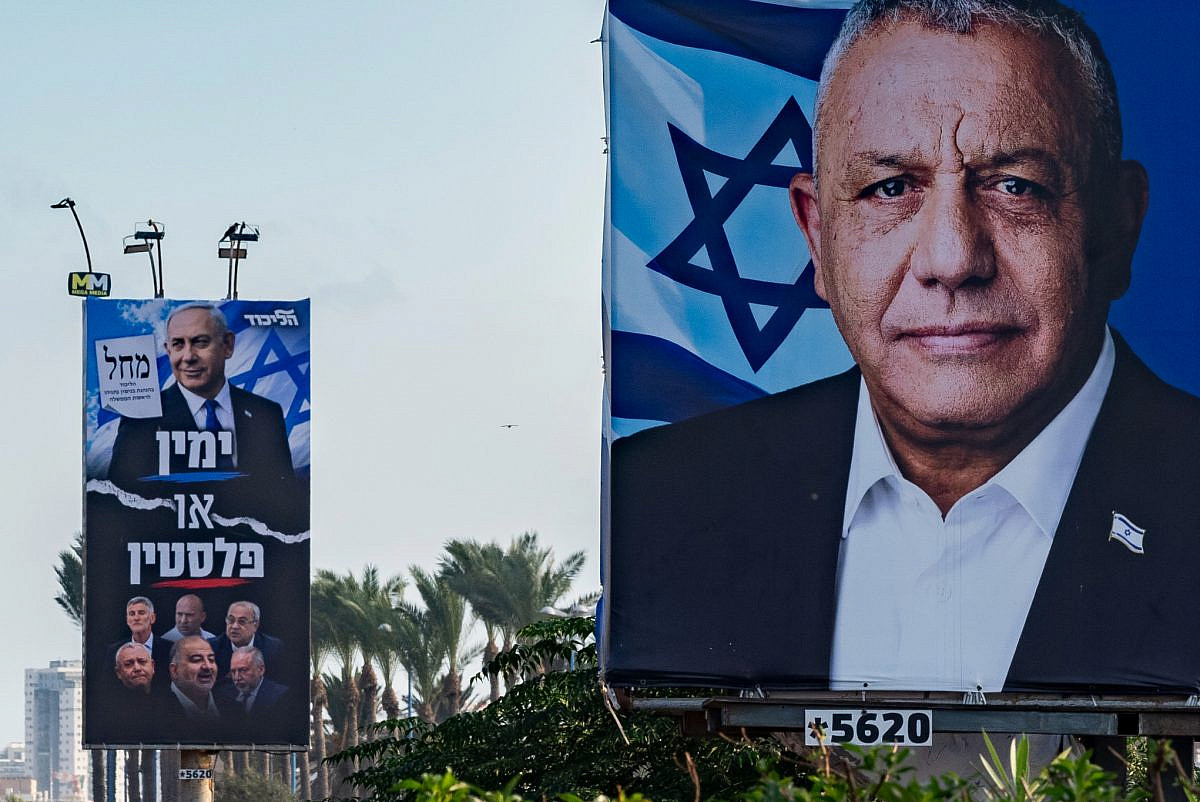
With polls indicating a deadlock between Benjamin Netanyahu’s camp and the so-called “change bloc” ahead of next week’s election, a noticeable shift has emerged in the campaign rhetoric of the leading opposition party, Yashar, and its leader, Gadi Eisenkot.
It began around a month ago, when, amid declining poll numbers, members of Yashar reportedly approached Eisenkot and urged him to declare that he would not form a government with the United Arab List (known by its Hebrew acronym Ra’am). Led by Mansour Abbas, the Islamist party had already joined the Bennett-Lapid coalition in 2021 — becoming the first independent Arab party to join an Israeli government — and remains the most plausible Arab partner for a future one.
Eisenkot obliged. In an interview with Channel 12 several days later, he announced that all potential coalition partners would have to “recognize Israel as a Jewish and democratic state, uphold the Declaration of Independence, support mandatory military service, and recognize Hamas as a terrorist organization that must be destroyed.”
These conditions appear designed to rule out both Arab and ultra-Orthodox parties, neither of which could realistically accept his full terms without alienating their base. But to dispel any ambiguity, Eisenkot was more explicit in a subsequent Channel 13 interview. Asked about the prospect of joining forces with Arab parties, he stated: “It is against my principles.”
The Eisenkot-led opposition bloc has been consistently polling around 10 seats short of the 61 needed to form a government, while Ra’am together with the Joint List (comprising the predominantly Palestinian parties Hadash, Ta’al, and Balad) is potentially on track to win as many as 15. So mathematically speaking, Eisenkot’s gatekeeping seems like a complete own-goal. All the more so considering that polls show opposition voters have little objection to relying on Arab lawmakers to oust Netanyahu.
But Eisenkot’s rightward turn has not stopped at delegitimizing Arab lawmakers. The specter of a Palestinian state has also been brought out of the woodwork. Despite the question’s total irrelevance in today’s geopolitical climate, Eisenkot’s team has decided that positioning him to the right of Netanyahu on “security” issues is a winning strategy.

“Two states for two peoples is a mistake.” “I am for settlement [in the West Bank] and against a Palestinian state.” “We will act to strengthen Jewish settlement according to the law and in accordance with the national interests of Israel.” Eisenkot has reiterated this stance in a variety of creative ways in recent weeks.
In a recent radio interview, he even castigated Netanyahu for “blocking with all his might construction in E1 for 17 years, for international considerations.” He was referring to the long-proposed settlement project east of Jerusalem, which would severely disrupt Palestinian territorial contiguity in the West Bank and has long been viewed by both opponents and supporters of the two-state solution as a means of burying it.
Eisenkot’s increasingly hawkish rhetoric seems designed to court right-wing voters who broadly support Netanyahu’s maximalist policies, but regard his government’s aggressive posturing and disregard for norms, procedures, and the rule of law as detrimental to Israel’s interests. In other words, he is trying to appeal to cross-bloc swing voters — a virtually non-existent constituency in this election cycle.
But as election day approaches, Eisenkot is doing more than merely trying to outflank Netanyahu on the right. He appears to be imitating the very politics of division that have defined his rival’s political career.
More Bibi than Bibi
Eisenkot’s racist move to exclude UAL and the Joint List echoes a familiar Netanyahu campaign tactic: portraying a political opponent as dangerous because of their willingness to rely on Arab political support.
In 2015, Netanyahu notoriously warned on election day that “Arab voters are coming in droves to the ballot boxes,” implicitly presenting their democratic participation as a security threat. In 2019 and 2020, he repeatedly depicted his rival Benny Gantz’s potential reliance on Arab parties as a threat to national security.

To the surprise of no one, Netanyahu is once again resorting to this tried-and-tested playbook. His main campaign slogan, plastered across billboards, city streets, and social media feeds, is “[It’s either] the right or Palestine” (which rhymes in Hebrew). Rather than challenge this divisive framing, Eisenkot’s team came up with a counter-slogan in the same spirit: “Benjamin equals Palestine.”
The accompanying video juxtaposes clips of Netanyahu expressing support for a Palestinian state over the years with footage of Eisenkot categorically ruling one out. Here, too, Eisenkot borrows directly from Netanyahu’s longstanding campaign strategy: presenting the prospect of a Palestinian state as an existential threat from which only the right can protect Israelis. The sole difference is that Eisenkot now places himself, rather than Netanyahu, in the role of the savior.
Eisenkot’s rightward turn does not stop at campaign slogans. In a radio interview last week, he sought to reassure right-wing voters that he would “never touch the yeshiva in Eli,” referring to the religious-Zionist pre-military academy Bnei David that has played an important role in bringing settlers into the Israeli military’s officer corps.
As scholar Yagil Levy explained in a recent interview with +972, this process has transformed the military’s relationship with the settlement movement, eroding the boundary between soldiers and settlers in the occupied West Bank. That erosion has helped create the conditions for the surge in settler violence against Palestinians, as well as attacks on journalists and foreign dignitaries, that we are witnessing today.
Eisenkot, to his credit, has condemned such violence as “Jewish terrorism.” Yet, much like Netanyahu, who has sought to minimize the phenomenon by attributing it to no more than 150 troubled youths, Eisenkot was careful to describe the perpetrators as merely “a handful of lawbreakers.” More revealingly, in explaining the danger they pose, he emphasized not the violence they inflict on Palestinians, but the damage to Israel itself: Their actions, he said, “burn away what little legitimacy the State of Israel has left, endanger the security forces, and harm settlement in Judea and Samaria and national security.”
Bnei David is also notorious for the pronouncements of its senior rabbi, Yigal Levinstein, who has called gay people “perverts” and described homosexuality as a problem to be eradicated. Eisenkot, a candidate presenting himself as an alternative to Netanyahu’s far-right coalition and the leader of a broadly liberal opposition, saw fit to publicly defend the institution.

Another telling example came in Eisenkot’s recent remarks about Israeli National Security Minister Itamar Ben Gvir. While describing the minister’s Kahanist worldview as unacceptable, he nevertheless credited him with doing “good things” in Israel’s prisons.
Under Ben Gvir, Palestinian prisoners have faced sharply deteriorating conditions, including severe food restrictions, overcrowding, beatings, and denial of medical care, according to Israeli and international human rights organizations. In September 2025, Israel’s High Court ruled that the state was failing to provide prisoners with adequate food. More recently, Israeli rights groups documented an increase in prison guards shooting Palestinian detainees with rubber bullets, sometimes at close range and resulting in serious injuries.
Eisenkot did not specify which measures he was praising. But offering credit to Ben Gvir on prison policy, amid mounting evidence of systematic abuse under his watch, is a remarkable concession. And if these remarks were intended to establish Eisenkot’s right-wing credentials, his comments about Gaza were even more explicit.
In the same radio interview, Eisenkot described Netanyahu’s lies about him in a recent Channel 14 interview as “heartbreaking.” Among them was the suggestion that he had opposed occupying Gaza. “This is the most annoying to me because he knows how much I pushed him [to do it while serving in the war cabinet],” Eisenkot said. “He knows we had a conversation in which I pushed him to [launch a ground invasion of Gaza].”
To drive the point home, Eisenkot added that “if Hamas does not disarm, the meaning would be occupying the Strip. There is only 40 percent left. It would be a good military action if [Hamas] doesn’t agree [to disarm].”
Eisenkot then invoked his military record, but went beyond the familiar discourse of deterrence and security into what sounded like an open celebration of death and injury.
“During my time as chief of staff, there were Marches of Return [in Gaza], but there were also 30,000 Palestinians wounded and 400 killed,” he declared, boasting that he had expanded the no-go zone inside the Gaza fence from 100 to 300 meters. “I changed the rules of engagement so that anyone entering the perimeter would be shot in the leg, while armed individuals would be killed. And many people were killed.”

Whether or not these figures are accurate, Eisenkot’s message was unmistakable: He was presenting the mass shooting of Palestinian protesters as a credential for leading the country.
One could be forgiven for thinking that in Israel in 2026, where the overwhelming majority of Jewish Israelis have supported the army’s actions in Gaza, this might not be a political miscalculation. But that ignores the old adage: Why vote for the imitation when you can have the real thing?
By praising policies associated with Netanyahu’s far-right coalition partners and claiming ownership of some of the military decisions that have shaped the past three years, Eisenkot is adopting elements of the politics of division and delegitimization that Netanyahu has helped entrench in Israeli political life since becoming Likud leader in the 1990s — and for which the liberal camp has long condemned him.
Worse still, he is allowing Netanyahu to dictate the terms of the political debate at a crucial moment in the race. And he would hardly be the first opposition politician to make that mistake.
A tradition of losing
In 2017, then-Labor Party leader Avi Gabbay sought to reposition the party closer to the center right. He publicly opposed evacuating settlements as part of a peace agreement and ruled out forming a government with the Joint List. The strategy failed: In the April 2019 election, Labor won just six seats, compared with the 24 secured by the Zionist Union alliance four years earlier. The party never recovered its former dominance of the center left.
Among the centrist parties that came to dominate the anti-Netanyahu camp was Benny Gantz’s Blue and White. Like Eisenkot, Gantz presented himself as a credible alternative to Netanyahu, emphasizing his military background and security credentials.

In January 2019, Gantz released campaign videos celebrating the destruction inflicted on Gaza during the 2014 War, when he was the Israeli army’s chief of staff. One advertisement proclaimed that “parts of Gaza returned to the Stone Age,” boasting of thousands of targets destroyed and more than a thousand “terrorists” killed. Yet despite assembling a major centrist electoral alliance and matching Likud’s Knesset seat total, Gantz failed to unseat Netanyahu in the April 2019 election.
Ahead of the March 2020 election, Gantz moved further right. He pledged to annex the Jordan Valley “in coordination with the international community,” while Blue and White ran advertisements targeting religious-Zionist voters. As part of the campaign, Gantz also visited the City of David archaeological site in occupied East Jerusalem, operated by a settler organization involved in expanding Jewish settlement in the Palestinian neighborhood of Silwan.
In that election, Likud won 36 seats to Blue and White’s 33. Gantz subsequently entered a Netanyahu-led unity government, splitting his own party in the process. The promised rotation that would have made him prime minister never happened, and his political standing suffered a blow from which he has struggled to recover.
This Monday, amid a dire showing in the polls, Gantz announced that he was dropping out of the race. His political career is almost certainly over.
Gideon Sa’ar offers another useful example. A former Likud minister, he established the New Hope party in December 2020, offering voters a familiar right-wing ideology without the baggage of Netanyahu, who was standing trial on corruption charges.
Initial polls suggested New Hope could win around 20 seats, but it ultimately secured just six. Sa’ar did help remove Netanyahu from office temporarily by joining the Bennett-Lapid coalition in 2021, yet he later returned to Netanyahu’s government after October 7. Earlier this month, in a striking display of spinelessness, he appeared in court to show support for his former rival during the testimony of Avichai Mandelblit, the attorney general who had indicted Netanyahu.
The political downfalls of Gabbay, Gantz, and Sa’ar cannot simply be attributed to their ideological positioning. But their experiences suggest that trying to outflank Netanyahu from the right is no guarantee of winning over his voters — and may come at a considerable political cost.
Most read on +972



Could Eisenkot face a similar fate? It remains to be seen.
There is, after all, something genuinely different about Eisenkot. He is an amiable man, mild-mannered, soft-spoken, and uncharismatic in an appealing sort of way. He exudes honesty — precisely the quality his party’s name, Yashar, seeks to convey — that contrasts with Netanyahu’s slick, salesman-like political persona, which is clearly one of his greatest assets.
Which makes his recent transformation all the more troubling. Why would a politician whose appeal rests so heavily on being different from Netanyahu choose to imitate his rhetoric and compete with him over who can take the more hawkish position?
As analyst Raviv Drucker observed in a recent Haaretz op-ed, Eisenkot’s campaign manager Ronen Manelis appears to subscribe to a cautious philosophy of campaigning: “You don’t win a political campaign, you lose one.” In other words, don’t take risks.
But avoiding risks is itself a political choice, and not necessarily a safe one. Eisenkot may believe that moving right will help him defeat Netanyahu. Yet the more he adopts Netanyahu’s language and accepts his terms of debate, the harder it becomes to explain what, beyond replacing the man himself, he is offering voters as an alternative.