

In partnership with

Having grown up in Israel’s Haredi community, I have fond memories of the weeks leading up to election day. In cities like Beit Shemesh and Jerusalem, the streets would fill with rallies and musical performances, endless stickers and flyers, billboards and giant banners draped over balconies.
Whether in national or municipal elections, everyone seemed to be competing for our attention: the major ultra-Orthodox parties — the Sephardic Shas and the Ashkenazi United Torah Judaism (UTJ); the non-Haredi parties that dared venture into our neighborhoods; and, of course, the anti-election campaigns of the community’s most hardline factions, which spent vast sums trying to persuade Haredim that participating in Zionist elections was a sin.
That carnival — so alien to the normally restrained Haredi street — has given way this time around to something far gloomier. Israel’s ultra-Orthodox cities and neighborhoods appear largely apathetic toward the election campaign. Attendance at rallies is thin. Many of the posters hanging from balconies are not promoting political parties at all, but supporting ultra-Orthodox draft evaders facing arrest and imprisonment.
More than anything, this mood is a testament to the failure of the ultra-Orthodox political establishment. Shas chair Aryeh Deri, for example, has repeatedly been booed at gatherings organized by the party’s own rabbis — the spiritual authorities whose wishes Haredi politicians are meant to carry out in the Knesset. Many Haredim see the veteran lawmaker as partly responsible for the failure of the ultra-Orthodox parties to protect yeshiva students from the arrests and sanctions imposed on those who refuse military service.
Deri entered this election campaign in the midst of an unusually public and bitter feud with one of Shas’s most senior rabbinic figures: former Sephardic chief rabbi Yitzhak Yosef, son of the party’s revered late spiritual leader, Rabbi Ovadia Yosef. The dispute mixed personal and intra-Haredi political tensions with a deeper ideological conflict over military service, with Deri increasingly portrayed by his critics as too willing to compromise. At one point, Yosef even instructed his followers to stop voting for Shas.
After months of confrontation, the two staged a highly publicized reconciliation meeting in which Deri ostensibly accepted Yosef’s authority. But once the cameras were turned off, the distrust remained. Among Deri’s critics, suspicion is growing that his close alliance with Prime Minister Benjamin Netanyahu has come to take precedence over the interests of his own constituency. From military conscription to education, yeshiva budgets, and other funding battles, Deri is increasingly seen as having failed to deliver.

Deri, once virtually synonymous with Shas’s political power, increasingly finds himself besieged by the very constituency that elevated him. He now faces a group of prominent Sephardic rabbis demanding a far more uncompromising position on military service — including opposition to the conscription of all Haredi men, even those who are not studying Torah full time.
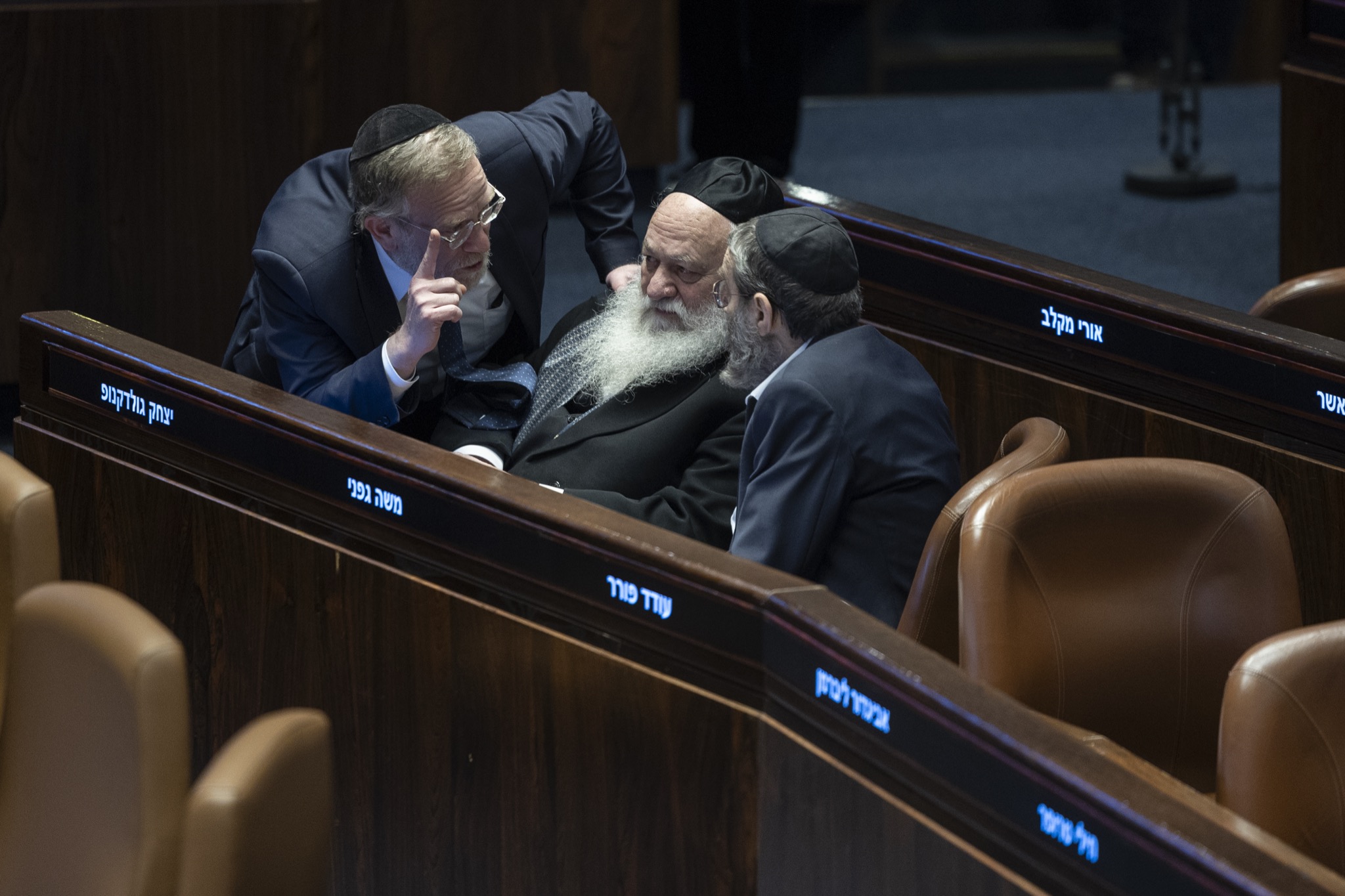
United Torah Judaism is not faring much better. Moshe Gafni, its powerful and long-serving parliamentary leader, was pushed from the party leadership despite pleading his case before its rabbinical council, as was one of his closest allies, MK Uri Maklev.
Both were ousted by the rabbis who control Degel HaTorah, one of the two factions that make up UTJ. Looming over their removal is essentially the same accusation leveled against Deri: that the party leadership failed to protect the Haredi public on the issue of military service, and that the decades-old alliance between the ultra-Orthodox parties and the Israeli right has reached an impasse.
Yet the attempt to placate the Haredi base by removing Gafni backfired. His humiliation triggered public anger toward members of the rabbis’ inner circles, who were accused of trying to make Gafni the scapegoat for a much larger political failure. The controversy even spilled into Yated Ne’eman, Degel HaTorah’s official newspaper, which broke with its traditional restraint to accuse aides of the ousted lawmakers of inflaming public anger.
Agudat Yisrael, UTJ’s Hasidic faction, is in turmoil as well. Its most influential spiritual authority, Rabbi Yaakov Aryeh Alter, the Gerrer Rebbe, blocked an attempt by some of his associates to remove party chair Yitzhak Goldknopf. In the Belz Hasidic court — the second-largest force within Agudat Yisrael — the Rebbe replaced longtime MK Yisrael Eichler with his associate Elyakim Stark. A day later, Stark and MK Meir Porush broke away from Agudat Yisrael to establish a new party, Torat Chomat Yisrael, effectively leaving Goldknopf as the chairman of a party whose faction was disintegrating beneath him.
In both Degel HaTorah and Agudat Yisrael, the central disputes revolve around the same two questions: how far to go in opposing Haredi conscription, and whether continued partnership with Netanyahu’s right-wing bloc still serves the community. The Gerrer Rebbe led the push to sever the alliance with Netanyahu but failed to bring down the government. That failure, among other developments, helped fracture the political front that had held together for years.
‘We’ve lost our magic touch’
Six weeks before Election Day, the offices of senior Haredi politicians were consumed by mudslinging, off-the-record press briefings, and finger-pointing.
“The mood is very sour,” an aide in UTJ who survived an effort to remove him told me. “Not only did we ultimately fail, but we’ve also lost our magic touch — the ability to say, ‘Give us the power and we’ll deliver solutions.’ We have no more rabbits to pull out of the hat.
“We blamed the attorney general and the High Court, but that isn’t enough. We’ve always had a judicial system, and we always knew how to maneuver around it. There’s a feeling that something very significant has changed in the way things work, and the Knesset members don’t understand it.”
Into this vacuum have stepped no fewer than four anti-establishment Haredi parties.
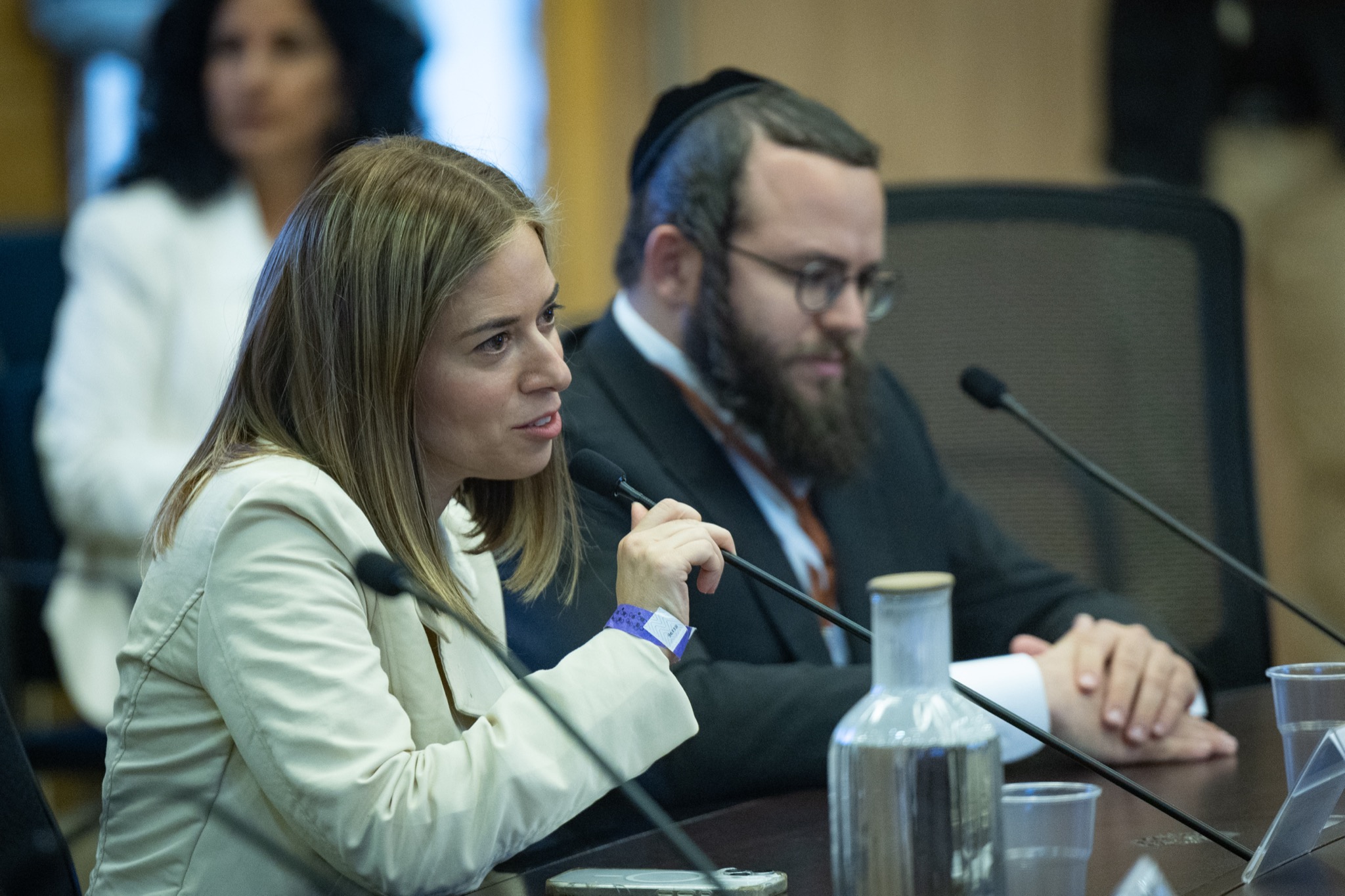
The most prominent is the Haredi Public party, led by Moti Leitner, deputy mayor of the majority-Haredi city of Beit Shemesh. Leitner is associated with emerging ultra-Orthodox communities that support military service and greater integration into Israeli society.
His slate stunned the Haredi community and its political establishment by placing activist Dr. Nahumi Yaffe in third place, making her the first woman to run on the Knesset slate of an ultra-Orthodox party. Leitner has meanwhile waged an aggressive campaign against the traditional Haredi parties.
From the opposite direction comes Tzeva Shachor (“Black Color”). Named after the internal Haredi alert system used to warn residents when authorities seeking draft evaders are nearby, the party is associated with more radical elements of Haredi society and hopes to capitalize on the anger of voters who believe the established parties have failed them.
As figures from more radical factions gain visibility in the Haredi media, public sentiment oscillates between rage at the sitting representatives and despair over whether political participation can still deliver anything for the community at all.
From euphoria to disillusionment
Only four years ago, the mood on the Haredi street and among its political leadership could hardly have been more different. After the 2022 election results made clear that Netanyahu could form a “fully right-wing” government, the community was euphoric.
Senior figures in the ultra-Orthodox parties spoke as though everything they had wanted was finally within reach. Haredi commentators on social media mocked members of the outgoing anti-Netanyahu “government of change,” while Haredi negotiators secured a series of symbolic, populist measures in the coalition agreements, like the elimination of taxes on disposable plasticware and sugary drinks.
The government formed in December 2022 represented the culmination of a political alliance that had been decades in the making.
Since the 1980s, the ultra-Orthodox parties developed an increasingly advantageous partnership with the Israeli right in general, and with the religious-Zionist movement in particular. From the right’s perspective, this alliance offered a way to move beyond the ultra-Orthodox community’s historic opposition to the state and its deep fear of the secularizing project associated with Zionism.
Although right-wing governments did not halt the secularization process, they were no longer committed to a model of shared Israeli secularism. Instead, they were increasingly willing to fund ultra-Orthodox educational institutions and enact broad exemptions from military service for the Haredi community.
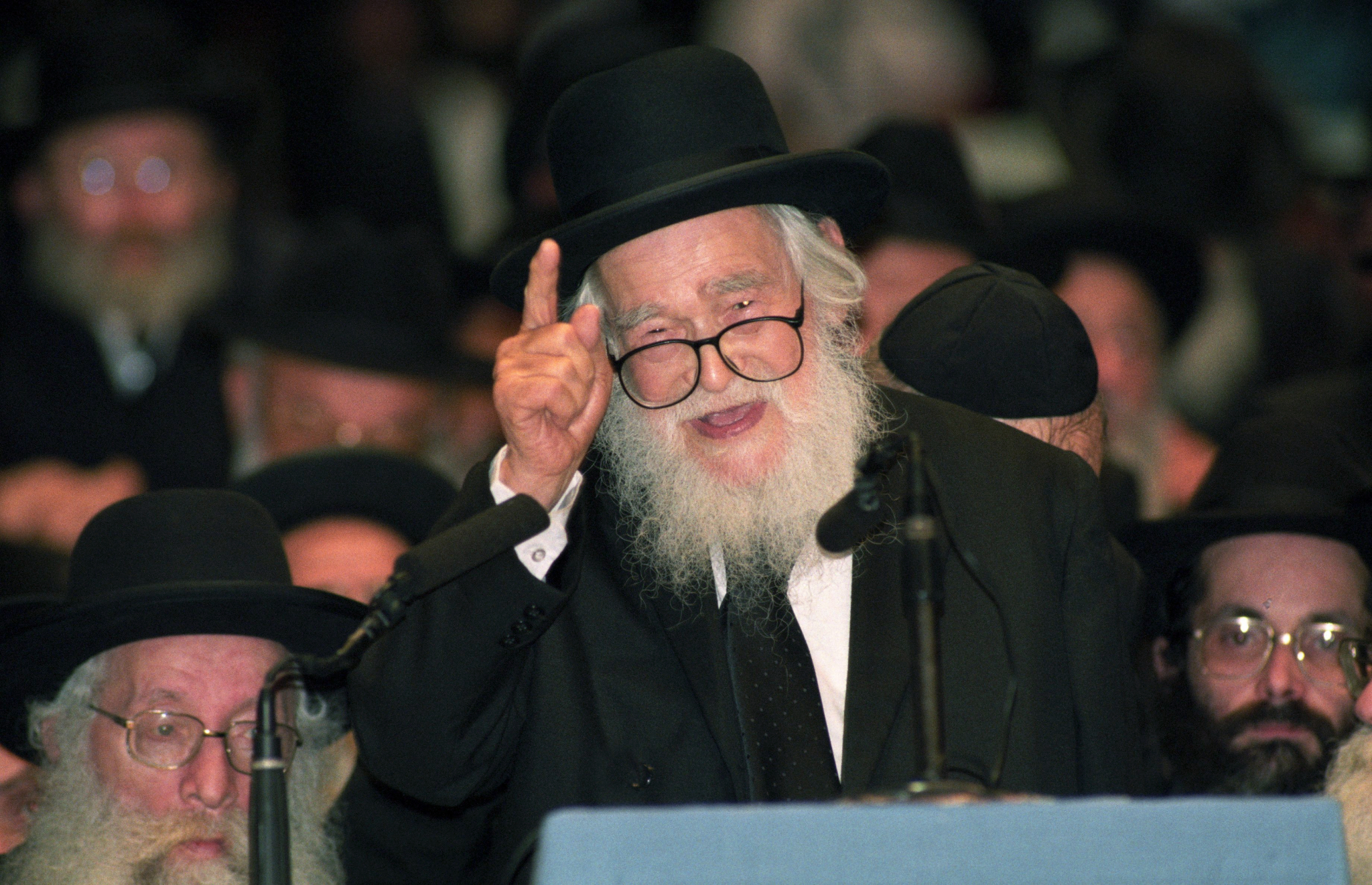
One ideological milestone was Rabbi Elazar Menachem Shach’s famous 1990 “rabbit address,” in which he castigated the secular Zionist left for abandoning Jewish tradition. Delivered during the 1990 political crisis known in Israel as the “dirty trick” — an unsuccessful attempt by then-Labor leader Shimon Peres to topple Likud leader Yitzhak Shamir’s government and form a coalition with the support of the ultra-Orthodox parties — the speech made clear that although Shach’s political views were at times closer to the center or left, he regarded the secular culture associated with the Labor movement as reason enough to prefer an alliance with the right.
Over the decades, the emerging coalition of right-wing, religious-Zionist, and ultra-Orthodox forces (what right-wing commentator Yinon Magal later called the “faith bloc”) consolidated around a set of common interests: maintaining Jewish supremacy between the river and the sea, opposing peace with the Palestinians, expanding settlements, and preserving autonomy for ultra-Orthodox education.
By the time Netanyahu’s “fully right-wing” coalition came to power, that agenda had broadened to include policies championed by right-wing think tanks such as the Kohelet Policy Forum: weakening the judiciary, advancing privatization, and reducing public spending.
Over the last three years, another principle was added: support for continuing the war in Gaza in the name of “total victory,” even at the risk of the lives of the Israeli hostages.
The alliance had grown stronger over time, both ideologically and demographically. It helped facilitate the construction and expansion of huge ultra-Orthodox settlements in the occupied West Bank, while differences between Haredi parties and the rest of the Israeli right steadily narrowed.
During election campaigns, the Haredi parties increasingly focused on preventing their voters from defecting to other right-wing parties. Yet they still preserved a degree of political flexibility. Their basic strategy was to remain with the right whenever possible, while keeping open the option of joining a centrist or center-left coalition if circumstances required it.
Even that flexibility largely disappeared after the 2021 election. Although Netanyahu was unable to form a government, the ultra-Orthodox parties refused to join the anti-Netanyahu coalition that eventually replaced him — and were willing to pay a political price for that loyalty.
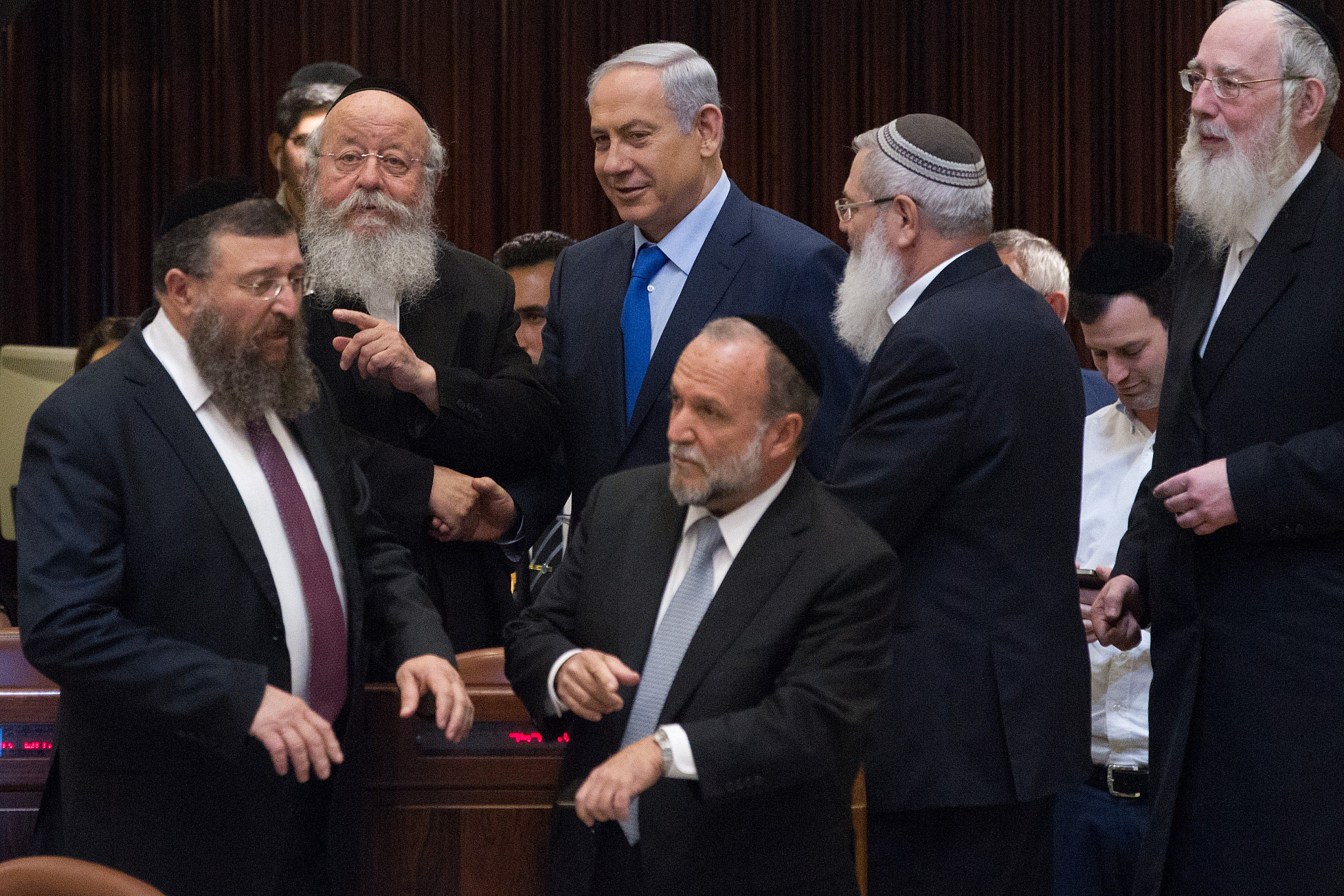
In return, the ultra-Orthodox leadership expected Netanyahu’s eventual return to power to resolve two of its most fundamental problems: permanently enshrining exemptions from military service in law, and rescuing the Haredi education networks from financial collapse.
The scale of those expectations was already apparent before the government was formed. Three weeks after the election, I wrote on X that the coalition negotiations had placed Netanyahu in “the most difficult role in history: the Jew who must tell the Jewish people that the Messiah hasn’t really come.”
Four years later, neither of those hopes had been realized. Instead, hundreds of millions of shekels in yeshiva funding have been frozen, sweeping sanctions imposed on Haredi families, and law enforcement authorities dispatched to hunt down yeshiva students who have ignored military conscription notices. Few in the community could have imagined such a reality amid the euphoria of 2022.
The political fallout has been dramatic. Gafni, one of the architects of the historic partnership with the right, has been pushed aside. Degel HaTorah’s spiritual leader, Rabbi Dov Landau, has declared in a handwritten letter that the alliance with Netanyahu is over. The Gerrer Rebbe has instructed Goldknopf to do everything possible to bring down the government.
Rabbi Yitzhak Yosef now attacks Netanyahu and the partnership with the right in public. And Deri, who tied his political fate perhaps more closely to Netanyahu’s than any other Haredi leader, finds himself increasingly distrusted within his own community.
But while these developments indicate that the alliance between the right and the ultra-Orthodox has entered a genuine crisis, it would be premature to write it off entirely. Both sides retain powerful incentives to preserve the partnership, and decades of political, institutional, and ideological ties will not disappear overnight. The problem is that the alliance can no longer deliver what the Haredi parties need from it.
Military conscription — always one of the partnership’s deepest fault lines — has become an even thornier issue amid the war and the expiration of the previous legal framework for exemptions. The war has intensified demands that Haredi men share the burden of military service, leading to a significant rupture even within the right-wing bloc itself. Most Haredis may support the war, but they refuse to let their sons leave their yeshivas to fight in it themselves.
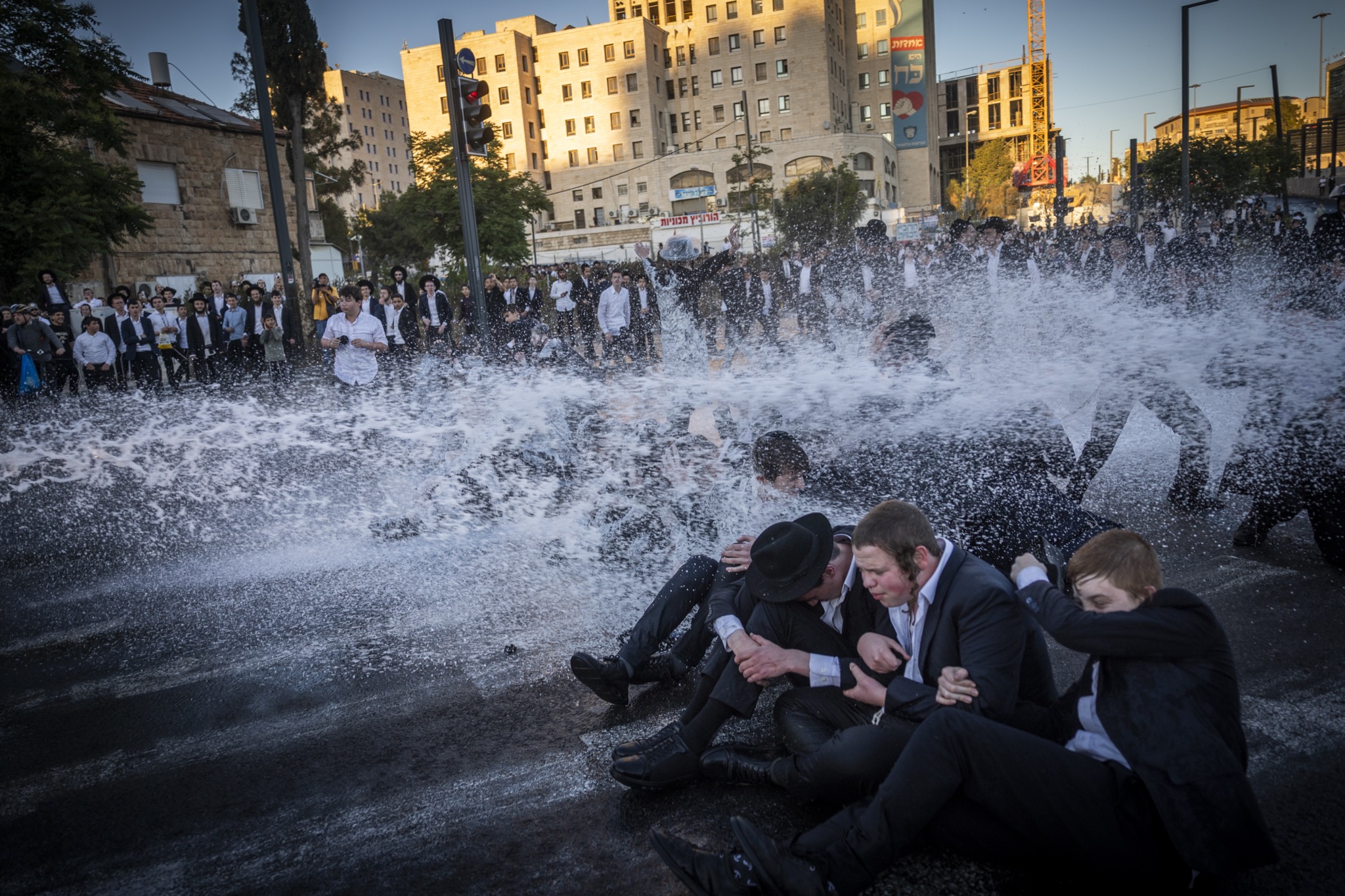
Still, occasional threats by Haredi politicians to “go with the left” should be taken with a grain of salt. They appear during almost every election campaign, relics of an era in which the ultra-Orthodox parties could serve as kingmakers between rival political camps. Even if a Haredi politician were prepared to cross the lines today, it is far from clear that anyone on the other side would reach out to take his hand.
A deepening cirsis
For the Haredi establishment, the dream of a fully right-wing government has turned into something approaching a nightmare. And the crisis runs beyond the coalition’s failure to resolve the military conscription issue or advance the judicial overhaul. Increasingly, it is being understood as a crisis within the community itself.
For a growing number of Haredim, worsening poverty, the growing power of the Haredi establishment and the constraints it imposes on individuals, its control over the Haredi job market, and the near-total power of Haredi educational institutions are all seen as products of the current political order, which grants enormous power to a small and increasingly discredited Haredi political elite.
Even rabbinic authority is being eroded, as politicians who constantly invoke the rabbis behave in ways the public increasingly sees as cynical, corrupt, or unrestrained.
Younger Haredim, meanwhile, are responding to this predicament in divergent ways. Some are leaving traditional communal frameworks and seeking greater integration into Israeli society through academia, employment, and military service. Others are moving in the opposite direction, embracing a more radical separatism and withdrawing even further from mainstream Israeli society.
In a few weeks, hundreds of thousands of ultra-Orthodox Israelis will go to the polls, including between 130,000 and 150,000 young Haredi men and women eligible to vote for the first time.
For many of these young men, the draft crisis is no abstract political dispute. State institutions are seeking either to compel them into military service or to impose consequences for refusing it. Financial and administrative sanctions are reaching further into their lives, while the possibility that an encounter with law enforcement could end in arrest and prolonged imprisonment has become increasingly real.
And the established Haredi politicians have no convincing answer. Their traditional partners on the right offer various conscription plans, all of which run counter to the worldview of much of the ultra-Orthodox public. Their political opponents, meanwhile, have floated measures ranging from stripping draft evaders of the right to vote to restricting their freedom of movement.
Most read on +972
Against this backdrop, Haredi advertising firms will spend the final weeks of the campaign trying to convince voters to put aside their anger, disappointment, and despair and go to the polls anyway. The message will be familiar: whatever you think of your own representatives, you would not want to help their enemies come to power — so you will vote as you are told.
The attorney general — long demonized by the right over her opposition to its judicial overhaul — is already appearing in Shas campaign material because of her insistence that the law be enforced against draft evaders. As election day approaches, the cast of villains expands to include Supreme Court justices and opposition figures such as Avigdor Lieberman, Naftali Bennett, and Yair Golan.
In the end, most Haredi voters will still cast their ballots for the established ultra-Orthodox parties. But this time, many will do so not because they believe in their leaders, but because they have been persuaded that there is nowhere else to go.
A version of this article was first published in Hebrew on Local Call. Read it here.