

For decades, the liberal camp in Israel has cultivated a convenient and effective defense mechanism. When faced with uncomfortable moral questions about Israel’s actions, responsibility could usually be assigned to the political fringes. The culprits were always the “bad apples”: hilltop youth, far-right ministers, a rogue infantry unit, settlers nobody in north Tel Aviv would invite to dinner.
This division of labor was remarkably convenient. The right committed the crimes; the liberals supplied the morality. The occupation and multiple rounds of war in Gaza, with all their ugliness, were things that “they” did, while “we” investigated abuses and protested to save Israeli democracy.
“NAZA” attacks that alibi. The film bypasses the usual villains and goes straight for the Holy of Holies of the Israeli elite: Unit 8200, which supplies the intelligence for airstrike targets, and the Air Force, which turns those targets into ruined buildings and dead families. The people placed under moral scrutiny are not settlers but graduates of top schools and elite military units who go on to universities and high-tech companies — exactly the people liberal Israel sees when it looks in the mirror.
That is the film’s most intolerable proposition. If what Israel has done in Gaza is genocide, then it is, in significant part, a liberal genocide. This is not because its architects call themselves liberals, but because the machinery of destruction depends on institutions staffed by the secular, educated, technologically sophisticated Israelis who imagine themselves to be the far right’s antithesis. The directors even deny the subjects the old Israeli “shoot and cry” ritual, in which feeling bad about violence somehow redeems it.
The right’s response was predictable: the army chief called the film a “blood libel,” Prime Minister Benjamin Netanyahu and Culture Minister Miki Zohar backed stripping its directors of their citizenship, and the military examined legal action over alleged leaks.
More revealing has been the fury from Israel’s “liberal” media. Commentators condemn a film they have not seen and dismiss its testimony, even as the military investigates how classified information reached the filmmakers, and as the reality of Gaza’s systematic destruction is evident. Journalists who routinely rely on anonymous security sources have discovered a sudden, almost puritanical concern for source transparency, showing little collegiality and sawing off the branch on which investigative reporting depends.
Critics complain that they cannot adequately scrutinize the film, with far less acknowledgement that Israel has refused to allow foreign journalists independent access to Gaza since October 2023. Standards of skepticism that were virtually nonexistent slept peacefully while the army operated behind a wall of censorship and restricted access have become considerably more exacting now that Israeli soldiers themselves are speaking.
The public debate has spent far less energy on the substance of the testimonies in “NAZA.” In Israel today, people who spoke about possible crimes appear to face more immediate legal danger for speaking about them than those accused of carrying them out.
And on top of it all, the central revelations are not new. Yuval Abraham first reported on the army’s use of AI targeting systems and permissive civilian casualty rates in November 2023. Israeli media had ample time — indeed years — to pursue the story. The current uproar has therefore little to do with journalistic standards. It is about what happens when facts that were tolerable when confined to marginal reporting become impossible to keep at the margins.
Bureaucratic thoughtlessness
“NAZA” is most disturbing when it shows how mass killing is translated into the language of the tech industry. Intelligence soldiers speak of algorithm development, target generation, datasets, thresholds, and optimization. The person who will die at the end of the process first appears as an entry in a system. The family around him appears as an estimate. The destroyed building and charred corpses appear as the output.
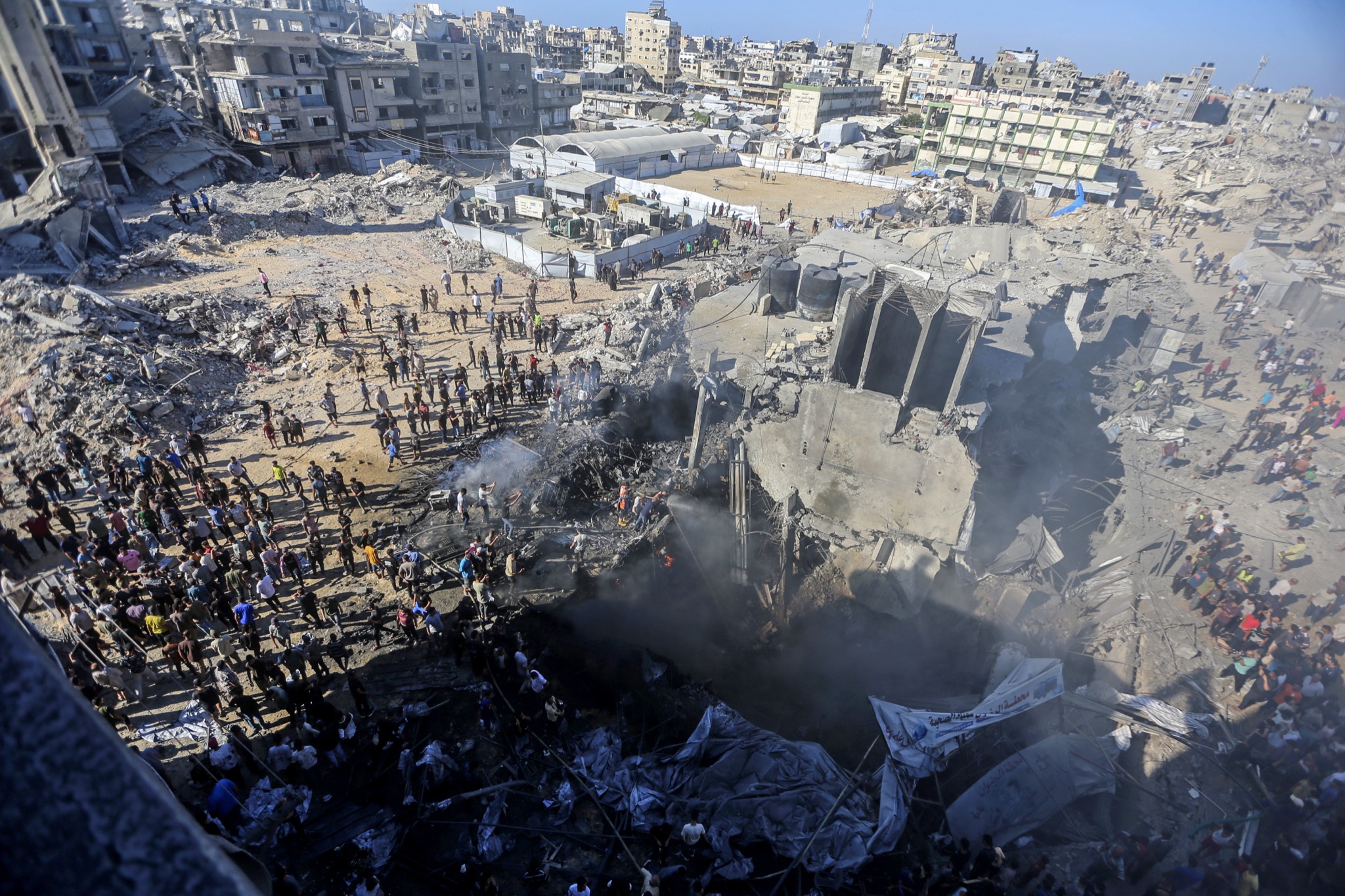
Unit 8200 is also one of the most prestigious pipelines into high-tech, allowing the expertise acquired inside the mass targeting apparatus to be later converted into professional capital. The obscenity is not that the soldiers sound sadistic — it is how often they sound simply competent.
That is where Hannah Arendt’s account of bureaucratic “thoughtlessness” becomes useful — not as a cheap historical analogy, but as a description of how responsibility can be fragmented. Thoughtlessness, for Arendt, did not mean stupidity so much as the failure or inability to see the world from the standpoint of the person on whom one acts. Large bureaucracies make that easier by dividing action into discrete functions. One person writes code, another validates intelligence, another approves a target, another flies the aircraft. Each can perform his task professionally while moral responsibility for the whole remains unclaimed.
Arendt was clear that bureaucratic thoughtlessness did not absolve individuals of responsibility for their actions. But some critics of Arendt have argued that adherence to bureaucracy can serve as a convenient disguise: the committed ideologue presenting himself as an obedient clerk.
The soldiers in “NAZA” offer us another way of thinking about this distinction. They are not defendants trying to evade punishment. They have chosen to speak, potentially exposing themselves to prosecution for doing so. Yet even in confession, they repeatedly and instinctively reach for the vocabulary of systems, procedures, and technical tasks. Their testimony suggests that bureaucratic language need not be either an authentic expression of thoughtlessness or a strategic courtroom defense. It can be the language through which people understand their work and, at the same time, rationalize their participation in violence.
The distance between these soldiers and their victims is also somewhat paradoxical. Intelligence officers can intercept phone calls, hear families inside buildings, watch live feeds, and review the aftermath of strikes in high resolution. The same system that creates extraordinary proximity to the victims can also preserve profound moral distance from them. A child’s voice becomes information used for verification; a family becomes “collateral.”

More information does not necessarily produce more recognition, but rather a more detailed abstraction. Within elite military units, this distance may be reinforced by the mentality of the “joiner:” someone whose desire to belong encourages them to subordinate independent critical thinking to the norms of the group.
The film’s title itself captures this process. “NAZA” is military shorthand for “nezek agavi,” “collateral damage” in Hebrew. The phrase already performs an act of moral compression: dead and wounded men, women, and children become a category within an operational calculation. Automation gives that euphemism greater power.
Earlier reporting by +972 and Local Call described periods in which officers said that the army permitted the killing of up to 15 or 20 civilians when targeting a junior Hamas operative, and more than 100 in some attacks on senior commanders. The army disputes key elements of those accounts and says strike decisions are made by humans in accordance with international law. But the moral problem exposed by the testimony remains: Once civilian death is represented primarily as a permissible number attached to a target, killing can be processed like an accounting problem.
This is what the banality of evil in the digital age looks like. The older bureaucracy offered forms, signatures, and chains of command; the new targeting apparatus adds interfaces, confidence scores, target lists, and software tools. Neither absolves the person using them. But both can help the user experience himself as an operator of a system rather than an author of consequences.
Calculated obfuscation
The Israeli media’s response often reproduces this displacement of responsibility. Faced with testimony about mass killing, much of the debate retreats immediately into procedure: Was a particular system really “AI”? Did an algorithm make the decision or merely assist it? Was the chain of command described with perfect precision?
Some of these questions matter. But technical scrutiny can also become a refuge from the larger question the testimonies raise. If the discussion can be reduced to whether the number of civilians killed in a particular strike is exact, people can avoid confronting the fact that soldiers are describing a system built to generate and process killing at enormous scale.
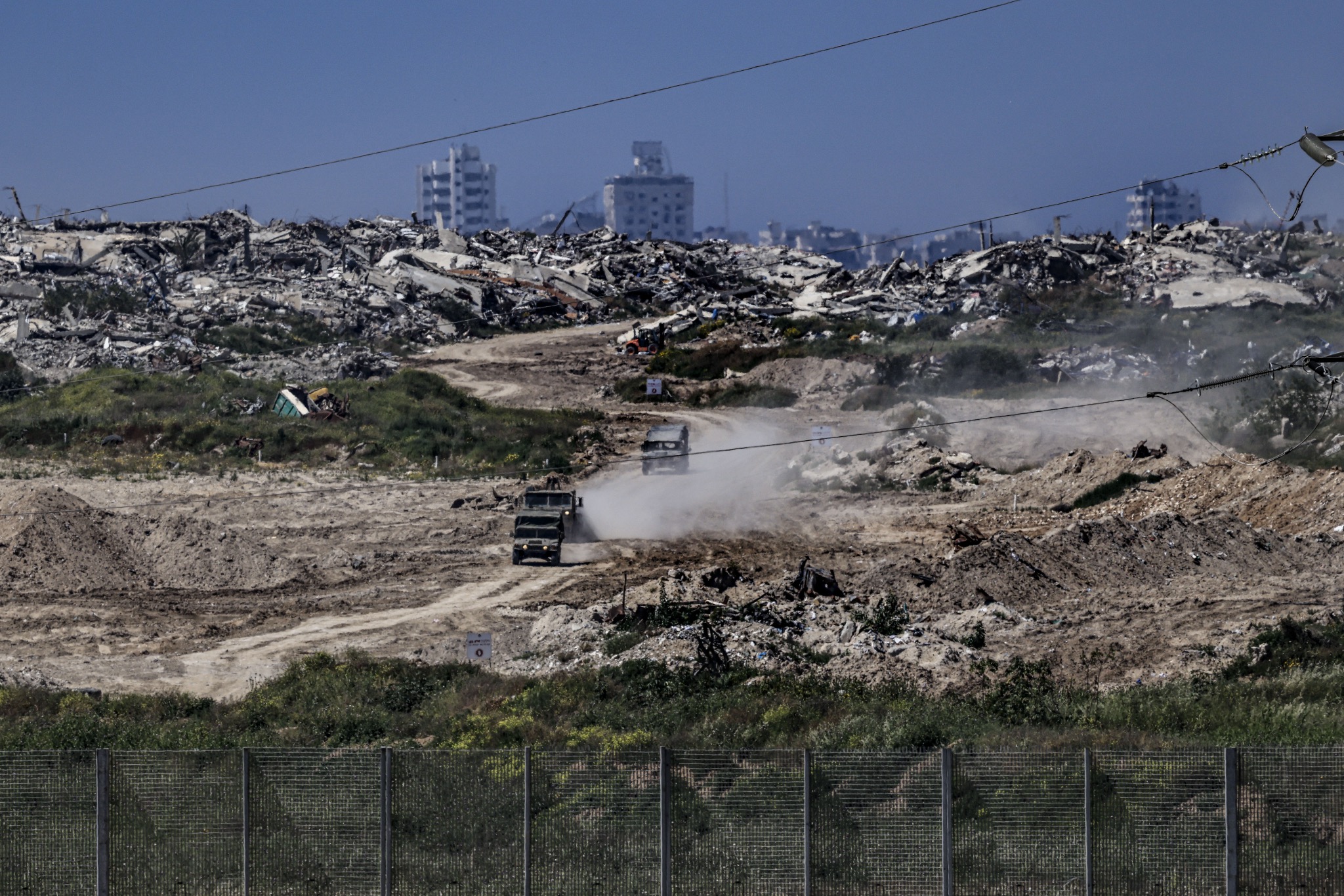
The soldiers in “NAZA” protect themselves from the human toll of their work by speaking about target discovery and optimization. Their critics in Israeli media can protect themselves by becoming fact-checking auditors of the machinery. The symmetry is uncomfortable: Both convert an ethical problem into a technical one. And technical problems are reassuring, because they have fixes. Algorithms can be improved, databases cleaned, protocols rewritten. What liberal Israelis cannot bear to hear is the possibility that the machine is actually functioning as intended.
There are structural reasons Israeli journalism is so susceptible to this retreat. The press is embedded in a society in which military service is a major institution of socialization and professional advancement. Many prominent journalists began in military media or security reporting, and military correspondents depend on the IDF Spokesperson for access. The army’s categories — precision, intelligence, operational necessity, target quality — arrive in the newsroom already carrying the authority of neutral descriptions, rather than the language of one side in a war.
Following a series of inflammatory remarks from the Israeli Chief of Staff, the army finally issued an official response to the film that perfectly replicates the very bureaucratic evasion the documentary critiques. The military claimed, for instance, that civilians were routinely warned prior to strikes, deliberately obscuring the grim reality that this was a sporadic exception. The actual operational norm — the one responsible for the massacre of thousands of children — was sudden bombardment without warning.
The army argued that, technically speaking, artificial intelligence “has never independently selected targets,” knowing full well that the mere seconds allotted for a human operator to authorize a strike preclude any meaningful factual or ethical review. So too did it avoid any discussion about the targeting of low-level operatives, many of whom were killed in strikes that were deliberately conducted in their homes, often with their families present.
In its response to the film, the army also claimed that it never “approved or carried out any strike in Gaza in which 500 civilians or anything close to that number were expected to be killed,” as is mentioned in one of the film testimonies. This, too, is a calculated obfuscation: by drawing attention to one of the highest target-to-civilian ratios, it tries to distract from the accumulation of thousands of strikes that served as the primary mechanism of mass slaughter in Gaza, in each of which the killing of anywhere from tens to hundreds of civilians was seen as acceptable.
And as always, the army suggested that suspected crimes are “addressed through disciplinary action, criminal investigation or other measures.” The reality is that Israel has convicted just two soldiers for harming Palestinians in the past three years — no surprise when top military officials have bragged about killing 70,000 “terrorists” in Gaza.
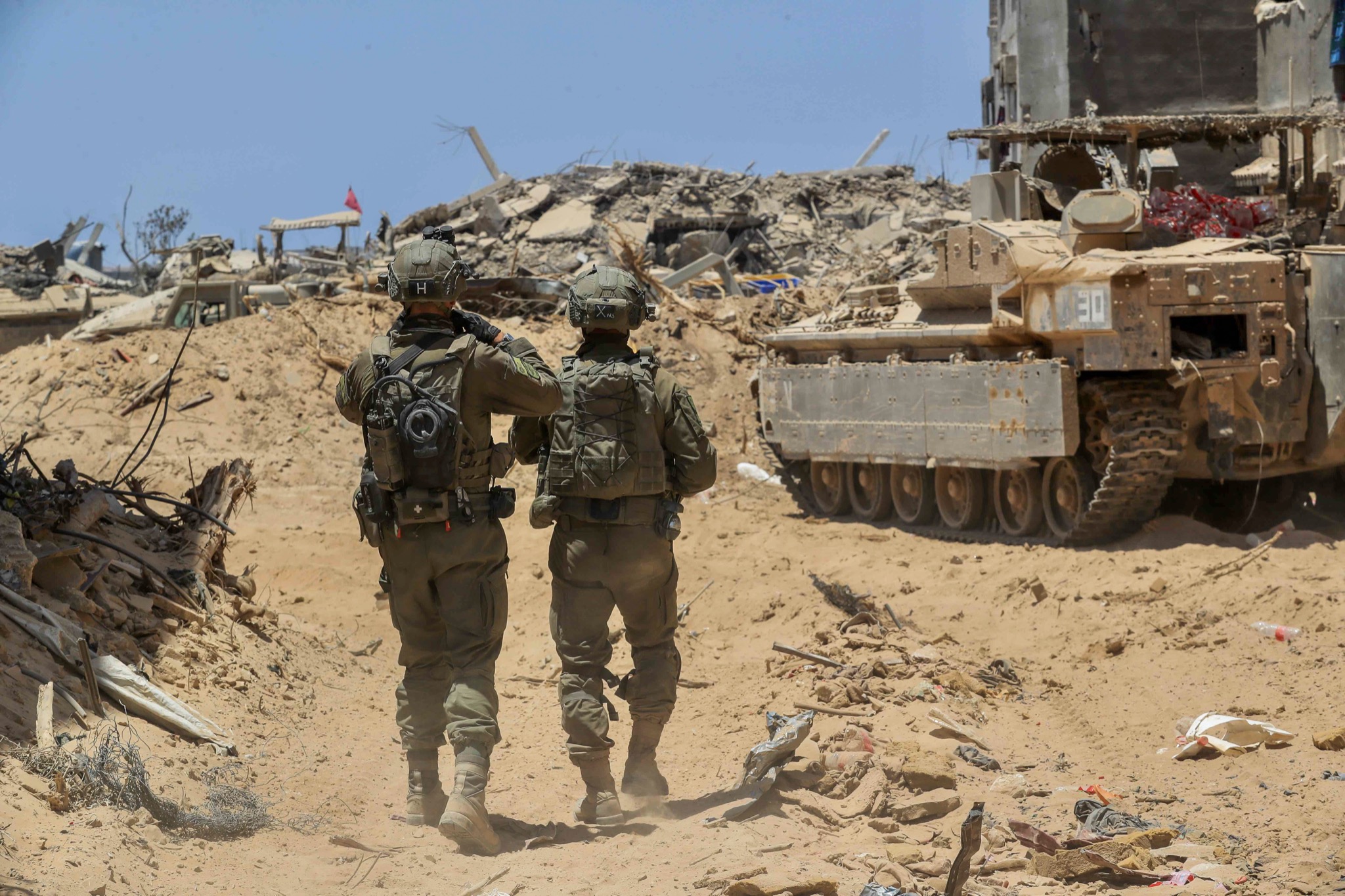
Yet, for the Israeli press, the military’s hollow rebuttals were exactly what they wanted to hear. Eager for a psychological alibi, and perhaps unconsciously guilty for not doing their job, Israeli journalists rushed to celebrate the army’s statement, framing the film as a work of sloppy journalism and retreating into a comforting, authoritarian tautology: the film’s facts must be wrong, simply because the army said so.
The liberal alibi
Israel’s center-left has long understood itself through its enemies: If National Security Minister Itamar Ben Gvir despises us, if the settlers call us traitors, if the far-right attacks the courts and the press, then we must be the democratic, moral Israel. “NAZA” breaks that comforting illusion. It suggests that you can oppose Ben Gvir, vote for the center, work in high-tech, demonstrate for democracy, and still participate in — or materially sustain — a system capable of mass killing. Hatred from fascists is not a certificate of innocence.
The settlers may be the loudest voices calling for the “voluntary emigration” of millions of Palestinians from Gaza, but the capacity to turn that population into targets was built and operated by institutions at the center of respectable Israeli society.
The film ends by moving from the rooftops of Tel Aviv to the ruins of Gaza, eliminating the distance that bureaucratic language creates. A Palestinian father digs frantically through the concrete of a collapsed building for his dead children. In the flood of Israeli commentary on “NAZA,” I have seen almost no discussion of that father.
This absence is not incidental. The army’s systems turn Palestinians into targets and collateral damage estimates; the public debate then turns the film itself into a technical controversy. In both stages, the Palestinian disappears. But ultimately, the dehumanization goes both ways: only a people who have lost their humanity can disregard such a heart-breaking scene showing, perhaps for the first time to the Israeli public, the result of their actions.
Most read on +972
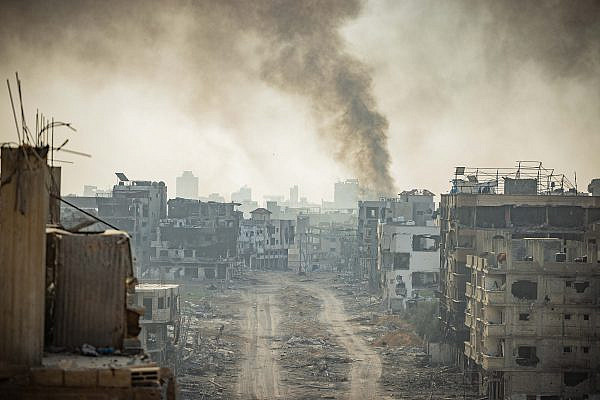
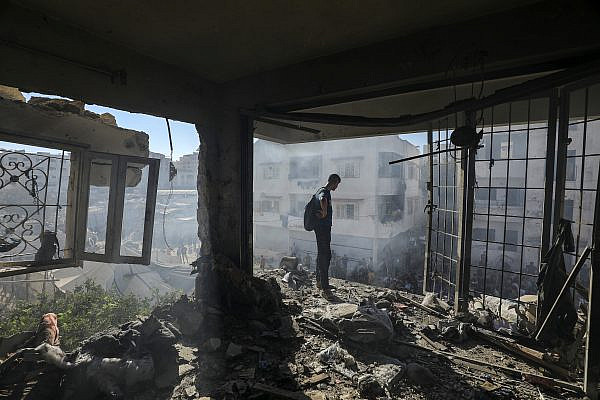

The scandal of “NAZA,” is not that it tells Israelis something they had no way of knowing. It is that it attacks the privilege of not knowing. It takes the language of code, intelligence, and procedure — the language through which respectable people protect themselves from what is done in their name — and places the bodies back inside it.
That is why the fury surrounding the film belongs to the story the film tells. A society that can still be horrified by the accusation of a war crime, but not by a father digging through rubble for his children, has already decided what it finds unbearable. And the violent reaction to the film shows that the Israeli public is unable to confront its image in the mirror, even when what it reflects is its most prestigious soldiers.