Last week’s election raised hopes around the world that Israel might finally rid itself of its extreme-right government and begin to reverse its descent into fascism. But replacing the politicians who have presided over that descent will do little to confront the attitudes that have become entrenched across Jewish-Israeli society. For a window into how far violence against Palestinians has been normalized, one need only examine the public’s response to a recently exposed plot by an Israeli professor to commit a massacre.
On Oct. 5, Israeli prosecutors indicted Shahar Nevo, a 59-year-old mathematics professor at Tel Aviv’s Bar-Ilan University, for allegedly plotting to kill hundreds of Palestinian citizens of Israel and residents of the occupied West Bank. According to the indictment, Nevo spent more than three years developing a plan to recruit 72 Jewish attackers who would be divided into 12 armed cells, in order to carry out simultaneous attacks on Palestinian communities. He estimated that 600 to 700 people would be killed, including women and children, and hoped that the violence would drive the remaining population to flee to Gaza, Lebanon, and Jordan.
Two days after the indictment, two of Israel’s largest news outlets, Mako and N12, published the story on Instagram. I examined 2,482 comments and replies on Mako’s post, along with 62 visible top-level comments (those responding directly to the post, rather than to another commenter) on N12’s post, and found two distinct but equally troubling responses.
On Mako, roughly half of the top-level comments praised or justified Nevo’s actions, accounting for around 70 percent of the total likes. The most popular suggested that he should be honored at Israel’s annual Independence Day ceremony, attracting more than 5,000 likes.
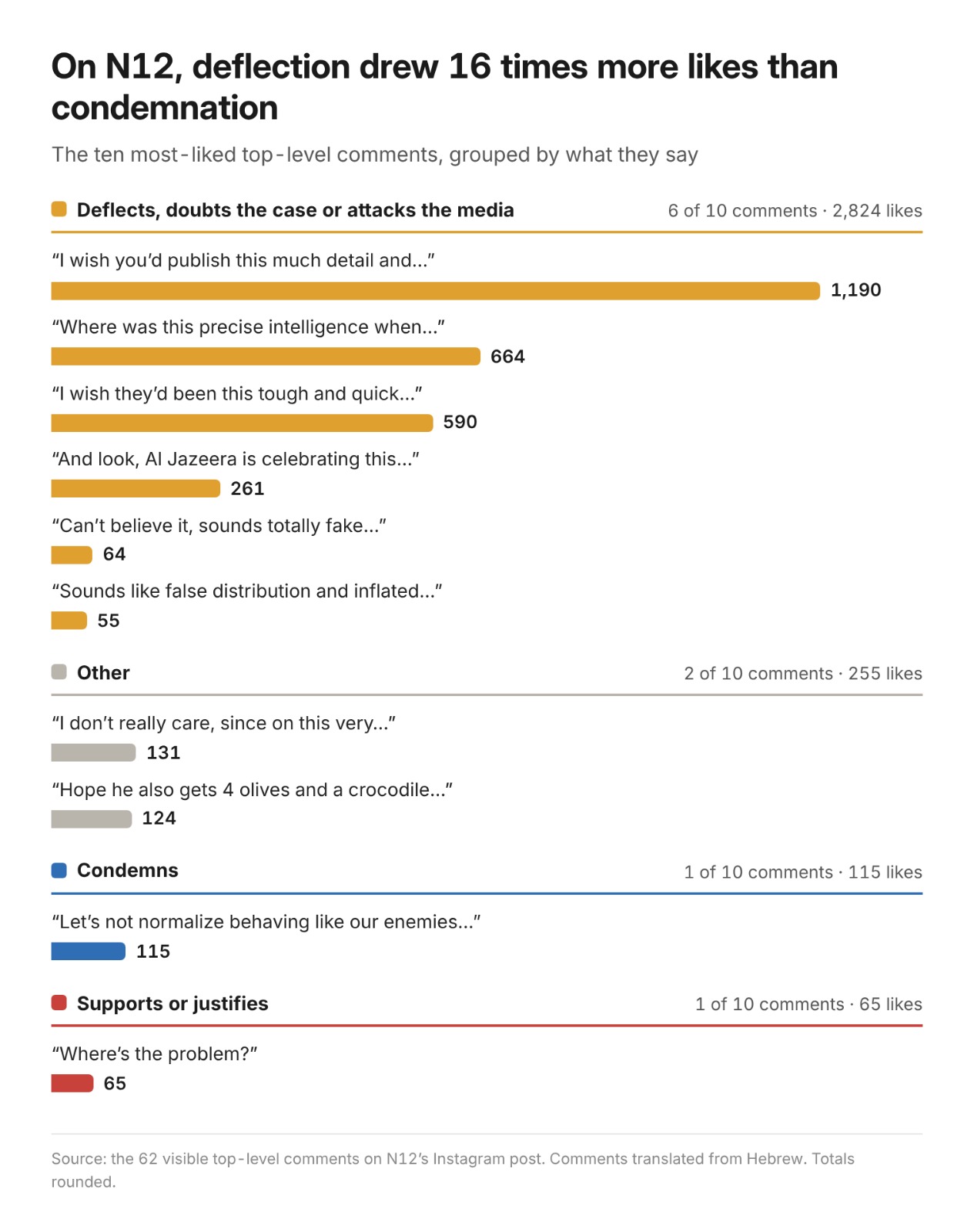
On N12, outright praise was less common, but comments questioning the allegations, attacking the Israeli media for reporting the story, or accusing authorities of treating Jewish suspects more harshly than Palestinian attackers attracted far more support than those condemning the plot.
Two Instagram comments sections, albeit under posts by mainstream outlets, are hardly a representative sample of Israeli public opinion. But it is difficult to dismiss the dominant reactions to Nevo’s plot as a fringe phenomenon, particularly in a country where calls for the expulsion and killing of Palestinians have become commonplace among politicians, media personalities, and, increasingly, the broader public. And while the two comments sections certainly differed in tone, both revealed how readily the prospect of mass violence against Palestinians could be celebrated or simply brushed aside.
Perhaps most striking, though, is the apparent absence of any fear of consequences. Thousands of Israelis openly endorsed a plan to massacre Palestinian civilians, even as Palestinian citizens of Israel have faced arrest and prosecution for social media posts expressing solidarity with Gaza or merely displaying a Palestinian flag. It is hard to imagine a more clear-cut illustration of apartheid.
‘Too bad it didn’t succeed’
According to the indictment, Nevo, who lives in the central Israeli city of Petah Tikvah, conducted reconnaissance trips, attempted to recruit members of the Israeli military to carry out bombings, and planned to use social media appeals to recruit soldiers, police officers, settlers, and criminals. The attackers would be armed with rifles, pistols, axes, and hammers. In a planning document, prosecutors say, he explicitly called for “mass killing” and instructed participants to show no mercy “even to the women and their children.”
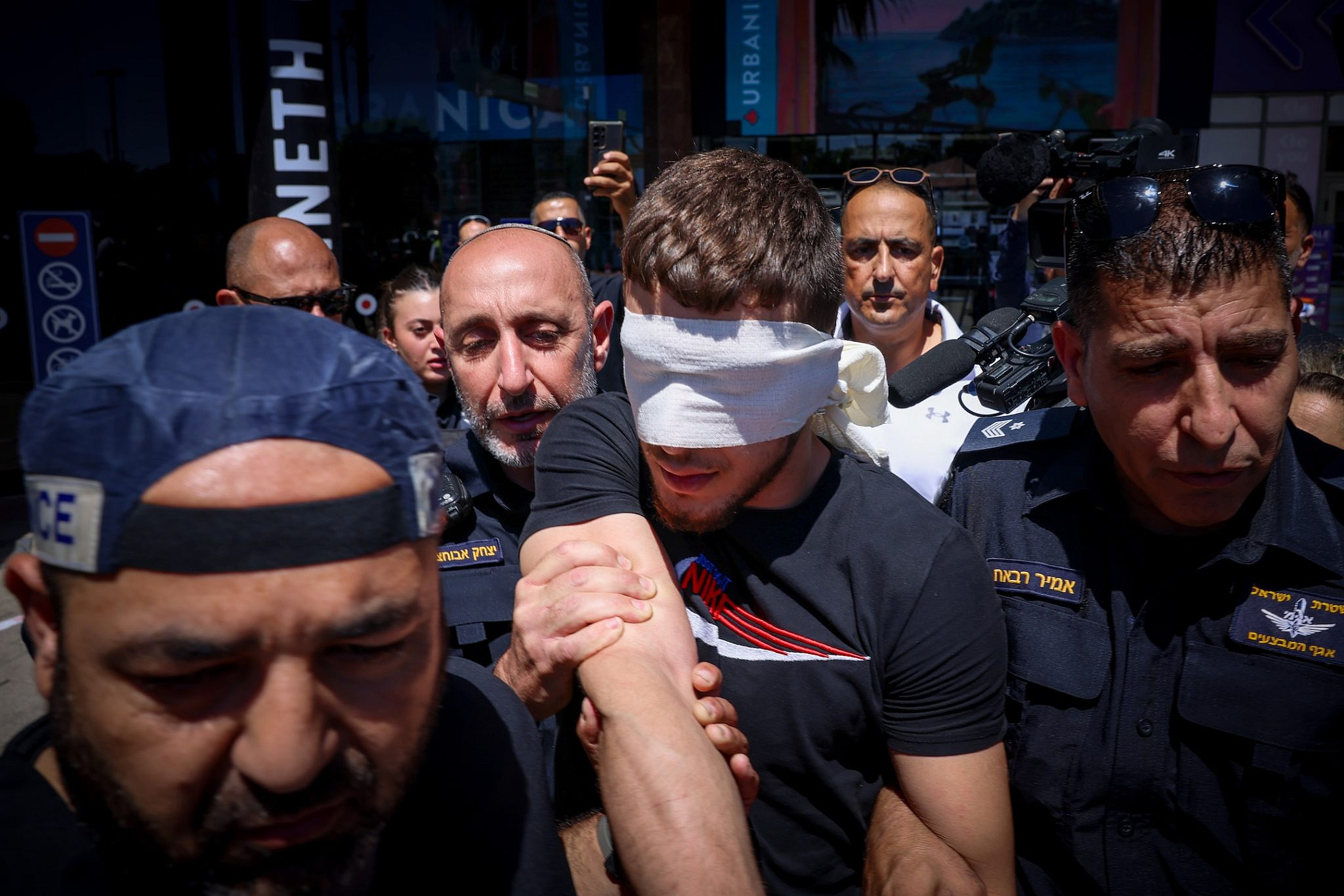
Nevo’s plot came to light because a politician he tried to bring in, the now re-elected Knesset member Moshe Feiglin, would not bite. Feiglin did not initially report the plot to police, but came to them regarding the threatening letters Nevo sent him after he ignored the professor’s appeals. Nevo was arrested on Sept. 17 and indicted two weeks later on charges of preparing a terrorist attack, blackmail, and obstruction of justice. He has reportedly admitted to the allegations and told the court he stands behind his actions.
Within three days, Mako’s Instagram post about Nevo’s plot had received more than 12,000 likes and approximately 3,300 comments. The most-liked comment asked, “What’s the problem? I don’t get it, he should light a torch.” This was a reference to Israel’s annual Independence Day ceremony, where a select few are invited to light a torch in what is one of the country’s highest civic honors. (This year’s participants included Avraham Zarviv, a rabbi and reserve military bulldozer operator who gained fame for demolishing hundreds of buildings in Gaza.) That comment received 5,146 likes, more than all the comments condemning the plot combined.
I collected and analyzed 2,482 of the comments, including 1,990 top-level comments and 492 replies. Roughly half of the top-level comments explicitly praised or justified Nevo, accounting for around 70 percent of all likes on these comments. Only about one in six condemned the plot or the positive reactions to it, receiving approximately 12 percent of the likes. Of the 10 most-liked comments, eight supported or justified Nevo, attracting a combined 15,300 likes, compared with around 1,600 for the two critical comments.
Some of the most popular responses treated Nevo as a national hero. “Why ‘Cleared for publication’? Why not write ‘The name of the hero’?” asked one commenter, receiving 3,492 likes. Others proposed rewarding him with a medal or electing him to office. “He should run in the election,” read one comment with 1,693 likes. “If he runs for government, I’m voting for him,” declared another, with 1,487 likes.
Hundreds of shorter responses hailed him as a “king,” a “champion,” or a “tzaddik” — a righteous man — often accompanied by crowns and clapping emojis. Some openly regretted that the plot had been thwarted: “Too bad it didn’t succeed,” one said. “Why did they stop him at all?” added another.
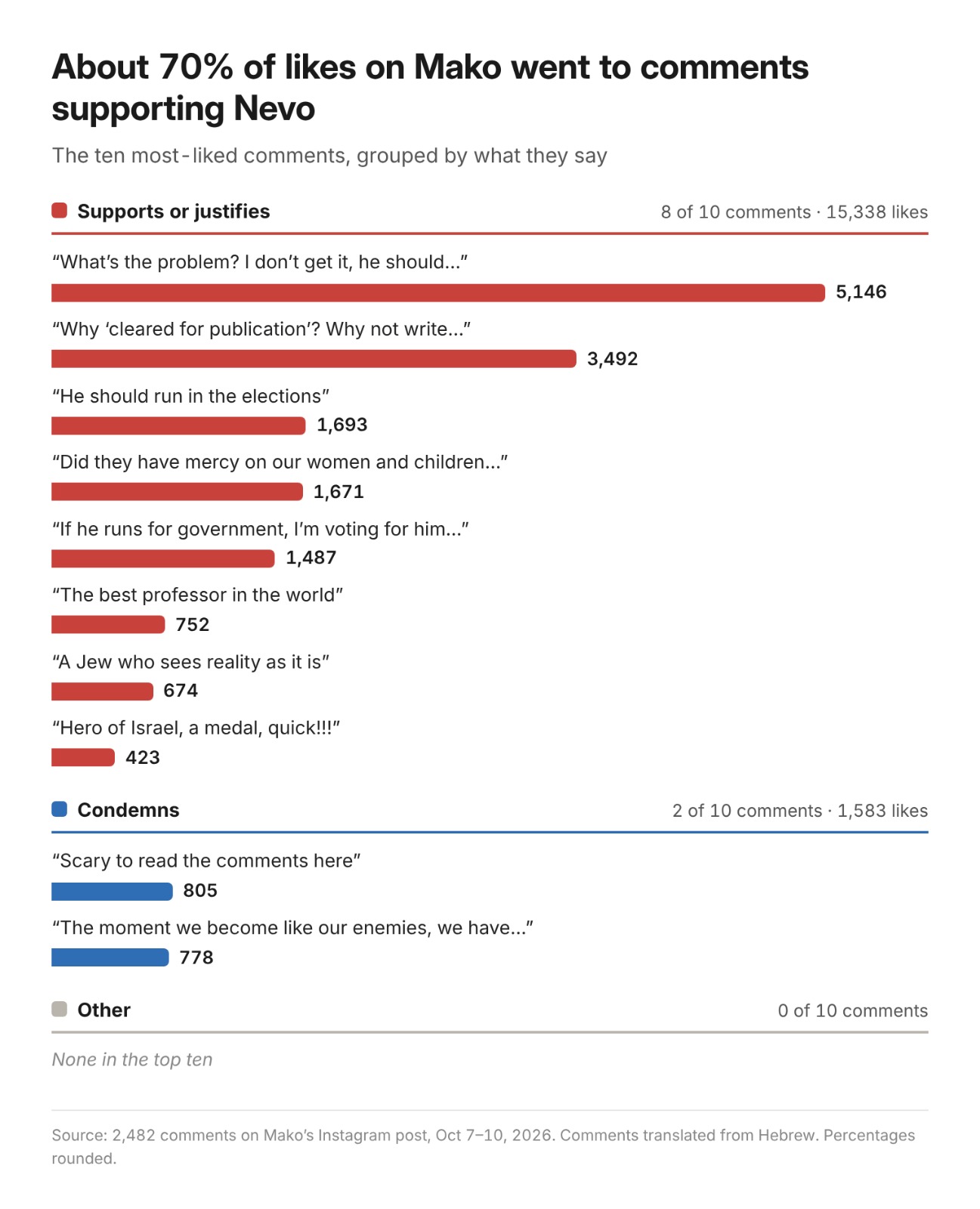
The Hamas-led attacks of October 7 were repeatedly invoked as a justification. “Did they have mercy on our women and children?” asked one commenter, whose response received 1,671 likes. Others declared that “There are no innocents,” demanded “An eye for an eye,” or referenced the maxim from the Talmud that states “If someone comes to kill you, rise up and kill him first” — applying a principle of self-defense to the planned killing of civilians who had attacked no one.
Some comments went further, calling directly for the expulsion or extermination of Palestinians. “Occupation, deportation, settlement” received 357 likes. In another thread, a commenter offered Arabs “a bus out of the country or a bullet in the head.” Dehumanizing language ran through it all: Palestinians were called “Arabushim” or “dirty Arabs,” likened to the biblical Amalek, or described as people who should be “sprayed” or “annihilated.”
Those who objected were met with abuse, saddled with the accusation of being bleeding-heart liberals or betraying their country, or told to move to Gaza. Female commenters were often subjected to sexual insults. One response reading “Scary to read the comments here,” which received 920 likes, drew replies asking whether rape and murdered babies frightened its author too, and telling her to “Be exterminated with your Arab friends in Gaza.”
Yet the objections themselves were more politically varied than might be expected. Some came from religious or right-wing grounds, including one commenter who cited a ruling by Rabbi Ovadia Yosef, the spiritual leader of the Sephardi ultra-Orthodox party Shas, against murdering innocents.
Palestinian commenters, meanwhile, pointed out the obvious double standard: Had an Arab publicly celebrated a comparable plot against Jews, they argued, the police would have intervened. Others tagged the Israel Police account directly, asking whether the comments constituted criminal incitement.

‘I’m not in favor, but …’
My analysis of the comments under N12’s post, published while his identity was still under a gag order, was more limited. I examined the 62 visible top-level comments and their likes, without reviewing the reply threads.
Here, explicit support for Nevo was more rare, although comments such as “He should get the President’s medal,” “I’m fine with it,” “Pity he didn’t manage,” and “Let him continue with the plan” collectively attracted around 230 likes.
Far more popular were responses that simply changed the subject, pivoting attention away from the massacre plot. The three most-liked comments, with some 2,450 likes in total, complained about the treatment of Jewish suspects compared with Palestinians; questioned the credibility of the investigation; and attacked the media for reporting on it.
“I wish you’d publish this much detail and depth about Arabs who planned attacks” read the top comment, with 1,190 likes. Another, with 664 likes, asked: “Where was this precise intelligence when thousands of terrorists activated SIM cards and invaded us?” A third, which received 590 likes, complained that the authorities had acted more swiftly against Nevo than against Palestinians involved in the protests and unrest of May 2021, adding: “I’m not in favor of his plans, I’m just against the hypocrisy of the State Attorney’s office and that whole delusional bunch.”
Other commenters accused N12 of serving Al Jazeera’s interests, inventing a false equivalence between Jewish and Palestinian violence, or fabricating the story for political purposes ahead of the election. Altogether, comments that deflected attention, questioned the case, or attacked the media received around 3,100 likes. By contrast, the most-liked unequivocal condemnation garnered 115, and all such comments together received approximately 190 likes.
Several responses began with disclaimers — “I condemn his actions,” and the like — before shifting to grievances against prosecutors, journalists, or Palestinians. The plan to murder hundreds of civilians became almost incidental to the discussion.
The contrast between the two comments sections is important to note. If, on Mako, many commenters wanted Nevo honored or lamented that his plan was thwarted, on N12, the general response was to question why his case deserved attention at all. But both conversations failed to appreciate the horror that could have been visited on the professor’s intended Palestinian victims.
Neither sample can be treated as representative of Israeli public opinion. But the prominence of these reactions on the pages of two major Israeli news outlets raises a question that extends well beyond social media: How did the prospect of massacring hundreds of Palestinian civilians become something that so many people could celebrate, excuse, or dismiss?
Going mainstream
The language blithely circulating beneath the two Instagram posts has a history. Calls to expel Palestinians, destroy their communities, and treat entire populations as legitimate targets are voiced routinely by Israeli politicians and media personalities. This phenomenon has increased considerably since October 7, but some of the most explicit examples predate the genocide.
In February 2023, the same month prosecutors say Nevo began planning his operation, a Palestinian shot dead two Israeli settlers near the Palestinian town of Huwara, prompting a revenge pogrom by settlers on a scale that was larger than any attack in recent memory. Days later, Bezalel Smotrich, who has recently been appointed Israel’s finance minister, declared that Huwara “needs to be wiped out,” adding that the state should be responsible for doing so. He later described the remark as a “slip of the tongue,” and kept his job.
Itamar Ben Gvir, who served as national security minister under the outgoing government and has spent the past four years overseeing the police, once displayed a portrait of Baruch Goldstein, the Jewish extremist who murdered 29 Muslim worshippers in Hebron in 1994, in his living room. He removed it only in 2020, after Naftali Bennett refused to join an electoral alliance with him, explaining the decision as necessary “for the sake of unity and a right-wing victory in the election.”
The celebration of violence has also extended to members of the Israeli security forces accused of abusing Palestinians. In July 2024, after military police detained nine reservists suspected of raping a Palestinian detainee at the Sde Teiman detention facility, hundreds of protesters stormed the base. The crowd included far-right coalition lawmakers, while armed, masked members of the unit implicated in the abuse also joined the demonstrations. Smotrich said he fully backed the protest, denouncing the investigation as a grave injustice to the reservists. (Despite their abuse having been caught on camera, the Israeli legal system has dropped all charges against the soldiers.)

On TV, such rhetoric is nothing out of the ordinary. Three Israeli human rights organizations documented more than 50 statements broadcast on the far-right Channel 14 that either called for or supported genocide in Gaza, alongside more than 150 advocating or supporting war crimes. A subsequent petition to the High Court cited about 250 statements as proof of a broader editorial line, rather than one-off slips. South Africa’s case against Israel at the International Court of Justice also cited a singer’s televised call to “erase Gaza” and leave no one there.
Among Channel 14’s guests in the early days of the war was Moshe Feiglin — the same politician Nevo would later try to recruit. If the war did not achieve “destruction, occupation, expulsion, and settlement,” Feiglin argued, nothing would have been accomplished. Three years later, the almost identical slogan “Occupation, deportation, settlement” appeared beneath Mako’s report about Nevo, endorsed by hundreds of users.
Polling suggests that the public has moved in lockstep with these far-right politicians and media personalities. In March 2025, Penn State sociologist Tamir Sorek, working with the Geocartography Knowledge Group, surveyed 1,005 Jewish Israelis and found that 82 percent supported expelling Gaza’s 2 million Palestinian residents, while 56 percent supported expelling Palestinian citizens of Israel. (In a comparable 2003 survey, the figures were 45 and 31 percent, respectively.) Among respondents under 40, support for expelling Palestinian citizens reached 66 percent. Nearly half of all respondents — 47 percent — agreed that when the army conquers an enemy city, it should follow the biblical example of Jericho and kill everyone in it.
The comments beneath the Nevo reports therefore echo attitudes documented well beyond Instagram. What might once have been dismissed as fringe outbursts find expression in mainstream political discourse, television broadcasts, and public opinion surveys.
A glaring double standard
Nobody commenting under these Instagram posts seemed to fear prosecution for incitement. Yet Israel’s incitement laws are used all the time to arrest and imprison Palestinian citizens of Israel — often, according to the legal center Adalah, in cases involving political or religious expression that should be protected as free speech.
According to data from the Knesset Research and Information Center, between 2018 and 2022, Arabs were the subjects of 97 percent of investigations under the relevant incitement provisions, nearly all of which ended with indictments and convictions. Meanwhile, freedom of information requests submitted by Adalah indicate that since October 7, Arabs have accounted for 100 percent of such cases in the Northern District and 95 percent elsewhere.

Obviously, this is not because Palestinian citizens incite more, but rather because the law is being selectively applied to target one community. Sympathy with Gaza, opposition to the war, and national or religious expressions are all routinely treated as crimes, while far more explicit calls for violence from Jewish Israelis aren’t even investigated.
A few examples illustrate the disparity. On Oct. 8, 2023, Bayan Khatib, an engineering student, posted an Instagram reel showing a plate of her shakshuka alongside a Palestinian flag and the caption “Soon, we’ll eat victory shakshuka.” She was arrested on suspicion of incitement, detained for three days, expelled from Haifa’s Technion Institute, and lost her jobs.
A week later, Palestinian singer Dalal Abu Amneh went to the police to report death threats against her, only to find herself being locked up over a social media post containing a Palestinian flag emoji and the phrase: “There is no victor but God.” She was subsequently placed under house arrest and banned from speaking about the war for 45 days.
To offer just one more example out of hundreds: In Umm Al-Fahm, lawyer and council member Ahmad Khalifa and activist Mohammad Taher Jabareen were convicted this year of “indirect incitement to terrorism” and “identification with a terrorist organization” for leading chants at a peaceful anti-war demonstration. Police did not investigate other participants who chanted the same slogans.
Returning to Nevo’s plot, the political scientist Gregory Stanton’s model of the 10 stages of genocide offers a way to understand the significance of the reactions to it. The model identifies several non-sequential processes that can precede or accompany mass atrocities.
One is dehumanization: the portrayal of an entire population as less than human, making violence against its members easier to justify. Another is polarization, in which those who challenge extremist rhetoric are intimidated or pushed out of public debate. Both patterns are visible in the comments — from references to Palestinians as Amalek or a people to be “annihilated,” to the abuse directed at those who expressed horror at the alleged plot.
Nevo’s preparations, meanwhile, illustrate another stage in Stanton’s model: the organizational dimension of political violence, evident in the proposed cells, weapons, recruitment efforts, and appeals to members of the security forces. His alleged plan was intercepted before it could be carried out. But the public reaction to its exposure is troubling for a different reason.
Most read on +972
It is indeed doubtful that every person who liked such violent comments would participate in the violence themselves. Much more disturbing is the ease with which the planned killing of hundreds of civilians could be recast as heroism, justified as self-defense, or pushed aside in pursuit of a more convenient political narrative.
When a man who planned to murder hundreds of his neighbors is labeled a hero, while the state arrests members of the community he wanted to drive out for posting a flag emoji on social media, his society has gone a long way down the road of fascism.
So it should not surprise anyone that the genocide in Gaza continues with broad support from the Jewish-Israeli public, in open defiance of international institutions. It should not surprise anyone that Jewish terror is spreading unchecked in the West Bank. And it should not surprise anyone that settler groups are starting to talk about importing the successful model of the hilltop youth — the land grabbers and the outpost builders from the West Bank — inside the Green Line.