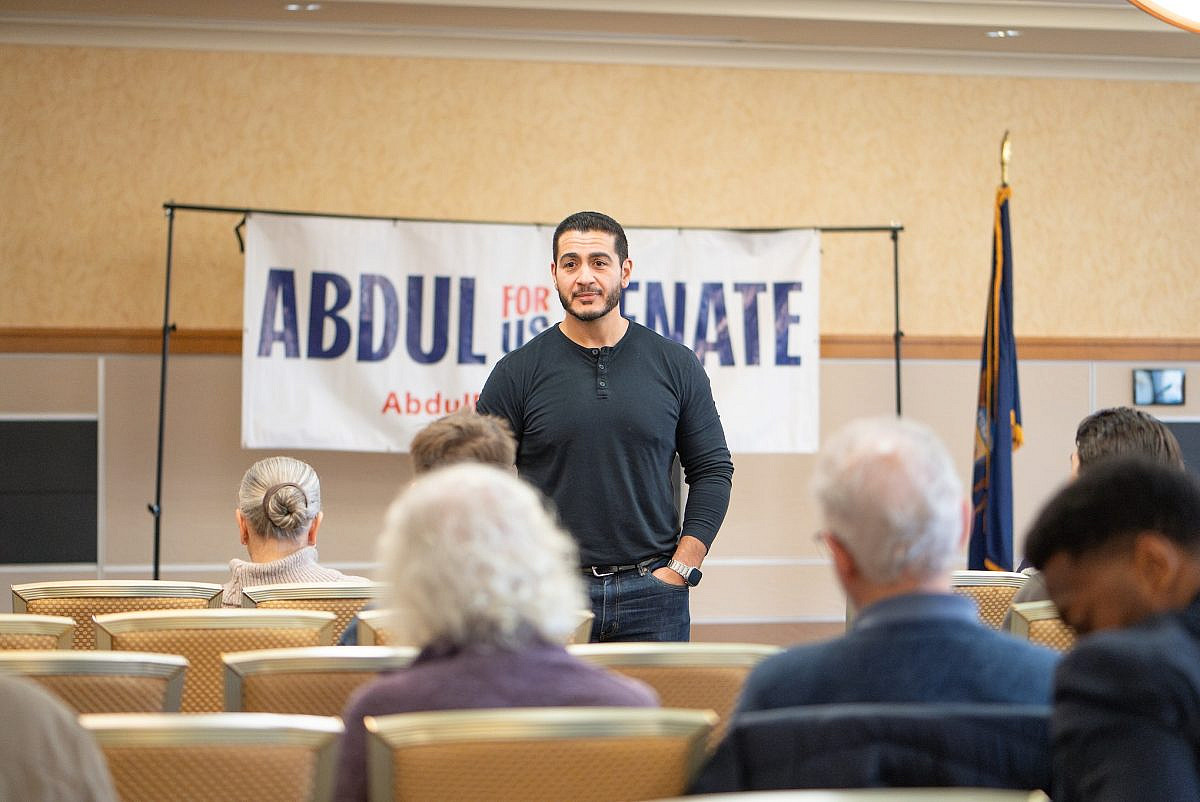
Hours before the polls closed on Nov. 3, Amer Zahr was filming a video outside a hookah cafe in Dearborn, Michigan. He wanted to thank Democratic Congresswoman Haley Stevens, who had lost the party’s U.S. Senate primary race to Abdul El-Sayed, for endorsing his Republican opponent Mike Rogers. The move, Zaher said, had mobilized Arab voters to turn out in droves for El-Sayed.
“Also, we’ve been giving out free hookahs and Sharia law textbooks, but I don’t think that has anything to do with it,” joked Zahr, a comedian, activist, and local school board member.
From inside the cafe, I could see him holding up his phone and ululating at the end of the recording. When he came in, he urged me to watch the freshly posted clip.
Zahr, an early supporter of El-Sayed, was jubilant even before the results were announced. The prospect of electing a U.S. senator who had made Palestinian human rights central to his campaign was reason enough to celebrate.
But for Zahr and many other Palestinian Americans, the stakes were far greater than Michigan’s Senate seat. They saw the race as a chance to prove that standing up for Palestinians could win elections — and to spur a reckoning within the Democratic Party ahead of the 2028 presidential race.
“When Abdul wins, we prove once again that pro-Palestine politics is good politics. The real win is forcing the 2028 presidential candidate field to speak in terms of justice and rights and self-determination for Palestinians. That’s going to happen, and we’re going to be able to finally change the platform if Abdul wins. To me, that’s what this is all about,” Zahr said.
El-Sayed did win, defeating Rogers by more than seven percentage points in a state that has twice voted for U.S. President Donald Trump over the past decade. His victory marked a crowning achievement for the Palestinian rights movement, one that could serve as a catalyst to finally tear down the pro-Israel consensus in Washington and meaningfully change American policy in the Middle East.
‘Down with AIPAC!’
Progressives have insisted that standing up against Israeli abuses is good politics. El-Sayed’s campaign subjected that proposition to a particularly punishing test — first against the Democratic establishment in the primaries, then against Republicans in the general election.
The American Israel Public Affairs Committee (AIPAC) spent more than $30 million against El-Sayed in the Democratic primary, while other centrist groups poured in another $30 million. His opponent, Stevens, enjoyed the endorsements of much of the party’s state and national leadership.
For months, Stevens’ allies blanketed Michigan’s airwaves, websites, and mailboxes with advertisements portraying El-Sayed, a former public health official, as unelectable and misogynistic. Notably, the ads funded by AIPAC and other pro-Stevens groups avoided mentioning Israel, whose popularity among Democrats has been steadily declining.
Instead El-Sayed and his supporters made Israel an issue in the race, highlighting Stevens’ staunch support for a country that leading human rights organizations and United Nations investigators have accused of committing genocide in Gaza. At some of El-Sayed’s primary rallies, “Down with AIPAC!” became a familiar chant.
Despite record spending in a Michigan primary, El-Sayed defeated Stevens in August, albeit by a narrower margin than polls had suggested. And then came the general elections, a second opportunity for Israel’s supporters to sink El-Sayed’s campaign. This time, nothing was off limits.
Republicans unleashed a floodgate of Islamophobia that targeted El-Sayed’s name, his policies, his family members’ backgrounds, and their social media posts, portraying the Michigan-born candidate as a foreigner whose loyalties lay elsewhere. President Donald Trump repeatedly called him a “jihadist” at pre-election rallies across the country. At an October 25 event in Port Huron, northeast of Detroit, one speaker questioned whether El-Sayed was even American.

AIPAC initially sat out the El-Sayed-Rogers contest, reportedly at Rogers’ own request. But in September, the lobby group re-entered the fray, spending hundreds of thousands of dollars on mailers against the Democratic nominee before funneling $9 million to a Republican political action committee involved in the race. During an October debate, Rogers appeared to reverse his earlier position, saying he would take all the help he could get.
Rogers, meanwhile, seized on El-Sayed’s support for Palestinians to suggest that he harbored dual loyalties. A Republican-funded PAC targeted Black voters with ads claiming that El-Sayed cared more about Gaza than Detroit, an accusation Rogers himself echoed.
No apologies for Palestine
Then came a November surprise. Two days before the election, Stevens endorsed Rogers, whom she had previously criticized as “repulsive,” “disgraceful,” and “the worst kind of politician.” There was little doubt as to the reason behind her defection: Israel.
Days earlier, Stevens’ fiance, Jason Turkish, had announced his own endorsement of Rogers, citing El-Sayed’s repeated description of Israel’s assault on Gaza as genocide.
“When he says genocide over and over again, when he refuses to condemn an ad that says Jews are to blame for the price of bananas, he makes my community less safe,” Turkish, who is Jewish, told reporters.
Both Turkish and Stevens had taken offense at an advertisement funded by Rebellion PAC, an outside group established by left-wing commentator Cenk Uygur, that linked U.S. support for Israel to rising grocery costs. El-Sayed distanced himself from the commercial, stressing that he had neither authorized nor supported its message.
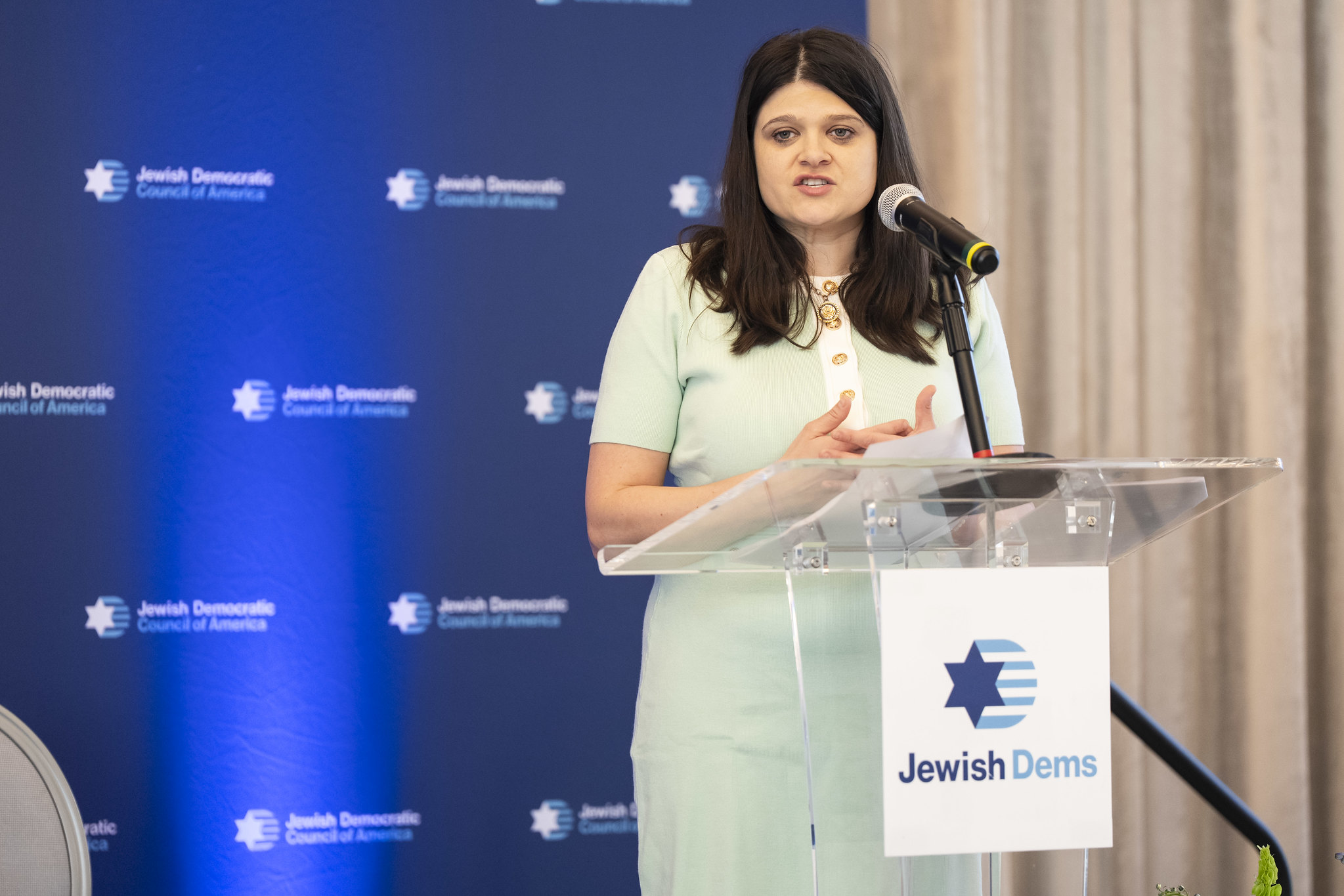
But in a statement made two days before endorsing Rogers, Stevens insisted that “the ad did not invent its argument; it dramatized one Dr. El-Sayed has made in his own words throughout this campaign: that Israel is the reason Michigan cannot afford schools, health care, and child care.
“The standard here is simple. If those words are wrong when a Political Action Committee supporting his campaign says them, then they are equally wrong when Abdul says them, and Abdul has said them from the start. I therefore expect him to apologize for those statements as well.”
El-Sayed did not apologize. Instead, he continued to make the case against foreign wars and military aid, tying his criticism of U.S. foreign policy to the economic frustrations of Michigan voters.
At an October 30 rally in Dearborn, hours after Stevens released her statement, he doubled down on his message that the problem went far beyond Trump. “Donald Trump is not himself the disease of our politics. Donald Trump is just the worst symptom,” El-Sayed told the crowd.
“The disease is the system that allows big corporations, billionaires, special interests to buy and sell politicians in ways that leave them rigging the system against us. It’s why we pay more for all we have to buy, get paid less for the work we do, [and] watch as our tax dollars get misspent to buy bombs and tanks for other people’s countries rather than schools and healthcare, here in our own [country].”
The argument resonated against the backdrop of soaring economic costs from U.S. military involvement in the Middle East. Israel has received more than $21 billion in U.S. military aid since 2023, while the war on Iran — which the State Department claims Washington launched in “at the request of and in the collective self-defense of its Israeli ally” — has cost more than $47 billion. The conflict has also driven up energy prices, spiking gasoline costs and fueling inflation.
El-Sayed’s campaign linked these foreign policy decisions to voters’ everyday economic grievances, refusing to treat Israel’s unconditional support for Israel as separate from the concerns of working Americans.

A battleground victory
Outside a Detroit rally where former President Barack Obama campaigned alongside El-Sayed and other Michigan Democrats on October 24, 19-year-old Detroiter Samuel Machado wore a “Latinos for Abdul” hat and a keffiyeh. For him, the scarf was a reminder to the party’s leadership that supporters of Palestinian rights were an increasingly important part of its electoral base.
“We have to make sure that we’re standing up here for the kids in Palestine, the innocents in Palestine, and make sure that the people on stage don’t forget that their voices are crying out for change,” Machado told me.
He dismissed Rogers’ argument that El-Sayed’s concern for Palestinians comes at the expense of Michigan residents. “Abdul, if anything, cares more about Michigan than these corporate Democrats and Republicans who want to keep sending our money to Israel,” Machado said.
“He wants to invest that money here in Michigan to help Michigan kids go to school, help Michigan people get health care. I think that [shows] care more about America than giving all of our money to a foreign settler colonial apartheid state that’s committing genocide.”
El-Sayed ultimately beat Rogers by seven points — 52.5 to 45.5 percent of the vote — despite the efforts to make his positions on Israel seem politically disqualifying. And the result carries particular weight because of where it happened.
Progressive candidates who champion the Palestinian cause have previously won House in safely Democratic districts. But El-Sayed won a statewide contest in one of the country’s most closely contested battlegrounds, demonstrating that such positions need not prevent a candidate from assembling a winning coalition beyond the party’s progressive strongholds.

A recent survey by the Chicago Council on Global Affairs suggested that a majority of Americans — 56 percent — support decreasing or ending US military aid to Israel. According to the same study, Israel’’s overall favorability has been tanking in the United States, currently standing at 30 percent among Democrats and 62 percent among Republicans.
El-Sayed’s win against Stevens in the August primary was in many ways a referendum for Democratic voters on Israel and AIPAC’s involvement in American politics. It is less clear if support for Palestinian rights was the decisive factor in his win against Rogers. After all, it came as part of a blue wave that saw Democrats pick up seats in traditionally Republican states across the country.
But it makes a different point difficult to dispute: Even a campaign that placed the issue front and center, and faced tremendous opposition because of it, could prevail in a competitive general election.
‘Palestine can no longer be sidelined’
Perhaps the clearest measure of how much has changed within the Democratic Party comes from another victory on election night.
In August 2024, Abbas Alawieh sat cross-legged on the sidewalk outside the Democratic National Convention (DNC) in Chicago, seemingly oblivious to the unforgiving sun as he made phone calls urging party officials to allow a Palestinian American to speak at the gathering.
Two fabric banners lay on the pavement in front of him, held down by plastic water bottles. They read “Not another bomb” and “Arms embargo now.” Alawieh, a former congressional staffer, had co-founded the Uncommitted Movement to pressure then-President Joe Biden, and later Democratic presidential nominee Kamala Harris, to end U.S. support for Israel’s assault on Gaza.
By the time of the convention, the movement’s immediate demand was something considerably more modest than an arms embargo: a Palestinian speaker who would endorse Harris from the stage. Party leaders rejected even that request, leaving Alawieh and his fellow activists literally and proverbially outside the convention.

Two years later, on the same night El-Sayed won his US Senate race, Alawieh was elected to the Michigan State Senate. At a Democratic election-night watch party in Dearborn, he appeared to be wearing the same silver suit he had worn outside the DNC. But this time, rather than pleading for a place on the party’s stage, he was laying out what presidential hopefuls would need to do to earn the support of his community.
“The path to the presidency in 2028 will require that every candidate who wants to go to the White House … will come through our communities here in southeastern Michigan,” Alawieh told reporters.
“We will want to know: What is your plan? What is your plan to take care of our communities here at home to ensure that we address the pain that working people are facing in this country, and also, what is your plan to stop the killing of people abroad, many of whom are our own family members?”
Iman Abid, political director at the US Campaign for Palestinian Rights (USCPR) Action, sees the victory of El-Sayed and other progressives as evidence of a broader transformation in public opinion.
“The general sway of the American people has moved in the direction of the Palestinian cause. More and more people no longer want to see their money being spent on the transfer of weapons or the funding of the continuation not only of genocide but of apartheid, occupation, and all the things that are happening across Palestine,” Abid told me.
Most read on +972

For Abid, the election showed that “Palestine can no longer be sidelined or exceptionalized.” And the shift is importantly not confined to Democrats. Abid pointed to a striking acknowledgment by Vice President JD Vance, a likely Republican presidential contender in 2028, that the Iran war and changes in the U.S. relationship with Israel were among voters’ leading concerns.
For years, the prevailing assumption in Washington was that criticizing Israel carried significant electoral risks, while supporting it was the safer political choice. The Michigan election results are the latest — and perhaps most significant — in a wave of victories by openly pro-Palestine candidates that have complicated that calculation. The question now is whether the Democratic Party’s national leadership will respond to this changing electorate or continue defending a foreign policy consensus that growing numbers of its own voters reject.