

On June 8, Jad Suliman woke up too late to receive bread at the local distribution point in Jabalia refugee camp, a lifeline for his northern Gaza neighborhood. With nothing to eat, the 8-year-old walked to school on an empty stomach, where he was handed a single packet of biscuits. But rather than eat it right away, he saved it to share with his mother and sisters.
As usual, before heading home that afternoon, Jad visited his father’s small electronics repair shop nearby. “He always came in, said hi, and kissed me with his pure smile,” Youssif Suliman, 43, said of his son. “I would give him two shekels, he’d buy snacks from a nearby market, and then he’d head home.”
That day, Jad was too hungry to stay for long. He took the pocket change and said goodbye to his father. Only a few minutes later, Suliman heard an explosion, and a thick cloud of dust immediately swallowed the street.
“My heart just dropped,” he recalled. “When the dust finally cleared, I saw my son lying in a pool of his own blood. His school bag was still strapped to his back, his face pressed to the ground. Shrapnel had struck his neck. We just started screaming.”
In a panic, Suliman scooped up his son and ran toward a nearby UNICEF malnutrition clinic, but the facility was unequipped to treat trauma injuries. By the time an ambulance brought them to Al-Shifa Hospital half an hour later, Jad had succumbed to his wounds.
For many people in Gaza, stories like Jad’s have reinforced a growing conviction that the ceasefire announced October 2025 exists only on paper. The agreement was supposed to halt hostilities, facilitate humanitarian aid, and ease restrictions on movement. But instead, Israel has killed 992 Palestinians and injured more than 3,100 since October, according to Gaza’s Government Media Office, and continues to limit medical evacuations and the entry of aid and commercial goods.

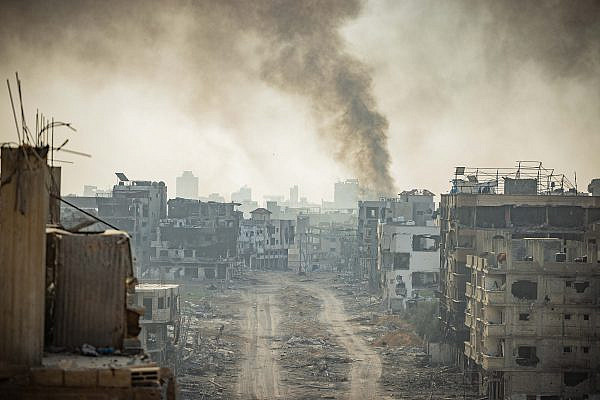
Since the beginning of May, escalating Israeli airstrikes across the enclave have felt like a return to the war’s most intense days. And as Israeli forces push to seize even more of Gaza’s territory, many Palestinians are left questioning whether the diplomatic process has any meaning at all.
“The Israeli forces are attacking Gaza with a green light from the United States,” said Gaza-based political analyst Thabet Al-Amour. “[Israel] has managed to domesticate the mediators, the international community, and the sponsors of the agreement, who fail to exert pressure or even reproach Israel.
“At least before the ceasefire, the cause remained at the forefront of Arab, Islamic, and American public opinion,” Al-Amour continued. “However, Israel is exploiting the political cover of a ceasefire while the slaughter and genocide continue unabated.”
The failure of the ceasefire to offer Palestinians any meaningful protection is felt most keenly by parents like Suliman, who are forced to bury their own children while the world looks on.
“Jad was deeply attached to animals, spending hours playing with neighborhood cats and birds,” his father recalled. “Lately, he had been wishing for a chicken — hoping it would lay eggs, which he loves.” Suliman added that Jad was a diligent student who rushed to finish his homework so he could play and fly kites with his cousin.
“What kind of threat could an 8-year-old child possibly pose for them to kill him? What was my child’s fault?”

‘The fire was eating them alive’
Like many residents of Gaza City, 45-year-old Reem Swesi was asleep in the early hours of June 4, when she awoke to her son’s screams. Swesi lives next door to the Lebbad family apartment in the northwestern Al-Mukhabarat neighborhood, which was one of four apartments targeted in overnight Israeli strikes. The blast was so close that she barely heard the explosion itself.
“Dust and rubble were filling my apartment,” Swesi recalled. “The first thing I saw was my neighbors burning and their furniture on fire.”
Fearing a second strike, she rushed downstairs with her two children. Civil Defense crews, paramedics, and neighbors tried to force open the Lebbad apartment’s multi-lock door, which had been warped shut by the blast pressure. When they failed, they entered through Swesi’s apartment, tearing down the canvas partition separating the two homes.
Swesi, who works as a journalist, later returned to her flat to document what happened. “I watched them pull the bodies out through my house,” she said. “I saw the charred and mangled remains; blood was everywhere, staining every corner of the rubble of the apartment.”
Five bodies were recovered, including a young girl and her father whose corpses had melted into a large mattress. “The rescuers had to cut part of the girl’s body so they could move it, while other parts of her body were burnt and stuck to the floor,” said Swesi. “It was a horrifying night — in my mind, I keep seeing how the fire was eating them alive.”
Though she has tried to repair her apartment, Swesi said neither she nor her children have recovered from the attack. “For me and my family, it feels like a crime scene,” she said. “Neither I nor my children can forget that children were burning to death right next to us. My children are traumatized whenever they want to go downstairs.”
Seven-year-old Hala Lebbad was the sole survivor of the room where her parents and three siblings were killed. Her uncle, who had been sleeping in the apartment, managed to pull her from the fire.

“She sustained severe second- and third-degree burns and serious damage to her legs,” said her aunt, Hanin Lebbad, 28. “Because of the critical medical shortages and poor blood circulation, she is at risk of amputation.”
Hanin had been in the apartment only an hour before the strike. “Sixteen people in my family were in the apartment that night,” she said. “Five were killed, and most of the others suffered serious injuries.”
Israel alleged that Hala’s father, Hassan Lebbad, was the deputy head of Hamas’ General Security Service and a key figure in the group’s decision-making process. (A spokesperson for the Israeli army stated that the attack was directed at a “terrorist target that posed a threat to IDF forces.”)
But according to Hanin, “My brother, whom they killed, was a normal civilian policeman and did not pose a threat to anyone. Killing him with his family is a human rights violation.”
A wedding turned into a funeral
Two days later, on June 6, Israeli airstrikes hit a tent in the Al-Jawazat neighborhood of western Gaza City, killing at least seven people. Among the dead were 8-year-old Maryam Qadoum and her father Abdullah.
A photograph of Maryam’s 32-year old uncle, Mohammed, carrying her body to her burial circulated widely online. For Mohammed, the image brought to mind another taken four years earlier: He was photographed in August 2022 carrying the body of his 5-year-old niece Alaa, who was killed by shrapnel from an Israeli bomb in the Shuja’iyah neighborhood of eastern Gaza City.
“When I was carrying Maryam, I instantly recalled the funeral of Alaa four years ago,” Mohammed told +972. “That time, Maryam was young but alive, and her father was alive. But now they are all gone. Our children that we were doing our best to protect have now been killed.”
Mohammed said the two photographs tell the story of countless Palestinian families, who have yet to finish mourning the death of one relative when Israel kills another. “I look at the two photos and see the complete family with Alaa, Maryam, and Abdullah. I am still not able to believe that they are gone, and I only have their memories.”
Elsewhere in southern Gaza, a family preparing for a wedding found itself instead holding a funeral. At 11 p.m. on June 5, 25-year-old Mohannad Ferwana was surrounded by relatives, friends, and neighbors in Khan Younis, celebrating his last night as a bachelor. He had borrowed a wedding suit from a close friend and spent the evening making final preparations.
Three hours later, an Israeli airstrike targeted his tent, killing him before his wedding day arrived.
During the first months of the war, Ferwana and his family lost their home to Israeli bombing, and were displaced to their family’s guest hall in a nearby house. Recently, Ferwana had pitched a small tent on the roof of the building to create some privacy.
That night, his father, 58-year-old Othman Ferwana, slept beside him because the shelter below was crowded with female relatives participating in pre-wedding rituals. Later, unable to bear the heat, Othman moved a few meters away from the tent to sleep in the open air.

“I jolted awake to the weight of stones raining down on me, burying the lower half of my body,” he said. “On my right side, the tent was devoured by flames, filled with the screams of women. I don’t know how I found the strength to pull myself up from under the rubble. I saw that the airstrike had assassinated my son.”
Residents rushed to help, throwing water on the flames while waiting for Civil Defense personnel to arrive. “The fire was eating my son for 30 minutes before my eyes. By the time the flames were put out, his body was charred.”
For Gaza’s rescue workers, responding to attacks like these remains difficult in the face of severe equipment shortages. “The lack of proper equipment delays us from helping people whom we can hear suffocating under the rubble, either burning or bleeding until they lose consciousness,” said Raed Dahshan, head of Civil Defense in Gaza City. “Even our personnel lack proper protective equipment, which puts us at great risk. One of our rescuers recently injured his hand while helping people and had to be delivered to the hospital.
“We are doing our best to maintain our fire truck and ambulances with the few available pieces of equipment in Gaza,” Dahshan insisted. But he noted that only one fire truck remains operational in Gaza City — leaving them reliant on other governorates when multiple airstrikes occur simultaneously, and delaying rescue operations.
Most read on +972
An electrician by trade, Ferwana had spent months trying to save for his wedding. His family had also taken on significant debt to cover expenses, from buying new clothes and mattresses to securing transportation and renting the wedding hall.
“The night before, his mother and sisters were overjoyed, preparing their bridal dresses while they were full of happiness,” Othman recalled. “Now, his bride is in shock; she does not believe what is happening around her. The Israeli occupation turned our joyful wedding into mourning.”
An Israeli army spokesperson declined to comment on most of the incidents described in this article, sending the following response: “The IDF directs its attacks at military targets only, while taking steps to minimize harm to civilians and civilian infrastructure in accordance with the laws of war, including taking precautions before carrying out attacks.”