
The translation of Sally Rooney’s recent book into Hebrew, in coordination with +972 Magazine and the governing bodies of the Boycott, Divestment, and Sanctions (BDS) movement, has gotten a lot of attention. Susan Abulhawa provided the most cogent argument for why the translation didn’t need to proceed, and it’s worth reading in full.
I follow +972 on Twitter, and have written for this site before. I believe in the work the magazine does and see real opportunity in working alongside anti-Zionists wherever they may be and whatever their national identity, Palestinian or Jewish-Israeli. Yuval Abraham has done good work in revealing what Lavender is and how the Israeli army has deployed it in service of mass murder. Equally, the reporting and testimonies collected from Palestinians in Gaza are invaluable.
Many of those reports are entries in the ledger: They will aid in the construction of a monument to the memory of the people exterminated in Gaza. Perhaps they will one day assist in the prosecution of the many hundreds of thousands of perpetrators.
Grim hope keens…
When Haggai Matar’s article announcing Rooney’s translation showed up on my Twitter feed, I felt vaguely annoyed. Why this? Why now?
I’ve since learned in conversations with friends at +972 that the effort to publish a book in Hebrew, in compliance with BDS, preceded the genocide. It began five years ago when the world was a different place, when boycotts could perhaps afford to proceed glacially and with precision (or perhaps not). That information explains a lot about how things came together, for me, and I suspect for many others.

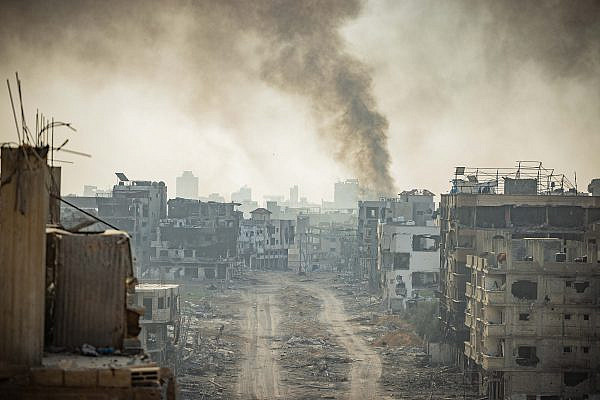
But on that day, the irritation caused by the announcement flitted by quickly. My attention had been spiked by the next item in the scrollwheel: a video depicting a wailing infant in Gaza with a massive lower leg injury. As the child screams, he lifts his left leg off the hospital bed. His foot and a sizable piece of his ankle trail the leg, attached only by connective and soft tissue. The fragmented bone is visible. His mother, Hanan Mahmoud, was killed in the Israeli strike that disfigured and disabled him for life.
The video has been deleted, but you can see a still from it here. There are other videos from Lebanon. And other videos…
***
In thinking through my initial, fleeting reaction to the news that Rooney’s book would be translated for an Israeli, Hebrew-speaking and reading public, I uncovered several things. First, I feel fairly fed up with the endless discussion of Jewish-Israeli feelings and sensibilities. What follows from that is that I am indifferent about whether Zionist Israelis regard BDS as antisemitic, one of the arguments Haggai made in his essay about the reasons for the translation.
I am also indifferent about whether Zionist Israelis have a friend in the world, or whether appeals can be made to the better angels of their unnatural commitment to Jewish supremacy, mass rape, and so forth.
This fact about me — nearly three years into a genocide — is not a fact about everybody; it’s a personal view. I don’t care if Zionists in the Jewish-Israeli camp ever come around, but other people might. I accept that.
This personal feeling follows from a conclusion: The ultimate liberation of the Palestinians, at least those who survive the crucible of Zionist rule in Palestine, will come through the massive application of sanctions and boycott. There’s evidence for that view in South Africa and in other places. History shows that kicking and screaming means kicking and screaming.

If, at the margin, someone in Israel who was once a Zionist decides that they’re also fed up with the solipsism, and arrives at the conclusion that endless navel-gazing will eventually cause a bending-in, miring them in their colon, planted in their own shit, in other words, well, great. Learn to stand up straight on your own two feet and don’t be such a baby in the meantime. And when you do, there’s real work to be done.
It’s a petulant attitude, but it’s how I feel.
***
Now to substance.
The BDS movement exists for one reason: Palestine’s liberation from Zionism. Practically, that means arresting the violence. Stopping Jewish-Israeli men and women from killing kids, women, and men in Palestine and Lebanon every day.
In organizing campaigns locally, regionally, or globally it’s worth evaluating where each of us sits, what our individual and organizing points of leverage are, and how they accrete in service of that big, urgent goal. To make an obvious point more obvious: My personal leverage varies greatly depending on whether I’m in the United States, where I am empowered and well-connected, and whether I live in Gaza, where my life is worthless, and my leverage virtually non-existent.

That’s the frame for evaluating whether the Park Slope Coop boycott effort is meaningful, and it explains why the hard-won victory there was worth investing in. It’s also the frame that confounds the effort to translate books into Hebrew. The points of leverage available to Jewish Israelis in the Palestine solidarity movement are great — and they offer opportunities for direct action. But the translation isn’t that.
A theory of change is meant to focus resources and efforts in service of goals. The situationally-empowered people who chose to translate books into Hebrew in Israel are well-intentioned — my commentary here isn’t meant disparagingly or intended to dispirit anyone — and they wield leverage. Yet, what they chose to do is totally unmoored from an identifiable theory of action that helps deliver the goal articulated above.
In Park Slope, one can tell a convincing story about how the high-profile nature of the boycott will help produce knock-on efforts which cohere into a massive boycott in a reasonable timeframe. That boycott will hurt Israel economically, and faced with poverty Israelis will relent. Nothing at all, lots of small campaigns, then all at once.
But I fail to see how Jewish Israelis reading fiction that has nothing to do with the urgent reality and needs of their victims will produce Palestinian liberation. Someone reads a book … then Palestinian freedom? I’m unable to fill in the ellipses. What is the causal mechanism exactly? What is the multi-stage process through which freedom emerges? And if it exists, does it correspond to the urgency of the moment?
I don’t see it. But perhaps my imagination is attenuated by grief.
There is a second argument for the translation: By demonstrating that BDS does not target people as such, but rather complicit institutions, the movement becomes more palatable to some unknown body of writers and authors who have until now languished on the vine. And their new engagement will further isolate non-compliant institutions.

The argument is a specious one, like the endless appeals to the undecided centrist, the lukewarm coquette who is supposed to swing elections here in the United States. A writer who has so far refused to boycott — after a profusion of horrors, a whole herd and mob of terrors inflicted by Jewish-Israeli men and women and documented by their victims — is far from being humane and thoughtful. Their participation is contingent, and the sole contingency is the continued elevation of Jewish life and comfort above that of all others. Those people, if they exist, are not allies. They are speed bumps — barriers to justice.
Finally, there is an argument that goes to on-ramps — how to bring more Jewish Israelis into the campaign for boycott and sanctions. There are undoubtedly a handful of valued, important Jewish anti-Zionists in Israel today. Haggai himself is a refusenik — he spent nearly two years in an Israeli gulag for refusing to join that country’s army. I care about him and people like him and the individual contributions they make. We stand in solidarity together, no doubt.
Most read on +972

The question of on-ramps is more important for new entrants. Is there room for them in this movement? What is their role?
The answer here is simple and does not need to be belabored. Yes, anti-Zionist Jewish Israelis have a role to play, and that role should leverage their privilege in the way many of the authors who write for +972 do. Others should boycott their army. They may engage in civil disobedience. Or stab the tires on the jeeps and throw their bodies before the bulldozers. Otherwise, gum the works of the meatgrinder. Do something real. And make it meaningful.