
“These times make me think of 1933,” my neighbor commented as our sons zoomed down a hill on their bikes. This was a common sentiment in the early months of President Donald Trump’s second term — how to stop a leader with fascist tendencies who had gained power through a democratic process.
But it wasn’t our usual neighborhood conversation. Rümeysa Öztürk, a graduate student at Tufts University, where I teach, had recently been kidnapped by masked U.S. Immigration and Customs Enforcement (ICE) agents for writing an op-ed in our student newspaper in support of Palestinian rights and student governance. The alarming video of the incident had left us all shaken.
My neighbor explained that his great-grandparents had come to the United States from Europe in the decades before the Holocaust. But other branches of his Jewish family had stayed and were entirely wiped out. This time, he expected, my publicly Palestinian family was more at risk than his. I think I nodded blandly. For many months, my mind had been with Palestinians in Gaza, where a genocide was underway. His concern for my family seemed to me both alarming and abstract.
Another friend had been encouraging me, for the sake of my family’s security, to apply for a new citizenship. We were at the town pool when she quipped, “There are the people who left in 1933, and the people who left in 1939. The former left with their property.” Watching our sons dive off the boards in sync, splashing and circling underwater before reemerging, I thought to myself: The property values in our town are solid, so even if we must leave, we’ll get a good price.
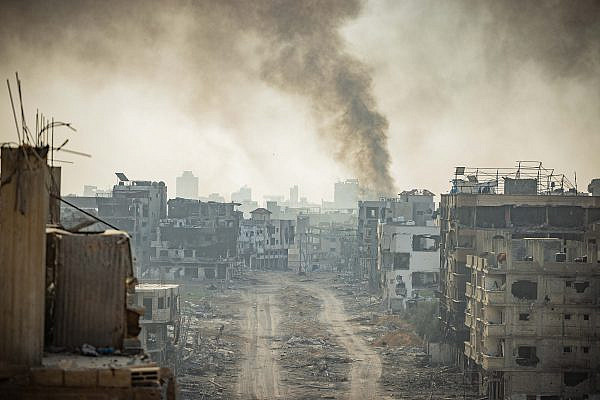
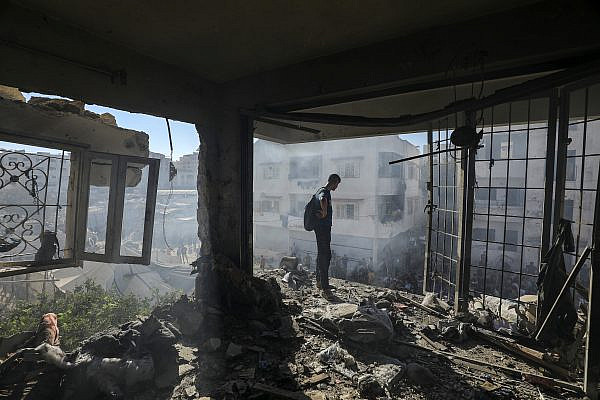
Again, as I tried to respond, I faltered in the strange space between my uncertain fears about what might happen here and my horrified knowledge of outright genocide and ethnic cleansing there. In the last two years, Israel has destroyed or damaged 81 percent of all structures in Gaza, including more than 81,000 homes in Gaza City alone. Despite the so-called “ceasefire,” Israel has denied Palestinians access to materials necessary to make even temporary shelters for winter, and the cold and flooding has meant only more deprivation and death. At least 40,000 Palestinians in the northern West Bank have been made homeless due to Israeli forced displacement in Tulkarem and Jenin.
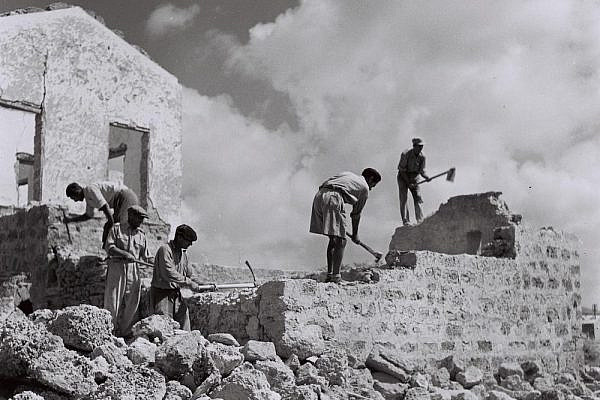
It was strange to be thinking about property values, too, given what I knew of the scale and continuity of Palestinian dispossession. My father lost his home just after the 1948 Nakba, when the new state of Israel destroyed his house in the Galilee. My husband’s home in the West Bank was demolished by Israeli forces in the early 1980s. There have been weeks when we have sat in our kitchen in Massachusetts — itself once a settler-colonial frontier — wondering whether Israel’s campaign of destruction would impact our family in the southern West Bank.

My family and I have joined protests against the genocide in our small town and beyond, and I have written about Palestine for years. Still, in our suburban ease it has been hard for me to hold these layers of dispossession together with the threat of homegrown American fascism.
Thinking from 1933 to 2025 was difficult in another way, too. For years, I have been trained to not make any analogies between Jewish and Palestinian history. In an environment where antisemitism is too often weaponized, any comparisons between the Holocaust, the Nakba, and Gaza can open one up to criticisms of diminishing what is often presumed to be the archetypal genocide. Dwelling on these linkages can also feel too grounded in a certain politics of intergroup dialogue that diminishes Palestinians’ centrality to our own liberation, as though Palestinians’ history and future can exist only in negotiation with Jewish history.
But as UN legal experts and institutions name Israel’s war a genocide — as we can see, too, with the testimony of our own eyes — and as the U.S. government specifically targets the civil liberties of Palestinians and their advocates, these old rules of discourse feel inadequate. I understand the problem of comparison: The Holocaust holds a unique and horrific place in history. But when my neighbors see scholars being kidnapped by masked agents for their writing, their minds turn to 1933 for a reason.
These are dizzying, catastrophic times. The overlaps across time and place are strange and vicious, but recognizing them allows us to find the ground on which to stand. More than ever, we must draw and insist upon these connections, because we need a politics that disrupts the normalization of authoritarianism and genocide at every turn.
Overlapping forms of dispossession
This summer, we visited a friend on a lake in Maine. It was a kind of a solidarity getaway: We usually saw each other at Palestinian rights protests, so I was not surprised to see in her house dozens of books that I held in my own Palestine studies shelves.
I was still wet from swimming when she told me a small part of her family story. Her Jewish parents had left Germany in the early 1930s, seeking refuge in several places in Europe before settling in the United States. Her grandfather had been taken to a Nazi camp, but her father had been able to secure his release. We were eating from white, flower-patterned plates passed down from my friend’s grandparents. “Be careful clearing the table!” I told my son.
In the midst of rambling conversations and long walks, my friend told me more about how the Holocaust had shaped her mother’s view of family life, how her mother never expected stability after that horror of displacement and genocide. We both knew that the Holocaust was not the first genocide of the twentieth century or even the first German one. But in our part of the world, and in my friend’s life, it had shaped so much. Her family’s experiences of loss and dispossession as refugees were part of what had made her into a lifelong activist, and especially shaped her advocacy on behalf of Palestinians.

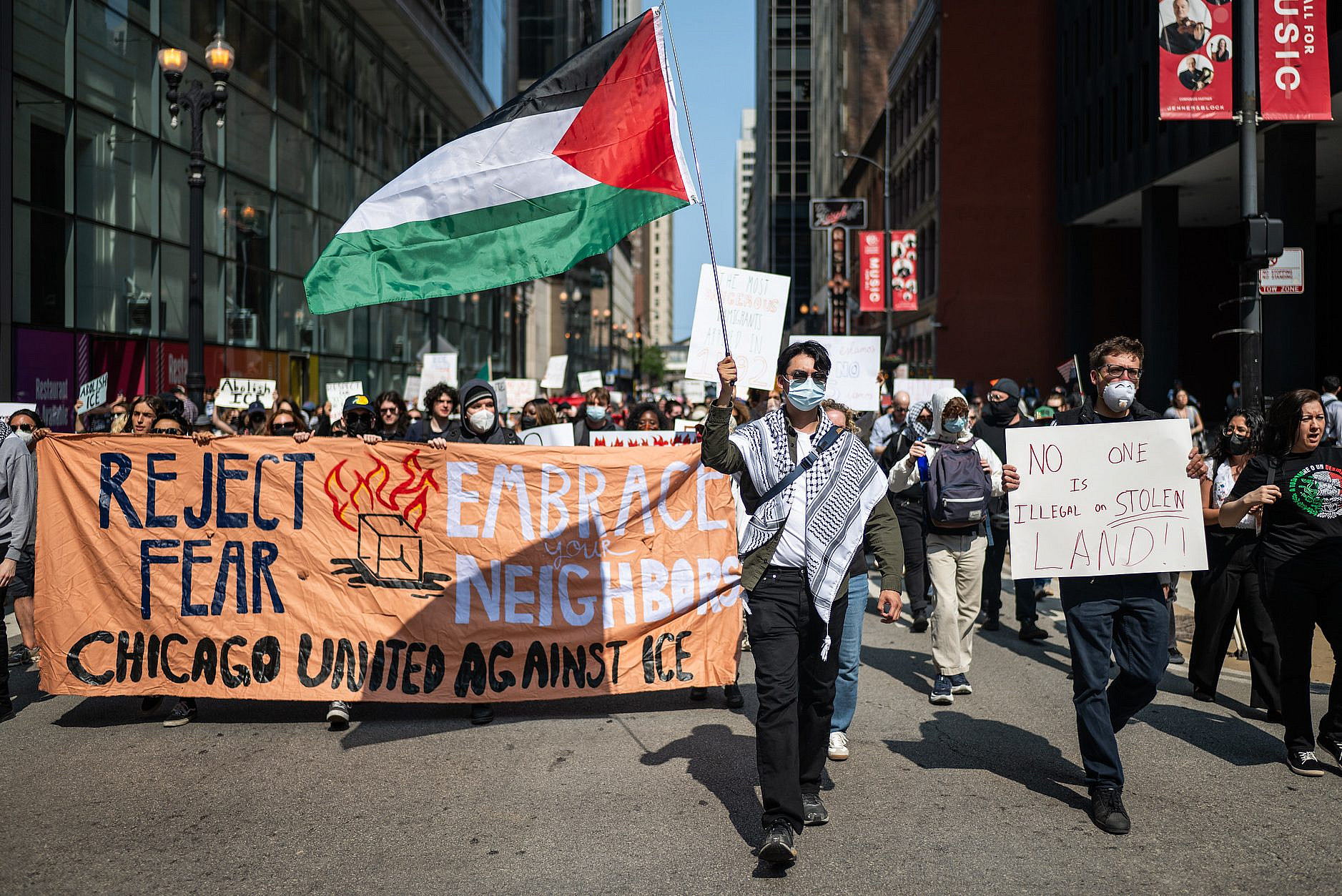
I was still thinking of her family story the next week when I set out for a protest against ICE detentions of immigrants in Burlington, Massachusetts, where an ICE office building near a shopping mall has been turned into a detention facility just a few minutes away from our house. Conditions there are “abysmal”, overcrowded, and “unsanitary” — and it is only one of many new detention facilities the Trump administration has established for ICE detainees. Many of these prisons have been generating their own forms of local activism, like “Alligator Alcatraz” on Miccosukee and Seminole land in the Everglades, where the Miccosukee tribe has joined the fight against the facility.
On the way over, I read an Instagram post about Dr. Hussam Abu Safiya, a pediatrician and the former director of Kamal Adwan Hospital in Gaza, who has been held in Israeli detention without any charge since December 2024. “Dr. Hussam is not okay,” his lawyer reported in the post. “He has lost more than a third of [his] body weight. He suffers from irregular heartbeats. He is still wearing his winter clothes despite the harsh detention conditions of starvation, torture, and isolation. He is held underground where he receives no sunlight.”
My mind immediately went to our own friends and acquaintances in Israel’s prisons. Because we have family in a West Bank refugee camp, we know prison to be an ever-present threat and one that has grown even more brutally violent in the last two years. I have seen in Facebook posts how people return from prison thin as ghosts from a system recently described by the Israeli human rights organization B’Tselem as “a network of torture camps.” I’ve heard from prisoners and social workers who serve them of the untreated broken bones that never fully heal, and the skin diseases that linger long after release.
Remembering Dr. Abu Safiya and the countless other Palestinians jailed by Israel, my stomach turned. For a moment, I wondered how I could go to any protest that was not about Palestine. But it soon became clear that there were too many connections to stay home: the violence of prison and the enduring and overlapping forms of dispossession of settler colonialism.

When I arrived at the demonstration near my hometown, from which I could clearly see a Macy’s department store, it reminded me of one I had attended years ago in Tel Aviv in solidarity with Palestinian prisoners on hunger strike, who were being held in a hospital in the middle of the city. I remember there, too, being shocked by the physical proximity of the horrors of the prison systems to the daily and mundane.
Here, in suburban Massachusetts, I was struck by the wide array of reference points and analogies protesters used to frame their opposition to ICE detentions — from signs referencing Bible verses and extolling immigrants’ contributions to the United States, to reminders of our own place on Native territory: “No one is illegal on stolen land.”
There were several references to Nazis and the Gestapo at the protest, but what stuck with me most was the sight of a woman holding a pink sign with a black and white picture of a young boy in glasses. “For my dad, who survived fascism in Nazi Germany,” the sign read. I thought of what it would mean to bring my own family history to the next protest, when Palestine has so often been an exception in progressive political spaces.
Palestine as a hub for global liberation
It’s difficult to gauge our shifting vulnerabilities, individually, as families, and as larger collectives. Almost every month, a new threat seems to emerge. While claiming to stand up to Trump, Harvard has fired a longtime Palestinian staff member and dismissed the director of a center on health and human rights due to their work on Israel-Palestine. The Supreme Court is allowing racial profiling in Los Angeles. The Trump administration has sanctioned prominent Palestinian human rights groups as terrorist organizations, calling out their work on the International Criminal Court investigations of Israel.
The list goes on: A scholar of anti-fascist activism was initially prevented from leaving the country to seek refuge from death threats, due to Trump’s targeting of “antifa” as a terrorist organization. A “Young Republican” chat group in New York circulated flagrantly misogynistic, antisemitic, and other racist comments, and the vice president dismissed it as youthful bad judgement, though the participants were leaders ranging in age from 18 to 40. Palestinians are now among the mostly African and Middle Eastern nationals who cannot get new visas to the United States.
As we see the U.S. government’s repression of Palestine activism as a means to challenge university governance and undermine civil liberties — while also witnessing the extraordinary waves of protest to stop the genocide in Gaza — it is clear that Palestine has become a hub of global liberation politics today. Palestine links people and issues in ways that would have been surprising a few years ago.

This new centrality presents vast possibilities, but also new challenges. As Palestinians, we must insist on being at the center of our own liberation; others have spoken on our behalf for far too long. This movement for justice must be focused on the lived realities inside Israel-Palestine, as well among Palestinian refugees who have been on the frontline of dispossession for generations.
At the same time, as members of other polities, we Palestinians in the diaspora have concurrent responsibilities. In the United States today, people refer to rising fascism here and I think about genocide there, whether in Gaza or Sudan, or genocide then, 80 or hundreds of years ago. We protest a prison at the mall here and must also remember prisons everywhere, from the Everglades to Egypt and El Salvador, while recognizing how everyday sites around us are proximal to systems of violence.
Solidarity politics and a commitment to dignity for all demands that we think in relation. We are called to break those rules that cordon off one story, like the history of the Holocaust, from another, like the Nakba, or ICE detentions, or American settler colonialism. Indeed, the effective use of legal categories like genocide and the struggle against global systems of violence demand this connective work.
Thinking across contexts can enliven Palestinian ideas of what a liberated future will look like. And at a time of multiple unfolding crises, it is all too clear that a backsliding in rights in one place exacerbates conditions elsewhere: The repression of protests and intensification of racism in the United States certainly makes a global struggle for Palestinian liberation even more difficult.
Most read on +972
When I was invited to address a pro-democracy “No Kings” rally in my town this fall, I spoke about the genocide in Gaza, and I finally did bring up my family’s Palestinian-American story. I had the courage to do this — and to wear a kuffiyeh amid a sea of American flags — because I had stood with some of these same neighbors at the small, weekly protests against the genocide in Gaza that we held just down the street.
I reflected on the special horror of witnessing a genocide supported by my government, and how as a child I had learned from my Palestinian father, then a D.C.-based journalist, about U.S. civil liberties that are now under threat. I grew up feeling that being Palestinian-American did not simply make me a target, it gave me insight into those civil liberties.
And as I spoke about our interrelatedness, I knew that drawing these connections is a means of preserving free expression that is rooted in vulnerability and compassion, cultivating visions of justice expansive enough for us all.