


Throughout my life, in the face of siege and repeated wars, my family has always marked the arrival of the new year together in Gaza. But this new year, for the first time ever, we were apart.
Recently, I left Gaza for Egypt with my mother. From the first days of the war, my siblings and I agreed on one priority: keeping her alive. She suffers from complex spinal problems, and I did everything I could to secure medical treatment for her abroad. I eventually succeeded — but only after a long and brutal ordeal that, in many ways, mirrored the broader suffering imposed on Gaza and its people.
We left behind the rest of our family in Khan Younis refugee camp, where they have been living since we were displaced far from our home (which the Israeli army has since destroyed), stripped of the ordinary moments that once gave our lives meaning. Despite the so-called ceasefire, they are continuing to endure unbearable conditions, with the wind, rain, and cold leaving little room for the hope that a new calendar year will bring positive change.
Even abroad, I still carry a deep fear inside me. The pain from my own injury returns again and again, pulling me back to moments of violence I cannot escape. But despite the trauma, I try to survive in whatever ways are available to me.
With each passing year, my responsibilities have grown heavier. This year, they rest almost entirely on my shoulders: ensuring my mother’s treatment, and caring for her alone.
December, then and now
As a reporter, I first covered Christmas and the new year in 2014, as my first assignment for Al-Mujtaa, a local Gazan outlet. In the years that followed, I traveled across Gaza each December to report on the holiday season. Avenues were decorated with lights, shop windows filled with decorations, and Christmas carols could be heard on the streets.

It felt like another country. I am from Al-Fukhari, a rural area east of Khan Younis in southern Gaza, where nothing remotely similar takes place. The holiday atmosphere filled me with excitement; I felt like a child discovering the world for the first time.
Each year, my reporting took on a different shape, reflecting Gaza’s diversity. I documented all-night New Year’s parties along Al-Rashid Street, the coastal road linking the north and south of the Strip. In 2017, Christian families welcomed me into their homes to share Saint Burbara dessert, traditionally eaten on Dec. 16 — which also happens to be my birthday.
That year, I filmed Ghada Tarzi, a generous Christian Gazan, preparing the dish in her beautifully decorated house. I remember the Christmas tree in her kitchen. She sent me home with a plate as a birthday gift, a moment I think about every year.
I also often joined the Gaza YMCA’s annual Christmas tree lighting, where Christians and Muslims gathered together to celebrate. Children clustered around the tree, dressed in their finest clothes, laughing and posing for photos. The city was different in December, shining like a bride in her wedding dress.
From 2019 until the outbreak of war in 2023, I worked as a science teacher at the Rosary Sisters School, a private Catholic school in Gaza City attended by both Christian and Muslim students. The holiday season there was a time of shared joy. We decorated classrooms and hallways, set up Christmas trees, and sang carols during recess. I always made sure the tree in my classroom was the best decorated. On the last day before winter break, the school principal handed out sweets shaped like Santa Claus.

Those days remain among the most beautiful of my life. I never cared that celebrations elsewhere might be more lavish; being with my students and colleagues meant everything to me.
All of this ended with the war in 2023. The Rosary Sisters School was destroyed in an Israeli attack that November. The Church of Saint Porphyrius, where I attended Mass in 2018, became the site of a massacre when an Israeli strike killed 18 people in the war’s early days. The Santa hat I once brought home, which my sisters and I took turns wearing, is now buried under rubble.
This is the third consecutive year I have not reported on the holiday season, because there is so little left to celebrate. December, once the brightest month of my year, has turned bloody and dark.
Ceasefire without safety
The holiday season in Gaza used to offer a reprieve from the violence and deprivation to which we have grown accustomed. But after two years of genocide, Gazans are bracing for what feels like another year defined by loss and the daily struggle to stay alive.
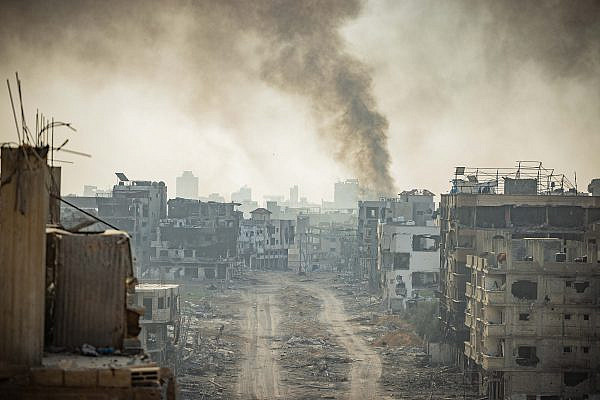
Despite the ceasefire, explosions continue to echo across Gaza. Demolitions of Palestinian homes have accelerated inside the Israeli-controlled “green” zone as the army expands the so-called “Yellow Line” deep into eastern Gaza City. Meanwhile, some two-thirds of Gaza’s residents remain barred from returning to their homes, most of which lie in ruins.

Since the start of 2026, at least nine Gazans have been killed, adding to more than 400 killed since the ceasefire. Three were shot by Israeli army fire near the Yellow Line, among them 11-year-old Fatima Maarouf. Two — a grandmother and her grandchild — burned to death when the nylon tent they were living in, likely made of flammable, makeshift materials to shield against the cold, caught fire while they were cooking. And four more were killed in airstrikes in Khan Younis.
“Our house is just tens of meters from the Yellow Line, but the Israeli army fires continuously and randomly, as if they want us to leave the area,” Rana Maarouf, Fatima’s mother, told +972. Despite the family’s efforts to stay safe, Fatima was struck in the head by bomb fragments, which also injured Rana and her 8-year-old son. “We don’t feel that the war has stopped,” she said. “Every day there is shelling, explosions, and random gunfire. We never know where to go.”
The Sawaf family is among the two-thirds of Gaza’s population still living in tents. “I want to take this tent, which floods every time it rains, and put it back in the neighborhood where I used to live, in Tel Al-Sultan,” Mai Sawaf, an art teacher in her 30s, told +972. Her hope, she said, once some semblance of stability is restored, is to “relive beautiful moments with my family.”
While some Gazans cling to the possibility of rebuilding their lives in the Strip, others are desperate to leave, worn down by the psychological toll of ongoing violence. “I need to rediscover my zest for life, which I completely lost during the conflict,” Salwa Faraj, 28, from Khan Younis, told +972. She is waiting for the Rafah Crossing to reopen so she can travel to Egypt and begin the year elsewhere.
“I want to take time to recover from what I experienced during two years of war,” she said. “I need a break from these sights and sounds.”

Imagining a different year
After two years of war, Gaza is barely recognizable. Still, some residents hold on to the belief that the new year will bring brighter days.
“I dream that the new year will open a new era for Gaza, one without war,” Khader Jamal, a man in his 20s from Khan Younis, told +972. Displaced with his wife and six children to a tent in Deir Al-Balah, Jamal hopes to return to their home in eastern Khan Younis, which was reduced to rubble during the war. “We want to rebuild Gaza and bring life back to it,” he said.
Most of the Gazans I spoke to shared a single, simple wish for the year ahead: lasting peace. “I hope this year will be beautiful and compensate for two years of suffering,” Jamal added. “We deserve to live in peace. I ask the world to allow us that, so our lives can continue.”
For Layla Ayad, a 36-year-old Christian from Gaza City, the war has drained the holidays of joy. “Each of us carries deep sadness — for the people, the places, the memories,” she said. “On Christmas Eve, we sat together crying for those we lost.”
Most read on +972
Ayad lost her home in Tel Al-Hawa and was displaced to a church, where she endured harsh conditions. “Nothing can truly restore what we lived through,” she said. “I miss the Church of the Nativity. I miss the Christmas atmosphere. We want peace, and we pray for it. I hope this will be a year without war, and that Gaza will return to its former beauty.”
Like these Gazas, I also search for a fragile hope in the new year, a new beginning that might allow us to repair some of the trauma of genocide and start rebuilding our lives. Even as our reality resembles a nightmare, we continue to imagine a year unlike the last two.