

When Israel and the United States first launched aerial strikes on Iran on Feb. 28, 20-year-old Shorouq Dawas was still asleep inside her family’s makeshift shelter in Gaza City’s Al-Yarmouk Stadium. But soon, her sister Nagham rushed in to deliver the news — and to rouse Shorouq into action.
“She shouted that Gaza’s borders were being closed and that we should go shopping before food runs out,” Dawas told +972. “I hurried to change my clothes, took what money we had in the tent, and left with her.”
Dawas lives with her 63-year-old mother and brother, while Nagham, 28, who is married, lives in another tent a few kilometers away, but the sisters often go together to buy food. Since the death of their father in August 2025, Dawas has taken on the responsibility of providing for the family.
When the sisters reached the market that morning, they were shocked by the crowds.
“People were rushing to buy as much as they could afford — white flour, sugar, oil, rice, tomato paste, lentils,” Dawas said. “Some traders began raising prices as they realized supplies might run out and no new goods could enter.”

For Dawas, the panic in the market revived memories of the Israeli-imposed famine that ravaged the Strip last year. Since the start of the ceasefire between Israel and Hamas in October 2025, she has lived with a constant fear that hunger could return. “Even if we could afford to store food, it would eventually run out, and we would starve like others,” she said.
The family knows well the consequences of food shortages. Dawas’ father, Zuhair, died at the age of 63 after suffering severe malnutrition during the famine last summer. Zuhair had also been diagnosed with cancer, but he was unable to receive treatment due to the lack of medical supplies in Gaza.
“During his final days, my father’s bones and ribs were visible from hunger,” she recalled. “We searched for days to find healthy food like eggs or vegetables to help him regain strength, but his health deteriorated rapidly as his immune system collapsed.
“I lost my precious father because of famine,” she added. “I don’t want to lose another family member for the same reason.”
Dawas also worries that with the world’s attention focused on the widening conflict in Iran and across the Middle East, Gaza could once again fade from view. “Netanyahu doesn’t need a reason to bomb Gaza whenever he wants,” she said. “We are exhausted from this unstable life.”
Food prices surge
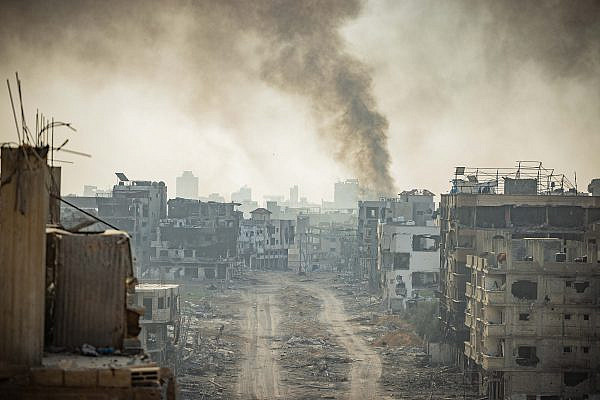
News that Israel had closed Gaza’s border crossings for “security reasons” immediately after launching strikes on Iran spread rapidly across the Strip on social media. For many residents, the announcement triggered fears of an immediate spike in food prices, especially given the already limited quantities of aid and commercial goods entering Gaza since the ceasefire.
Ali Arif, 26, witnessed the change firsthand. Together with his brother Imad, Arif runs a small fruit and vegetable stall on Al-Wahda Street in Gaza City. They opened the stall after the October ceasefire, hoping the relative calm would allow them to rebuild their livelihood.

Every morning, Arif receives produce from wholesalers, whom he pays after selling it during the day. On Saturday morning, shortly before the outbreak of the war, he had already bought his usual daily stock and sold it at normal prices. But when he returned to wholesalers the next morning to restock, he found that prices had surged and supplies had dwindled.
“There were almost no goods available, only small quantities of each type, and at more than triple the price,” Arif told +972. “Only traders who could pay immediately were allowed to buy.”
According to Arif, some wholesalers and farmers used the border closure as an opportunity to increase prices. “They know people have no other options,” he said.
Even before the closure, fruits and vegetables were far more expensive than before October 2023, and with Gaza’s economic devastation, most residents’ purchasing power had collapsed. “People could still buy small amounts every few days,” he said. “Now even that is becoming impossible.”
The rising prices have placed vendors like Arif in a difficult position — forced to pay more to wholesalers while facing the anger of customers who can no longer afford basic food. At times, he says, the pressure makes him consider leaving the trade altogether.
“When people come to buy vegetables and ask about the price, they start cursing at me as if I’m responsible,” he said. Still, Arif has little choice but to continue selling. “If I don’t work, no one will put food on my table.”
Like many Palestinians in Gaza, Arif closely follows updates from Israeli authorities about the situation in the border crossings on social media. When Israel announced on March 2 that it would reopen the crossings, the news initially raised hopes. But on the ground, little changed.

“Prices are still high,” Arif said. “Customers who bought two kilos of tomatoes [before the closure] now buy just two pieces.” Before the war began, he would purchase five boxes each of tomatoes, potatoes, and onions daily — and sell them all by evening. Now he buys just one box of each, and it often lasts until the next day.
Gaza’s Finance Ministry has tried to stabilize prices by limiting traders’ profit margins, with armed police occasionally deployed in markets to monitor prices and ensure compliance. But according to local merchants, this measure has not done enough to curb the sharp rise in prices, as the few officers cannot cover all market stalls and shops across the Strip.
Mahmoud Abu Hasnain, 45, who owns a small grocery shop in the Tel Al-Hawa neighborhood of Gaza City, said the deeper issue is the fragility of Gaza’s supply chain. “Goods already enter Gaza in very limited quantities,” he told +972. “Any disruption at the crossings quickly causes shortages.”
While he, like most traders, blames border closures for rising prices, this offers little comfort to struggling families. “Most residents depend on small salaries or humanitarian aid,” Abu Hasnain explained. “More and more families cannot afford food as long as the crossings remain unstable.
“I ask international actors to ensure that essential goods enter Gaza regularly and at fair prices,” he added. “The war is between Israel and Iran — why should people in Gaza pay the price?”
Patients left waiting
The consequences of the border closures extend beyond rising food prices: for the more than 18,000 patients in Gaza awaiting medical evacuation, including around 4,000 children, each delay can mean a slow and painful deterioration, if not a death sentence.

Zakria Hamoud, 60, has been hospitalized at Al-Shifa Hospital since November 2025. He suffers from severe back spasms, chronic heartburn, and acute lung infections caused by a rare disease known as GBS.
Standing beside his father’s hospital bed, Yasser, 29, told +972 that the family has been waiting months for permission to travel abroad for treatment.
“We have an urgent medical referral, but we are waiting for a chance that the borders will open for sick people so he can travel,” Yasser told +972. “Doctors told us that his condition is getting worse every day, and hospitals in Gaza have no way to treat him.
“My father was always our source of strength,” he added. “Now he lies on a hospital bed in severe pain, dying before our eyes while we stand helpless.”
Asma Khudair, 33, from Gaza City, is also waiting for approval from the Israeli authorities to leave the enclave, still suffering from the injuries she sustained when an Israeli airstrike hit her home in Khan Younis last July. Her seven-year-old daughter was killed in the attack.
Khudair has severe damage in the nerves and blood vessels in her left leg, and has partially lost function in her right hand. She has undergone four surgeries so far, but doctors say she still needs additional urgent procedures that cannot be performed in Gaza due to the lack of medical supplies.
“They told me that I may lose full function of my injured limbs because of the delay in treatment,” she told +972. “I wake up and fall asleep with deep pain in my limbs. I cannot move them normally.
“My heartbeat races whenever I hear anything about amputations,” she added. “I’m afraid of hearing that word. All I need is to receive treatment abroad before it is too late.”
For others, the border closures have erased what seemed like a rare chance to receive care.

Ayman Salem, 24, who asked to use a pseudonym for fear that speaking publicly could harm his chances of seeking treatment abroad, barely survived an Israeli airstrike in Jabalia refugee camp in January 2025. Pulled from beneath the rubble of his home, Salem suffered severe damage to the nerves in his right hand and feet, along with blood vessel injuries and complications from improperly treated fractures. Doctors warned that his condition could eventually require the amputation of his leg.
On Feb. 28 — the day the war between Israel and Iran began — he received a call from the World Health Organization informing him that he would be allowed to travel abroad for treatment. “I was counting the days for this chance,” Ayman said. “It felt like my soul was coming back to life — that I might avoid losing my leg and hand and walk normally again without crutches. I thought I could finally stop taking painkillers for the pain in my hand.”
But his hope was short-lived. “The borders closed on the day I was supposed to travel,” he said. “The chance I had been waiting for was destroyed.”
A deadly ceasefire
Since the start of the U.S.-Israeli war with Iran, Israeli forces have killed 14 Palestinians in Gaza — bringing the total number of casualties since the October ceasefire to 648, according to Gaza’s health authorities.
In one of the deadliest attacks of the past 10 days, three Palestinians were killed late Sunday night when an Israeli artillery shell targeted tents of displaced Palestinians in the Al-Sawarha area in central Gaza. Among those killed was 46-year-old Amal Al-Shamali, a correspondent for Qatar Radio and head of communications and PR department of the Land Authority.
“At around midnight, six shells were fired at the tents,” explained Al-Shamali’s sister, Fidaa, who lives in the same camp of displaced Gazans. Al-Shamali “was sleeping in her tent along with her three children and husband; she was hit in her head and died immediately.” Al-Shamali’s children survived, but one daughter was moderately injured and Amal and Fidaa’s mother was injured and lost sight in one eye. “All we want is safety, but there are no safe places in Gaza, and there is no real ceasefire,” Fidaa added.

Nour Saleh Al-Shalafneh, 30, and Salsabeel Anwar Faraj, 12, were also killed in the attack. “I saw women and children running in the dark, screaming and crying; the injured people were bleeding and there were no rescue teams,” Faraj’s uncle, Khalid Al-Azraq, told +972.
“My niece woke up when she heard the first explosion, but her father told her to go back to bed while he hurried out of the tent to see what happened. After the third shell, he heard his wife screaming: his daughter was hit by shrapnel while standing at the entrance of the tent, and died on the spot.”
Despite being provided with details of the strike, the victims’ identities, and eyewitness accounts, the Israeli army told +972 it “was not familiar with the incident.”
For many Gazans, these attacks have revived fears that Israel could renew a large-scale assault on the Strip, with U.S. President Donald Trump’s peace plan now reportedly stalled due to the outbreak of war.
“We remember the increased Israeli bombings and rising prices during the previous Israeli escalation with Iran in June, while the war in Gaza was still ongoing,” 33-year-old Mahdi Mushtaha from Gaza City told +972. “Now we live in constant fear that the war could return or that the borders could close again.”
Like many families, he lacks the savings to prepare for such a scenario. “We don’t have the money to store food,” he said. “If prices keep rising, we won’t be able to buy anything.”

For Afaf Al-Saftawi, a 37-year-old mother of seven displaced in a government building in central Gaza City, that fear is already shaping daily life. Since Israel’s attack on Iran, she has started reducing her family’s food portions and saving whatever remains. “I don’t trust that reopening the crossings will lower prices,” she said.
Al-Saftawi, who gets daily updates about rising food prices from neighbors, says she can barely afford to buy and store even basic items like flour and sugar. “The borders reopened, but prices are still very high,” she said. “Even cooking gas has become expensive, so I now cook with firewood.”
The expanding regional war is also reopening psychological wounds from the past two years under Israel’s genocide. “I can’t sleep well since the American-Israeli attacks on Iran began,” 45-year-old Hala Abu Halima, who is displaced in Deir al-Balah, told +972. “I keep thinking about what might happen if the war expands to Gaza.”
Most read on +972
Like many other Gazans, she is particularly haunted by the memories of the famine. “I still remember the humiliation of people being killed while trying to obtain food,” she said. “We don’t want to live through that again. I look at the sky and feel terrified whenever I hear the sound of a drone, even if it’s far away.”
Abu Halima worries about the broader economic consequences of the war in Iran, which has already led to the temporary closure of several airports across the Middle East and rising global prices for fuel and commercial transportation.
“My children keep asking if the war will return to Gaza and if we will have to evacuate again,” she said. “I have no answer for them. I cannot make them feel safe, because I don’t feel safe myself.”