


My phone rings most days from a number in Gaza. I have learned to answer it standing up, my body bracing to move before I even know what I’m about to hear.
Sometimes, the person on the other end is simply calling to say they are still alive. But just as often, they ask for something I cannot give them: a pharmacy that still has insulin for my young cousin Marah; a way to send money that will actually arrive; any information about when a crossing might open. Or they want to know who has been killed, disappeared, or lost beneath another layer of catastrophe — and, more recently, who has been kidnapped by the gangs.
These conversations are rarely about politics, much less Gaza’s future. They are about the next hour: whether it is safe to walk down a particular street, where to find medicine, whether the Yellow Line — the boundary of the territory occupied by Israeli forces since the October ceasefire, which has expanded from 50 to nearly 70 percent of the enclave — has moved again. Thousands of miles separate London from Gaza, but on these calls the distance I feel most acutely is between hearing someone I love ask for help and knowing I cannot help them.
Then I hang up and open the news. The headlines speak of reconstruction conferences, recovery strategies, and the institutions that will supposedly govern Gaza “the day after.” The vocabulary is polished: stabilization, rebuilding, recovery, even a “Gaza Riviera.” The world is already discussing what Gaza should become while Palestinians are still contending with what it has become.
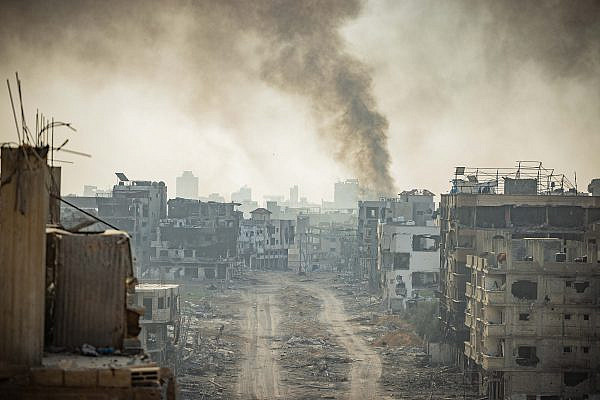
For more than 2 million Palestinians, many still living in tents, there has been no clean transition from a genocidal war to recovery. Daily life remains organized around displacement, finding food, and staying alive. This is a society still being dismantled, brick by brick, institution by institution, habit by habit — just more slowly, and with less of an audience.
And when I listen to what families in Gaza are asking for, food and water are only part of it. Increasingly, and in a lower voice, I hear another set of questions: Who is actually in control? Who can protect us if something happens? What if an armed group comes to the neighborhood? Who do we call if someone steals from us, threatens us, or takes advantage of us? When will there be a government we can actually turn to?

Safety has become its own separate, unanswered need — distinct from hunger and shelter — but it is tangled up with something larger. People are not only afraid of what might happen to them, but of having nowhere to turn to when it does. That’s because part of what is dismantling Gaza right now isn’t visible from a donor conference at all: the disappearance of governance and the collapse of any functional authority.
A governing vacuum
International discussions about Gaza increasingly revolve around who will administer the enclave after Hamas, based on the premise that the group must be removed from government and disarmed before reconstruction and a new political order can begin. In January, the National Committee for the Administration of Gaza (NCAG), overseen by U.S. President Donald Trump’s Board of Peace, was established to succeed Hamas and eventually usher in a Palestinian technocratic administration.
That process has largely bypassed the question of whether Hamas should govern Gaza, a political question that Palestinians themselves must ultimately decide. But another, more immediate question is: Who is governing Gaza now?
Hamas has not disappeared, but its capacity to govern has been severely weakened. In July, the Hamas-run government dissolved the Emergency Committee that had administered the enclave since October 2023, announcing that it would transfer its responsibilities to the NCAG. This was, formally, the condition that had long been demanded: that Hamas dissolve itself as Gaza’s governing party.
Hamas did that exactly. But Israel has prevented the new committee from entering Gaza. Rather than one authority replacing another, Palestinians have been left with neither.
The consequences are felt in the most mundane parts of life. Parents struggle to register newborns. Identity cards cannot reliably be renewed, while documents issued in Gaza may not be recognized elsewhere. Government employees can go months without salaries even as they remain nominally responsible for their workplaces. Civil registration, public services, official records, and other basic administrative functions have become fragmented or simply impossible to navigate.

Into that void has stepped armed groups, clans, and intermediaries whose power varies from one neighborhood to the next. Around the Yellow Line, reports have described abductions and armed raids by local gangs receiving Israeli support. Elsewhere, the Popular Forces — an armed faction Israel has acknowledged backing as part of its campaign against Hamas — has been accused of looting aid and attacking Palestinians suspected of ties to Hamas. Conflict-monitoring organizations and journalists have documented Israeli-backed groups carrying out detentions, abductions, and killings of civilians.
At the same time, older sources of violence — clan rivalries, personal vendettas, and accusations of collaboration — are resurfacing amid the breakdown of institutions that might once have contained them. On July 18, 28-year-old Qasam Youssef Al-Khawaja was found dead inside his art studio in the Abu Hasira area west of Gaza City. His family subsequently accused people they described as collaborators with Israel of killing him, although the circumstances of his death and the identity of those responsible remain unclear.
Gaza’s police announced an investigation. But what an investigation can mean under current conditions is itself uncertain. Police stations are barely functioning, forensic capacity has been devastated, officers have been repeatedly targeted in Israeli strikes, and there is no dependable chain of command through which families can seek answers. The announcement of an investigation may therefore offer little assurance that anyone will actually be held accountable.
The geography of these incidents helps explain what is happening. An abduction near the Yellow Line, violence in a displacement shelter, a killing in an art studio in western Gaza City: These do not suggest that a single organization has replaced Hamas, or that one criminal network has seized control. Instead, power has become dispersed and intensely local, exercised by different actors in different places without a dependable authority above them.
That power can manifest in seemingly ordinary encounters, too. Videos circulating online have shown armed men confronting civilians while distributing cigarettes and other scarce goods. These are intimidating and humiliating scenes, with civilians made to stand and wait before men carrying guns who determine who receives what.
In a place where so many ordinary systems of distribution and authority have collapsed, even handing out a cigarette becomes a way of demonstrating who holds power.
Who do you call when someone disappears?
These stories are not abstract to me. On July 16, I woke to a notification in our family WhatsApp group: Armed men had crossed the Yellow Line into Shuja’iya and gone to the home of my 66-year-old relative, Mamdouh Jamal Mushtaha. They entered his house and abducted him. He has not been heard from since.

Mushtaha, known by his kunya, Abu Mu’taz, had already lost his son, Mu’tasem, on Dec. 2, 2023, and endured long periods of displacement. In January 2026, he returned home and refused to leave again. His family urged him to move farther from the Yellow Line, but there was nowhere obvious to go. He was not a fighter. He was a 66-year-old man who wanted to remain in the home he knew.
I keep thinking about him. Where is he? Is he alive? Who took him, and what have they done to him? His family has spent the weeks since calling people, asking neighbors, following rumors, waiting for some message that might tell them where he is. But there is no obvious institution to contact, no reliable chain of responsibility that begins with reporting a disappearance and ends with someone at least being required to search for him.
I think, too, about my father, brothers, uncles, and cousins still in Gaza. For most of the war, the dangers I feared for them were already more than enough: bombing, displacement, hunger, being killed in a strike. I never used to wonder whether an armed gang might come to their door. Now I do.
That is what frightens me most about Abu Mu’taz’s abduction. It showed that danger no longer comes just from the Israeli military or from the privations of war. You can no longer tell who is a neighbor and who is a threat.
This is one consequence of prolonged institutional collapse. It reshapes the society underneath the crisis, changing not only who exercises power but how people protect themselves when formal systems fail. I’m wary of describing this simply as “rising crime,” because crime presumes some functioning distinction between the rule-breaker and the authority charged with enforcing the rules. In Gaza today, those lines have become increasingly difficult to draw.
None of this means that Palestinians have stopped looking after one another or distinguishing right from wrong. Neighbors share food they can barely spare. Doctors continue treating patients without knowing whether they will be paid. Volunteers move aid for strangers. These relationships have kept people alive through nearly three years of war. But solidarity cannot issue an identity card, investigate a disappearance, or compel someone to answer for a killing.

And the Israeli violence that helped produce this collapse has not ended. Even as Palestinians contend with abductions and armed groups, Israel continues to bomb and kill people across Gaza.
According to the Palestinian Health Ministry, 1,254 Palestinians have been killed and 4,121 wounded by Israeli fire since the ceasefire was announced in October 2025. At dawn on July 30, an Israeli airstrike hit Al-Shati refugee camp in northern Gaza, destroying the tents and shelters of 35 families and forcing them back into the agony of displacement again.
In the same hours, another Israeli attack struck a displacement tent in Al-Mawasi, near Khan Younis, and a residential apartment in the Bureij refugee camp was also hit. Two people were killed, including a child, and 10 others were wounded.
In 2023, attacks like these might have led international news coverage. Now they register, if at all, as another line in Gaza’s daily casualty count — a level of violence the world has grown accustomed to that the people living through it never could.
The fiction of the ‘day after’
Calling Gaza “post-war” does much more than describe a supposed stage in the conflict. It changes the questions being asked. Instead of how to stop the killing, the conversation turns to who will administer aid, who will govern Gaza, how much reconstruction will cost, and who will pay for it.
Those questions matter; Gaza will need to be rebuilt. But the danger is that reconstruction becomes a way of discussing Gaza without having to confront why Palestinians still cannot live there safely.
The fiction of a “day after” is useful to nearly everyone involved in designing it. The Board of Peace acquires a purpose and future to plan from outside Gaza. The Palestinian Authority (PA) can present itself as the eventual Palestinian alternative without reckoning with its nearly two-decade absence from Gaza, or its failures in the West Bank.

Hamas, meanwhile, can point to the formal end of its administrative role and to the agreement it recently signed, committing in principle to disarm and surrender its weapons to the NCAG. Trump called it “a monumental step toward peace and security.” But Hamas negotiators immediately qualified their commitment: They would not implement their side unless Israel fulfilled its own obligations to withdraw.
Israel did not publicly sign the agreement at all. Within days of its announcement, the Board’s own envoy was in Jerusalem pressing Netanyahu simply to halt Israeli strikes. Israel has since persuaded the Board to change the terms, demanding that Hamas fully decommission its weapons before Israeli forces withdraw.
The agreement therefore formalizes a process that has not materialized on the ground. The likely path from here is neither collapse nor full implementation, but a rolling one: an agreement that stays formally intact while being worn down through delay, reinterpretation, and mutual accusations of non-compliance, with time becoming one more thing to fight over.
It is also worth being honest about what “disarmament” actually means after nearly three years of war. Israel has dismantled much of Hamas’ battalion structure and killed commander after commander, while a siege in place since 2007 has tightly controlled what enters Gaza. What remains is small arms — weapons that have not prevented Israel from entering Gaza, nor protected Palestinians from the armed gangs operating there.
Placing those weapons under civilian authority would still be consequential, but the questions remain open: Who will collect them, by what authority, and how will fighters on the ground respond to a new administration created under American sponsorship?
The agreement largely codifies a military reality Israel had already imposed. Hamas is being required to relinquish what remains of its armed capacity before Israel relinquishes its far greater power over Gaza. Disarmament is being demanded of the side already ground down militarily. Withdrawal and an end to the bombing are demanded of the side that retains overwhelming control over whether either happens.

That is why Gaza’s future is easier to discuss than its present. The present stubbornly leads back to the most difficult questions of responsibility, including Israel’s continuing control over key aspects of Gaza’s territory and movement.
Entrenching the Gaza-West Bank divide
For Palestinians, reconstruction cannot begin with a new organizational chart. Appointing an authority to oversee a hospital does not rebuild it. Equipment still has to enter Gaza; doctors have to be alive, paid, and able to reach work; patients have to reach them. A school needs teachers, students, and a functioning neighborhood around it.
Government works much the same way. Rather than any logo or list of ministries, what matters is whether someone can register a birth, issue an identity document, pay a teacher, keep water running, supply a hospital, clear rubbish, or protect a person who reports a crime.
Gaza has experienced the gap between a political handover and an actual transfer of power before. In October 2017, Hamas dissolved its administrative committee in Gaza and agreed, under a Cairo-brokered reconciliation deal, to transfer full civil control to the PA by December.
The handover never happened. Within weeks, Hamas and Fatah were publicly accusing each other of failing to honor the agreement. The deadline was postponed and eventually abandoned. By early 2018, negotiations had floundered on questions that remain unresolved today: Hamas refused to disarm any of its factions, and PA President and Fatah chairman Mahmoud Abbas refused to accept anything short of full PA control over Gaza’s security.
The PA never meaningfully assumed control of Gaza’s ministries, security apparatus, or crossings in any meaningful sense. Hamas continued governing in practice while the agreement said that authority was transferred elsewhere. That may be a more useful precedent for 2026 than the orderly transition envisioned by the Board of Peace, since the current transfer to the NCAG risks the same fate.

Even if the current handover succeeds where the 2017 agreement failed, however, it presents a different problem. The NCAG is not simply replacing Hamas’ administration. It also creates an alternative center of Palestinian governance outside the PA.
Under the Board of Peace’s own plan, the PA can return to Gaza only once it has “satisfactorily completed its reform program” — a threshold nobody has defined and no one is bound to ever certify as met. Trump and Netanyahu have both said the PA will have no role in governing Gaza until “it completes a reform program,” while Israel’s government has repeatedly rejected a significant PA role in Gaza “in any way.” In practice, the Board is stripping away what little standing the PA had left to govern there, while the PA itself remains too weak — institutionally and politically — to assert its own claim to the territory in the meantime.
Backed by Washington and answerable to it, the Board lacks any democratic mandate from Palestinians. It is chaired indefinitely by Donald Trump, who holds the power to select his own successor. Yet the Board is being given enormous influence over Gaza’s future: what reconstruction will look like, who speaks for Gazans, and increasingly, where its borders with the rest of Palestinian political life actually sit.
Embedded in the same process is a broader political consequence. Gaza is being treated as a discrete territory whose institutions and political future can be redesigned separately from those of the West Bank. The more Gaza becomes a self-contained technocratic project governed through an externally sponsored body with no institutional relationship to Ramallah, the more the prospect of a single Palestinian polity recedes further still — the very outcome that both Washington and Israel’s current government seek.