


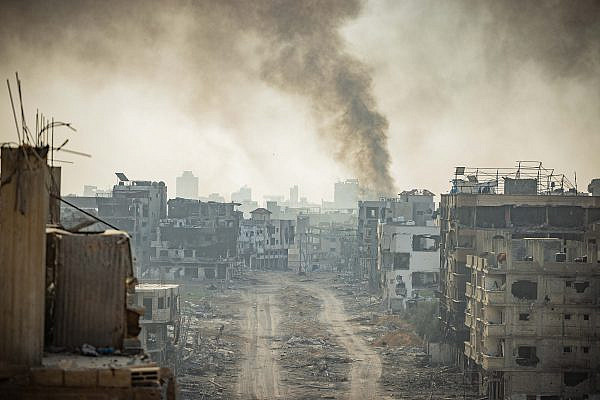
At the end of a makeshift red carpet laid down between destroyed buildings in central Gaza’s Deir Al-Balah, a few dozen Palestinians sat in front of a large TV screen. A hush fell as the film began, with attendees shifting between somber focus and audible sobbing as they watched their experiences of the past two years reflected back to them over the next hour and a half. The film was “The Voice of Hind Rajab,” and the screening marked the opening of the inaugural Gaza International Festival for Women’s Cinema.
“I cried while watching the film,” Nihal Hasanein, one of the attendees, told +972 Magazine after the screening on Oct. 26. Earlier this year, she lost three of her sons in an Israeli airstrike on her home in Beit Lahiya; now, she’s living in Deir Al-Balah’s Al-Jazaeri camp, where the film was screened. “It brought back memories of losing my children all at once, along with my home,” Hasanein said.
Directed by Tunisian filmmaker Kaouther Ben Hania, “The Voice of Hind Rajab” reconstructs the murder of 5-year old Hind Rajab and six of her family members by Israeli soldiers as they attempted to flee Gaza City by car in January 2024. Premiering at the Venice Film Festival in September, it received the Grand Jury Prize as well as a 23-minute standing ovation from the audience. It has subsequently won several other prestigious awards, making it one of the most acclaimed Arab works of the year. The screening just south of Rajab’s home city in Gaza was the first in the Arab world.
The Gaza International Festival for Women’s Cinema was launched by Palestinian filmmaker and researcher Ezzaldeen Shalh, former president of the International Union of Arab Cinema, in collaboration with the Palestinian Culture Ministry and local and international film institutions. According to him, the festival aims to showcase films produced, directed, or written by women — particularly in Palestine, but also across the Arab and wider world — and that address women’s issues.
The inaugural edition, organized under the slogan “Legendary women during genocide,” sought to shed light on the suffering of Palestinian women over the past two years and to re-establish Gaza’s cultural life. “There was a need for an artistic platform that represents Palestinian women and enables them to tell their stories to the world through their own lens,” Shalh said.

Over the course of six days from Oct. 26 — which marks National Palestinian Women’s Day, and the anniversary of the first Palestinian Women’s Conference in 1929 — to Oct. 31, the festival featured nearly 80 films from over two dozen countries spanning the Middle East and North Africa, Europe, and the Americas. The screenings attracted over 500 attendees, numbers that pale in comparison to pre-war figures when over 2,000 people per day would flock to similar cultural festivals in Gaza.
Alongside Ben Hania, the inaugural festival honored two other women whose work has served the Palestinian popular struggle: Palestinian filmmaker Khadijeh Habashneh and the late Lebanese filmmaker Jocelyne Saab. The jury included prominent filmmakers like Annemarie Jacir, director Céline Sciamma, and actress Jasmine Trinca.
Yusri Darwish, head of the General Union of Cultural Centers in Palestine, celebrated the festival as “a new affirmation that Gaza loves life despite the genocide, and that it can turn rubble into a screen and sadness into a message of hope.”
Darwish noted that holding the festival at this time is “a tribute to the Palestinian women who have endured the horrors of war — from loss and detention to displacement — and who deserve to have their stories told to the world with honesty and justice.”
Overcoming obstacles
According to Shalh, the biggest challenge to putting on the festival was finding a venue, since “all such venues in Gaza had been destroyed.” The team had to erect temporary tents against a backdrop of partially collapsed buildings; without electricity, they relied on a generator to screen the films. “Communication with directors and the jury was difficult,” he added.
Conditions in Gaza made attendance impossible for those who would have to travel longer distances. Niveen Abu Shammala, a journalist who lived in the Shuja’iya neighborhood in eastern Gaza City before the war but is now displaced in a tent in the west of the city, used to report on cultural events, especially film festivals, across the Strip. However, the high cost of transportation, in addition to the late hour — the festival opened after 3:30 p.m — meant that she could not attend this one.

“Even though the war has stopped, there is still fear of moving around at night,” she explained. “I would have liked to watch the participating films, since it is difficult to download them with the extremely weak internet.”
Nelly Al-Masri was able to attend, watching all three films screened on the second day of the festival which was held at the headquarters of the Journalists Syndicate. She was especially moved by the Jordanian short film “Hind Under Siege,” which is also about Hind Rajab. “This film affected me deeply,” Al-Masri told +972. “It spoke in the name of the children of Gaza, not only in the name of Hind.”
Al-Masri had hoped to attend more of the festival, but transportation costs, the ongoing difficulty of obtaining sufficient food and clean water, and caring for her children made that impossible. “Many women are going through the same thing,” she said. “We hope conditions in Gaza will improve.”
Ten-year-old Hamsa Mahmoud didn’t know about the festival beforehand, but she ended up attending several screenings after noticing crowds gathering around the tents close to where she lives. “This is the first time I’ve attended a festival,” she explained. “I felt happy to be here — and even happier to have the chance to watch something on a screen. Since the start of the war and the power cuts, we haven’t been able to watch anything. I wish there could be more festivals like this.”
Most read on +972
Another attendee, community activist Faten Harb, sees film as an important medium to reinforce the steadfastness of Palestinian women in Gaza. “Art is a noble message and the easiest and simplest way to reach the world without saying too much,” she said.
“The world has grown tired of hearing news of killing, destruction, and the wounded,” Harb continued. “That’s why we must look for other ways to convey the suffering of the people of Gaza. We urgently need these kinds of events to shed light on what happened in the Gaza Strip during the genocidal war — especially for women, who were hit the hardest.”