In partnership with

For nearly two weeks, a Palestinian student at Hebrew University has been languishing in an Israeli prison cell as the state seeks court approval to detain him for six months without charge or trial.
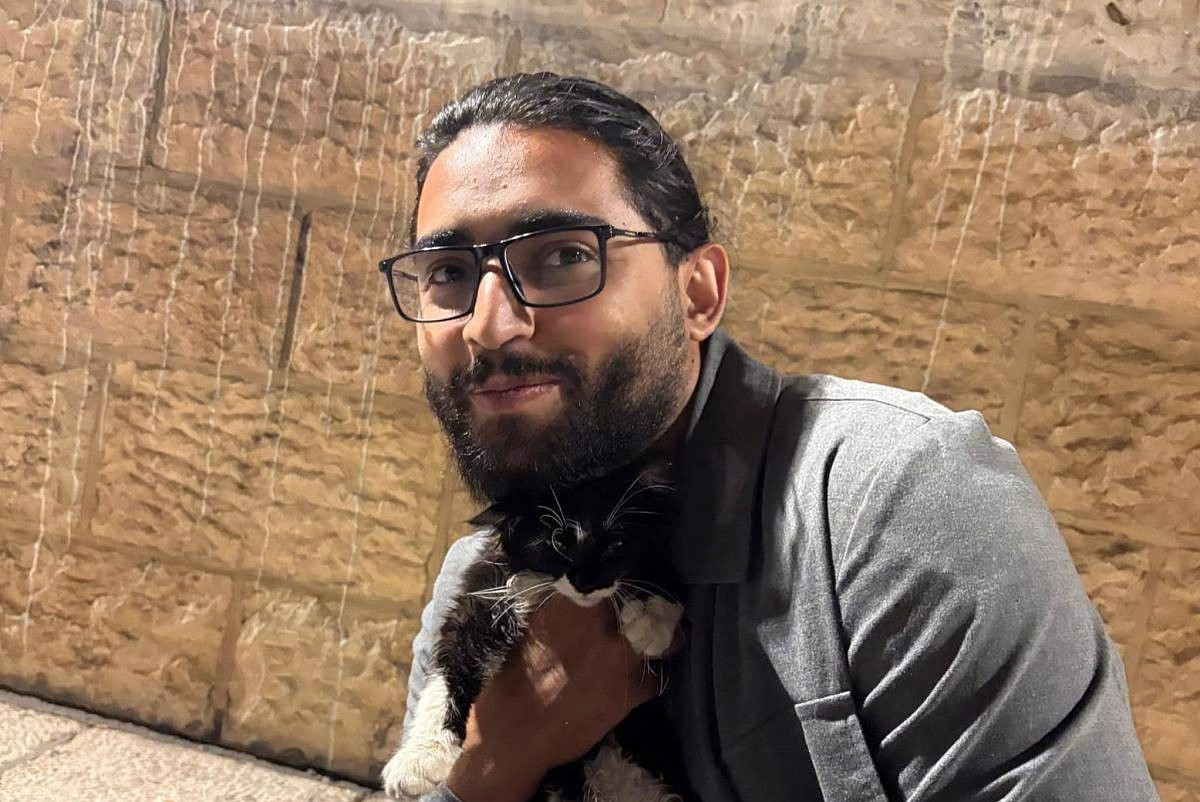
Mahdi Tunsi, a 26-year-old sociology and criminology student from the East Jerusalem neighborhood of Silwan, was arrested on the morning of Nov. 8 at his dormitory on Mount Scopus. His family and friends only discovered he had been detained the following evening, when they contacted the police to report him missing.
The authorities have accused Tunsi of “conspiracy to commit a terrorist act,” without providing any evidence. According to his attorney, Nasser Odeh, the investigation has focused on his political activism on campus and his involvement with the Jewish-Arab movement Standing Together, as well as the anti-occupation NGO Ir Amim.
“They asked him where he spends his time, what he does, what he thinks, and what his activities are,” Odeh explained, based on the investigation materials he received.
Odeh claims the arrest at the dormitory on university grounds went beyond the scope of the court-authorized arrest warrant against Tunsi. “The warrant authorized an arrest at his home, [but] the court didn’t know he was a student,” Odeh told +972, The police, for its part, stated that the investigation was conducted in cooperation with the Shin Bet — Israel’s internal intelligence service — and that the arrest was carried out in accordance with the law.
The police investigation had effectively concluded earlier this week, and Tunsi was supposed to be released. Instead, however, the police brought in the Shin Bet, which requested that Tunsi be held in administrative detention — a form of incarceration that can be extended indefinitely, without the authorities needing to publicize any evidence — for six months, as there was no basis for continuing his detention within the framework of criminal proceedings.
Tunsi was transferred to Megiddo Prison, where the Israeli prison authorities have allowed skin diseases to run rampant since October 7. Odeh also noted the difficulty of bringing personal belongings and supplies into the prison. “Given the conditions under which security prisoners have been held in recent years, anyone who enters prison without their personal belongings may remain there without them.”
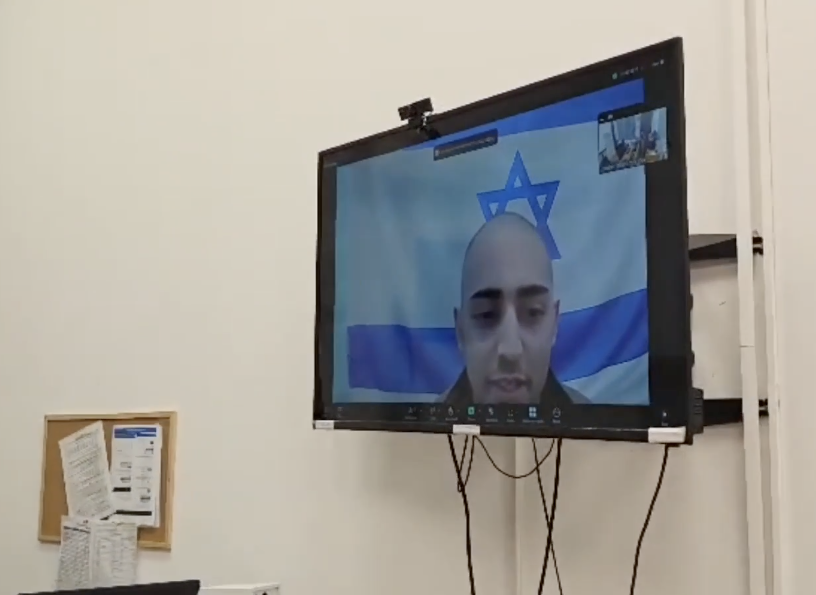
Yesterday, a Jerusalem court held a closed-door hearing to consider the state’s request to place Tunsi in administrative detention. But no representative from the Shin Bet appeared to present its classified material, and the judge declined to rule on the state’s request.
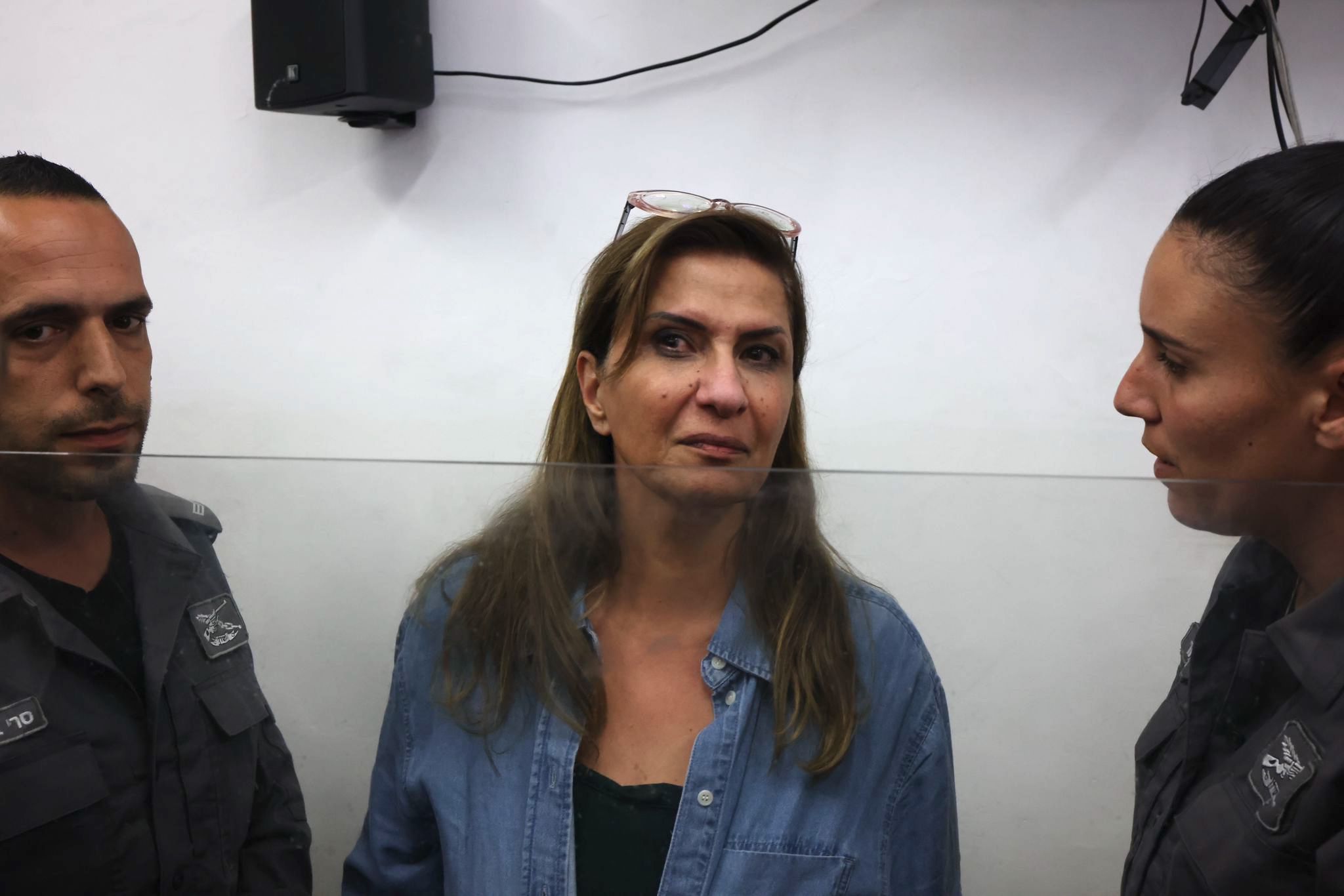
Tunsi appeared at the hearing via video conferencing, with his head and beard shaven and his glasses missing. He will remain in custody at least until Tuesday, when a follow-up hearing is scheduled.
‘How did the university allow this to happen?’
According to Odeh, Hebrew University officials initially said they were unaware of Tunsi’s arrest. But Odeh learned from the police that the arrest had been coordinated with and approved by the university.
Later, however, the university changed its story. Officials said they had been notified minutes before the police arrested Tunsi, and that the police neither requested nor required the university’s approval for the arrest.
The university stated that its security personnel were not present during the arrest, and that the police later informed the university by phone that nothing unusual had occurred. This account does not align with Tunsi’s version: He told his attorney that the police beat him in the dorms, in the patrol car, and at the station, and he appeared at the detention-extension hearing with visible bruises on his face.
The police claimed that Tunsi resisted arrest and fell out of the patrol car — but according to the dormitory security officer, Tunsi left quietly and did not resist.
While the police have previously arrested students on Hebrew University’s campus and in the dorms, Odeh believes it is necessary to establish what university officials knew and what action they took after the arrest. He argued that the police should have notified Tunsi’s family, and that the university should also have ensured that they were informed. “How did the university allow this to happen?” he asked.
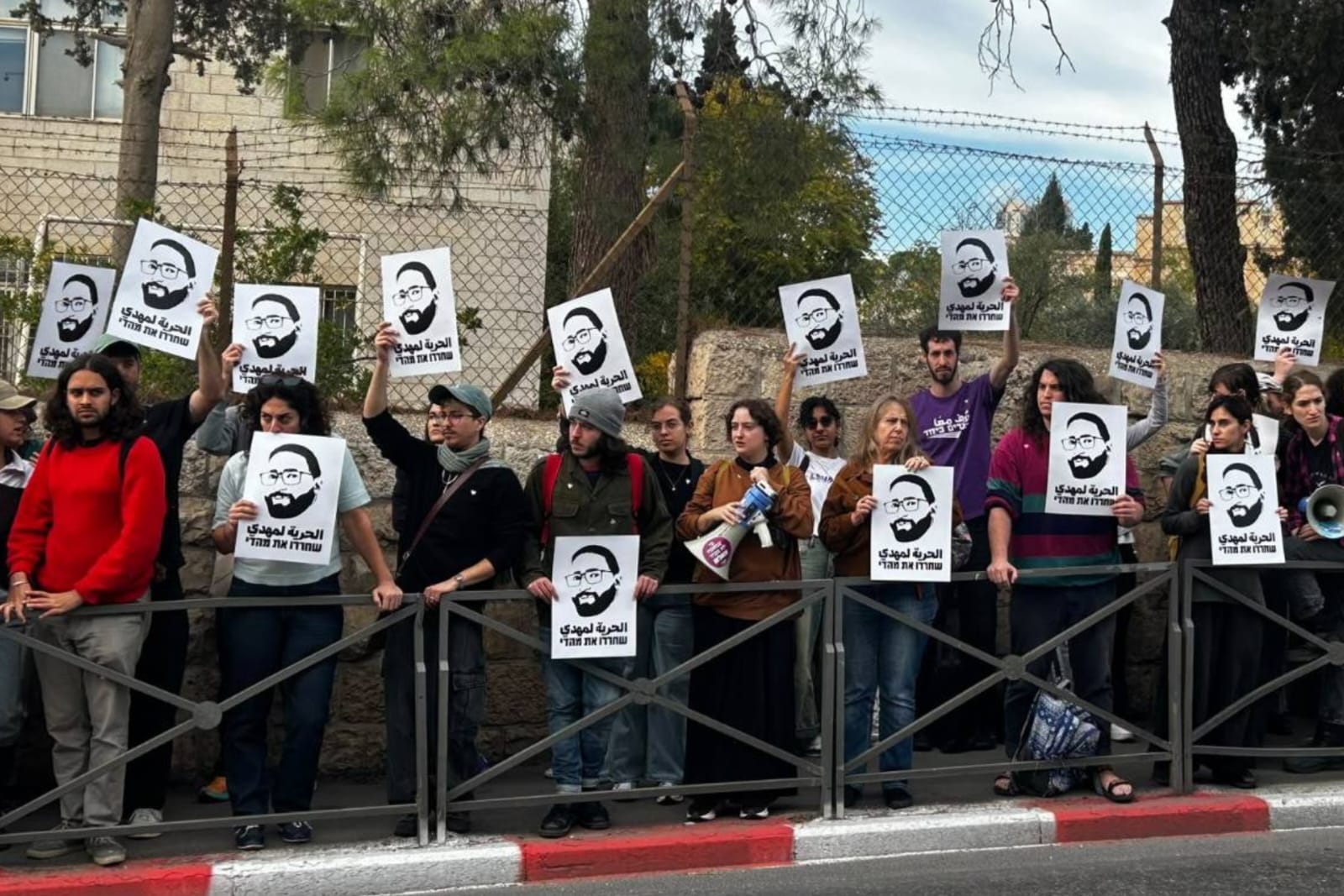
“His friends were looking for him, and no one knew where he was,” Muhammad Tunsi, Mahdi’s brother, recalled. “The family didn’t immediately realize he was missing, because when he has consecutive days of classes, he stays overnight in the dorms.” When Mahdi’s friends contacted the police, they were told that only a family member could receive information, so they called Muhammad.
In other words, even though the university knew about the arrest in real time, Tunsi’s family only found out about it a day later.
Standing Together demanded that the university explain its role in the arrest and work with the police and the Shin Bet to secure Tunsi’s release. “The Shin Bet’s witch hunt against the Arab population in Israel continues,” the movement stated, alluding to the arrests of Palestinian political activists in the aftermath of the Israeli election. “Administrative detention is an undemocratic and inhumane tool. We strongly oppose the forced disappearance of people and their interrogation in basements without basic rights.”
Likewise, the student branches of the Hadash and Balad parties at the Hebrew University condemned the arrest and demanded that the administration take a stand and protect his rights. “Mahdi is one of us,” their joint statement read. “We must not grow accustomed to the absence of our friends, or read about their arrests and continue with our daily routines as if nothing happened.”
Eden Soussana, who serves as the chairman of the Hadash student movement in Jerusalem, has known Tunsi since they met two years ago at a political event at the university, and the pair were roommates for a short period before Tunsi moved into the dorms. He told +972 that the university’s conduct was “despicable.”
“First, it absolved itself of all responsibility. Second, it has ostensibly adopted the police’s version of the events. Third, it has exonerated the police: The officers themselves say they beat him and used ‘reasonable force’ against him, while the university’s security officer and the university state in their response that everything proceeded ‘without incident.’”
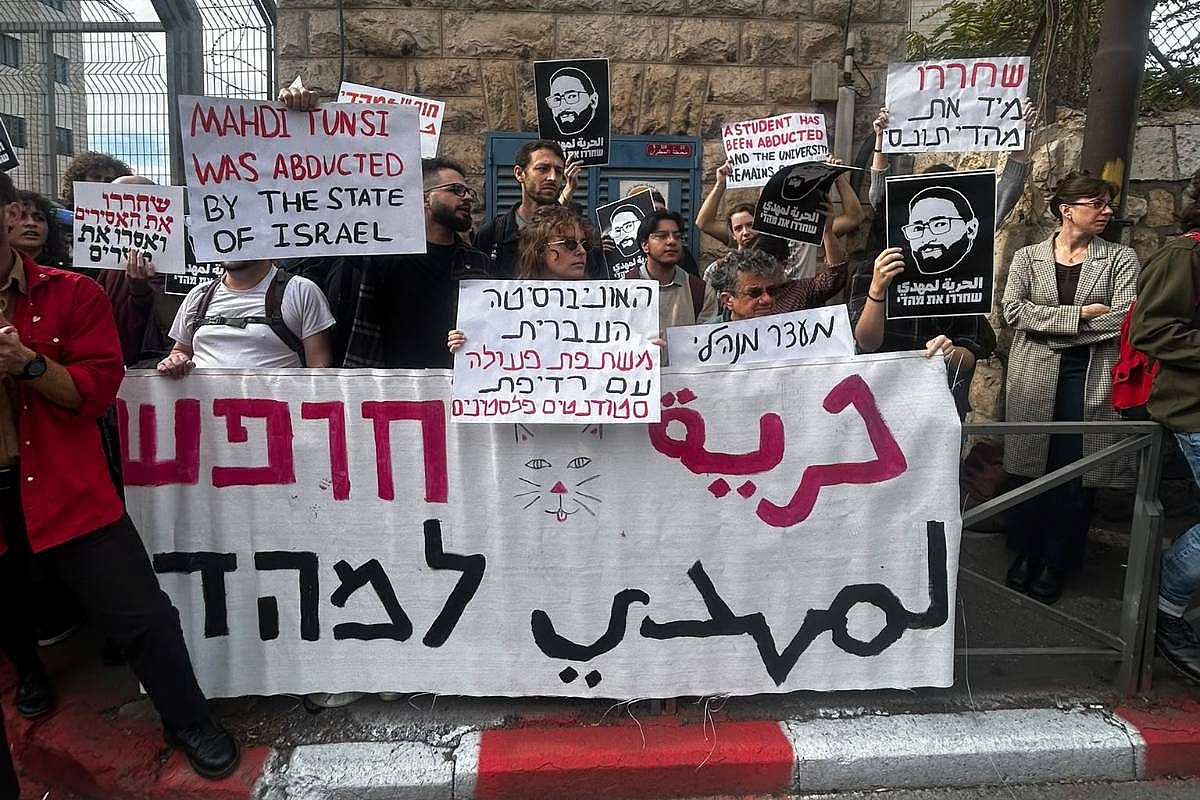
Even if the university couldn’t prevent the arrest, Soussana believes it could have refused to let them into the dorms. He also described the failure of university security guards to accompany Tunsi during the arrest as a “violation of the university’s regulations.”
And its secrecy in the days after Tunsi’s disappearance only made matters worse. “We spent five days not knowing where our friend was, and we spent another three days investigating to figure out where he was and find him a good lawyer,” Soussana explained. “They simply hid it.
“In their letter, they say they’re in contact with the family, but it’s a blatant lie. We’re in touch with the family, and I can assure you that no one in the family received a phone call or text message from the university.”
For its part, Hebrew University stated that it is not a party to the proceedings and has no information regarding the circumstances of the case. They also stated that it is concerned for Tunsi’s well-being, is in contact with his family, and hopes that his case will be resolved quickly while his rights are upheld.
Close ties with the Shin Bet
The university’s prolonged silence about the case — broken only 10 days after the arrest — and the laconic, disingenuous language of its message are not coincidental. Hebrew University and other academic institutions in Israel have an enduring relationship with the Shin Bet and other state military entities, alongside a record of policing and punishing community members who express dissent.
Until 2016, the Shin Bet demanded that Israeli universities provide it with lists of all their graduates, including their ID numbers and contact details, allegedly so that the organization could try to recruit them. The universities complied willingly. It was only after the Association for Civil Rights in Israel appealed to the legal advisor of the Shin Bet that this practice was discontinued.
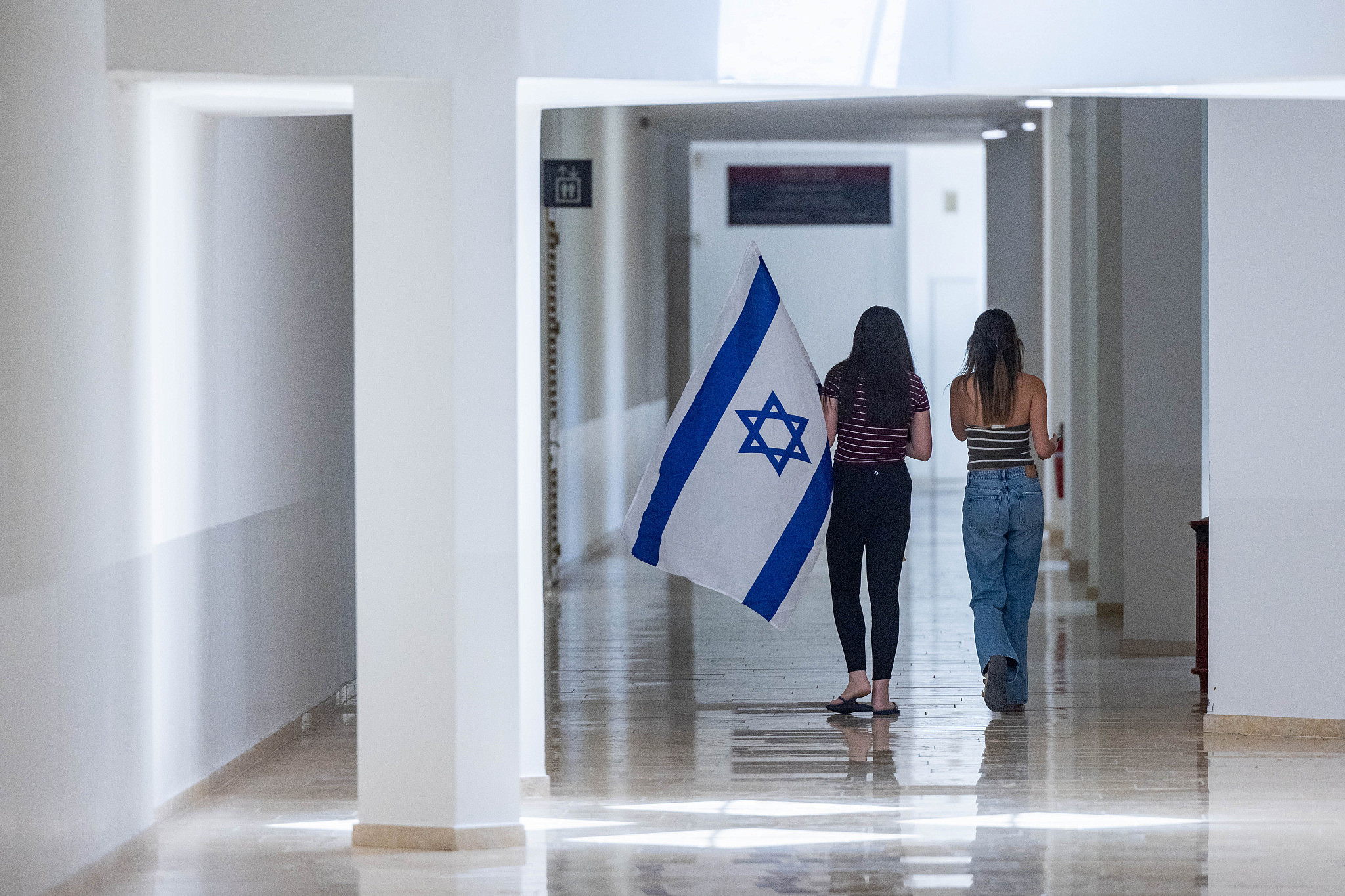
But this has not weakened the Hebrew University’s close ties with the service: Just recently, it acknowledged that between 2019 and 2022, it had research ties with the Shin Bet amounting to more than NIS 600,000 ($180,000). The university did not provide additional information about the nature of this cooperation.
Even though graduates’ details are no longer shared automatically with the Shin Bet, its representatives still show up at university career fairs to recruit students. The Shin Bet even appears on the university’s career center website, which promotes an on-campus spotlight event for the service, urging students to join its ranks to “make a change” and combat “terrorism, espionage, subversion, and the disclosure of state secrets.”
And these collaborations are no exception: Hebrew University maintains extensive connections with Israel’s whole defense establishment. For example, the Hebrew University (alongside Ben-Gurion University) leads in the scope of its cooperation with the Defense Ministry, with agreements worth approximately NIS 80 million ($24 million) between 2019 and 2022 to provide academic programs for reservists, active-duty soldiers, and other military personnel. Among these are programs that prepare participants for military roles, particularly in weapons development and intelligence.
Given the depth of these connections, it is no surprise that Hebrew University failed to prevent Tunsi’s arrest. Nor is this the first time the university has neglected its duty to protect members of its community — or worse, punished them — for political reasons.
In March 2024, the Hebrew University suspended Professor Nadera Shalhoub-Kevorkian without due process, after she signed a ceasefire petition and made remarks about Hamas’ October 7 attack during a podcast interview. At the same time, faculty who openly supported Israel’s military operations in Gaza were not disciplined.
A letter sent to Shalhoub-Kevorkian, a renowned Palestinian legal scholar, at the end of October 2023 by the dean of the Law School and the rector accused her of conduct “not very far from crimes of incitement and sedition.” The dean and rector added that the university felt “shame” at having “a faculty member like [her],” urging her “to consider leaving [her] position.”
The university reversed Shalhoub-Kevorkian’s suspension later that month, only for her to be arrested and interrogated by the Israeli police in April. She left the university several months later.
Similarly, in January 2019, Dr. Carola Hilfrich, a senior lecturer in Comparative Literature and Cultural Studies, was caught on camera telling a student in uniform that she “cannot be naive and ask to be treated as a civilian when you choose to wear a uniform.” (It was later discovered that the soldier was a longstanding member of the far-right organization Im Tirtzu.)
Following the incident — which was widely covered in the Israeli media — the National Union of Israeli Students published a statement condemning Hilfrich. The Hebrew University backed the soldier and told the media that it “respects all its students, including those who come to study during their military service, whether they are active-duty, career, or reserve soldiers.”
Hilfrich received dozens of hate letters, and the university even received explicit death threats against her, but chose not to defend her publicly. Instead, it published a massive advertisement in Haaretz: “Students in uniform? Welcome! The Hebrew University and the Student Union warmly support all students who are soldiers studying at the university during their compulsory service, reserve duty, or in the special programs jointly run by the university, the IDF, and other security bodies in the State of Israel.”
‘This is what scares the regime’
Not all Israeli academic bodies have remained silent since Tunsi’s arrest. The Israeli Sociological Association condemned the request to place him in administrative detention and demanded that university officials publicly oppose it.
Separately, a group of sociology and anthropology lecturers at the Hebrew University who had taught Tunsi wrote that they know him as “a curious, engaged student committed to his studies.” They expressed concern that he would be held in administrative detention without trial and added that they “fear that his detention is politically motivated, in part due to his public and social activism.”
One of those lecturers was Yael Berda, an associate professor in Hebrew University’s Department of Sociology and Anthropology, as well as a member of Academia for Equality and co-chair of the executive committee of A Land for All.
“I know [Tunsi] very well — he took four courses with me, and I also know him from his social activism both in East Jerusalem and Jewish-Arab partnerships,” Berda told +972. “I think the risk that Palestinian social activists are willing to take despite the repression is what scares the regime the most.”
Most read on +972

She described Tunsi’s arrest as part of the state’s “incitement campaign” against Palestinians since Israel’s election, which includes making false and baseless accusations.
“From what we understand, they initially issued him a criminal arrest warrant and then converted it to administrative detention,” she said. “If there is evidence, then why isn’t the arrest criminal, and why is it being reclassified as administrative detention? This is the most drastic measure possible: detention without evidence. You don’t know what you’re accused of, and you can’t defend yourself.”
For Berda, Hebrew University’s claim that it is uninvolved in Tunsi’s case reflects the fact that the university leadership does not want to undermine its relationship with the security establishment — a relationship which, she argued, “is treated as self-evident, just as it is in large segments of Israeli society.”
But she takes solace in the response of other faculty, staff, and students at the university. “Many people at the university are now mobilizing, signing petitions, and expressing support for Mahdi — including people who are not necessarily on the political left,” she noted. “It is not enough, but it is an important process. For some, this is the first time they have seen up close how the security system can cast a shadow of suspicion over someone without any evidence being presented.”
A version of this article was first published in Hebrew on Local Call. Read it here.