
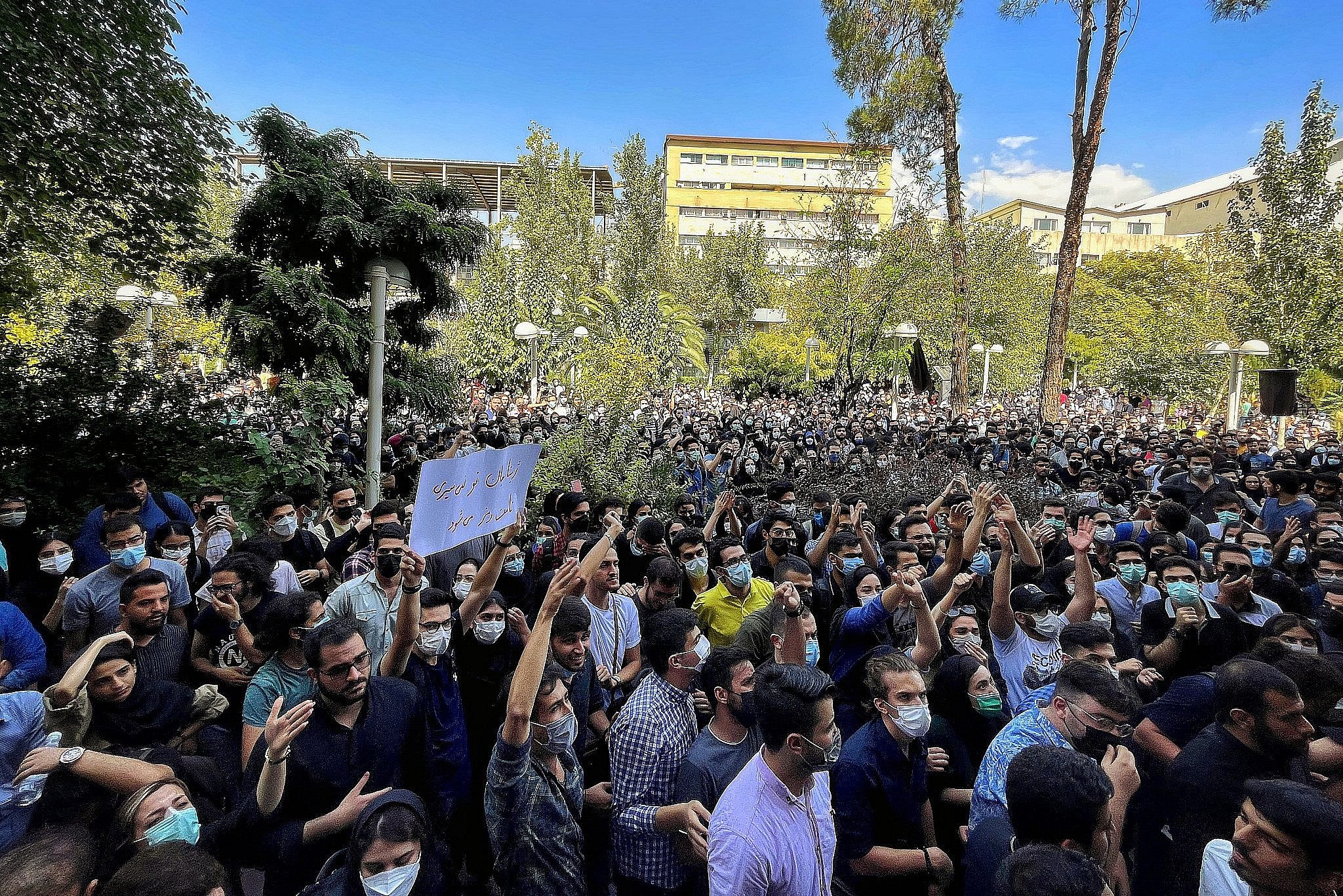
On Dec. 28, anti-regime protests erupted in multiple Iranian cities, spreading across the Islamic Republic within days to become the most significant wave of unrest since the “Woman, Life, Freedom” uprising of 2022. Unlike previous protest cycles, no single issue has predominated. Demonstrators have chanted against water shortages, currency collapse, government corruption, and the regime’s regional military adventures with equal fury.
The simultaneity and geographic proliferation of the protests — reaching over 100 cities and towns — is especially revealing. These have not been coordinated actions by an organized opposition, but rather the spontaneous combustion of a society reaching its breaking point. From the impoverished outskirts of Tehran to middle-class neighborhoods of Shiraz, from Kurdish cities in the west to Baluch areas in the southeast, Iranians have taken to the streets to demand accountability from a regime that can no longer provide even basic services like a reliable water supply.
That another protest wave would engulf Iran came as little surprise. Over the past decade, the country’s deteriorating economic conditions have repeatedly fueled nationwide unrest. Near-hyperinflation, currently estimated between 42 to 48 percent annually, and the effective collapse of the national currency have devastated living standards.
The rial’s value has plummeted from roughly 40,000 to the dollar in early 2018, before the implementation of the Trump administration’s “maximum pressure” sanctions campaign, to an estimated real exchange rate today of nearly 1.5 million rials to the dollar. This economic freefall has coincided with the growing visibility — and increasingly ruinous consequences — of state corruption.
What distinguishes the current wave of protests, however, is not only what protesters are demanding, but the regime’s dwindling ability to defuse it. One of the Islamic Republic’s longstanding strategies has been to absorb unrest through a combination of repression and concession: allowing protests to simmer before violently suppressing them, while simultaneously offering material concessions.
The nationwide protests of 2017-18 and 2019, for example, sparked by worsening economic conditions, were met with brutal crackdowns, but also yielded modest concessions in the form of fuel and food subsidies, budgetary adjustments, and modified economic policies. Similarly, following the 2022 uprising, the state effectively stopped enforcement of the mandatory hijab in an attempt to sap the movement’s momentum.
Since the 2022 uprising subsided, Iran has faced multiple political, economic, social, and geopolitical shocks. These included the sudden deaths of President Ebrahim Raisi and other senior officials in a helicopter crash; the election of a reformist president for the first time since 2005; the reimposition of UN sanctions in September 2025; the effective collapse of the regime’s entire regional power structure, from Hezbollah in Lebanon to the Assad regime in Syria; and Iran’s first direct military confrontation with Israel in 2024.
Most consequentially, the 12-day war in June 2025 shattered a core pillar of the regime’s self-image. Despite years of tough rhetoric, the conflict proved to many Iranians that the country was effectively defenseless against Israel — that Israeli aircraft could bomb Tehran and other cities with impunity and terrorize the population, while facing no meaningful resistance from Iran’s military. While the war temporarily fostered a sense of national solidarity between the regime and those who would otherwise be its critics, this reconciliation did not last long.
As of this writing, clashes in Tehran are intensifying and demonstrations continue to spread, with at least 45 protesters killed and over 2,000 arrested. The Iranian regime has held onto power for over four decades by offering tactical concessions when necessary, but also not hesitating to deploy brutal force. This protest wave challenges that survival strategy in a new way. If earlier uprisings could be contained through specific concessions, now the demand is accountability itself. And when accumulated failures have eroded even the state’s capacity to provide water, no tactical concession can suffice.
Reaching breaking point
In early December 2025, Iran’s long-predicted water crisis reached catastrophic proportions. The Zayandehrud river in Isfahan, once the lifeline of the region’s agriculture, had been dry for months. In Khuzestan, residents reported receiving piped water only two days a week. In Tehran’s working-class southern districts, families awoke to completely dry taps, forcing them to buy overpriced bottled water or queue for hours at municipal water trucks.
Climate change has played a significant role in this crisis: Deforestation and desertification have accelerated dramatically, and with increasingly dry winters, snowpack in the Zagros and Alborz mountains — the source of much of Iran’s freshwater — has declined precipitously.
Yet the water crisis is also the outcome of political decisions, the culmination of decades of mismanagement. The regime has prioritized water-intensive agricultural projects and industrial development in water-scarce regions for political patronage purposes, ignored warnings from environmental scientists, and failed to invest in conservation or fix dilapidated water infrastructure — where an estimated 20-30 percent of water is lost to leaks before reaching consumers.
In particular, the Islamic Revolutionary Guard Corps (IRGC), which controls vast economic interests including construction and agriculture, has been implicated in illegal dam construction and water diversion projects that serve its business interests while devastating local communities.
For many Iranians, water scarcity has become the most tangible proof that the system is not merely corrupt or misguided, but fundamentally incapable of governing. Iran sits on substantial water resources, yet mismanagement has created artificial scarcity. This realization — that their suffering is not inevitable, but the direct result of political choices by the regime — has mobilized those who once still hoped for gradual reform.
One of the central fault lines of the current moment is the question of nuclear negotiations with the West and the prospect of sanctions relief. President Masoud Pezeshkian, who has urged the political establishment to listen to protesters and respond to their demands, was elected in part to pursue such an opening with Western powers. Yet after four decades of sanctions, the Iranian economy has developed mechanisms that have allowed it to function, giving rise to new moneyed elites while eroding the traditional middle classes — elites that may resist any agreement precisely because it disrupts a status quo that is beneficial to them.

The growing realization by many Iranians that, because of the hardliners in Tehran and the impossibility of trusting Donald Trump’s intentions, no agreement is on the horizon, may account for a sense of hopelessness that fueled this wave of protests.
It is against these backdrops that the upsurge in demonstrations must be read. They cut across age groups, classes, ethnicities, and sectors. The grievances are multiple: civil liberties, economic policy, currency devaluation, water shortages, crumbling infrastructure, and the loss of any credible path back to normal life. Yet they all point to a single underlying demand: accountability.
Here lies both the challenge and the opportunity facing Iran’s opposition movement. Previous protest waves articulated narrower, more tangible demands — subsidies, wages, policy adjustments — to which the regime could respond with limited concessions. Accountability, by contrast, is not something that can be bargained over. What concession can a system offer when its legitimacy itself is in question?
The external factor
Israel and the United States loom large in Iranian protesters’ calculations, though not in the ways many Western observers assume.
While Israeli officials have made little secret of their desire for regime change in Iran, and despite Benjamin Netanyahu’s recent bellicose statements, concrete evidence of an imminent military attack is limited. The 12-day war in June demonstrated Israel’s overwhelming military superiority, but counterintuitively, Netanyahu’s most critical achievement in that conflict may lie in the fact that Iran’s nuclear capabilities were not destroyed. The continued existence of a looming Iranian threat is key to the prime minister’s own political survival.
Meanwhile, in Washington, President Trump has publicly threatened intervention should Iranian security forces escalate repression and kill protesters. The administration’s abduction of Venezuelan President Nicolas Maduro and his wife certainly lends credibility to Trump’s threats, but it has also activated deep-seated Iranian anxieties about foreign intervention.
Israeli or American military action while Iranians are taking to the streets would almost certainly benefit the regime by allowing it to frame domestic grievances as foreign-backed destabilization. Iranian political memory is long: The 1953 CIA-MI6 coup against Mosaddeq, which British and American officials justified as saving Iran from chaos, instead ushered in 25 years of dictatorship. The parallel with Trump’s open discussion of taking control of Venezuela’s oil resources is not lost on Iranians, who hear promises of “liberation” as cover for imperial domination.
Most read on +972
This is why the chant “Death to the tyrant, whether king or [supreme] leader” resonates so powerfully. Iranians are rejecting the Islamic Republic, but also foreign-backed alternatives promoted by exile figures such as Reza Pahlavi, the former shah’s son, who asks the protesters to fight to the end from the comfort of his home near Washington, D.C.. While pro-Pahlavi slogans have appeared more frequently than in past protest waves, broadly speaking most Iranians appear to want sovereignty, democracy, and accountability — not a return to monarchy or subjugation to foreign powers’ strategic interests.
Whether this wave succeeds where others have failed remains uncertain. The regime retains substantial coercive power; the opposition remains fragmented; and foreign intervention threatens to derail rather than aid democratic aspirations. Yet the convergence of economic collapse, environmental catastrophe, regional humiliation, and exhausted legitimacy suggests that Iran may have entered a new phase.
This does not mean the Islamic Republic is on the brink of collapse — it has repeatedly demonstrated its creativity in finding ways to survive. The question is not whether change will come, but what form it will take and at what cost to the Iranian people.