

In partnership with

Over the past few decades, Israeli engineering has produced something close to the ultimate technological marvel: a multi-layered missile defense system that can turn incoming projectiles into a fireworks display in the night sky. But beneath this protective canopy, an inconspicuous yet consequential transformation has taken hold that is more perilous than the missiles themselves: The Iron Dome has eliminated Israelis’ fear of war.
A technology designed to preserve life has fostered a sense of near-total immunity, turning the catastrophe of war into a tolerable disruption if not a sterile consumer product — something absorbed into daily life with indifference, somewhere between the evening news and a food delivery.
When fear of war recedes, so too does the public’s motivation to bring it to an end. In this environment, technological security does not shorten wars but helps sustain them as a permanent condition. Israel, in the Iron Dome era, no longer presents itself as a vibrant civilian society that also maintains a military; instead, it takes pride in essentially being a massive military base around which civilian life is organized.
A rare moment of candor from Prime Minister Benjamin Netanyahu gave shape to this transformation, when he warned in an address to finance officials last September that Israel faced growing international isolation and would need to become an economically self-sufficient “super-Sparta.” He later dismissed the remark as a “slip of the tongue” after shares on the Tel Aviv stock exchange took a hit. But if it was indeed a slip, it was a revealing one.
What Netanyahu outlined is the political and cultural hybrid in which Israelis live: the liberal, creative dynamism of Athens fused with the rigid discipline and militarism of Sparta. In the crude 2026 version, Athens designs the algorithm and Sparta pulls the trigger.

The result is a society that operates like a fortified military compound governed by nominal democratic processes, where the boundary between the civilian and military spheres has been blurred completely. Israeli industry has become a well-oiled engine of military innovation, turning war from a failure of diplomacy into a defining feature of the state’s existence. This internal loss of deterrence is our national disaster, because a society that does not fear war is a society doomed to live with it forever.
War as a monthly subscription
To understand the depth of this distortion, it helps to turn to the language Israelis use to describe themselves. In Israel, there are no “citizens,” certainly not in the boring democratic participation sense of the word. There is, instead, a “home front” — a term that conceives of the public as the passive rear formation of the fighting military force. Its function is to absorb the impact of the situation and maintain composure while simultaneously cheering on the army conducting operations overhead.
In effect, the “home front” turns citizens into logistical support units expected to “demonstrate resilience,” a euphemism for enduring suffering without objection, so as not to shake the sniper’s steady gaze as it carries out the next successful assassination.
That organizing principle surfaced with unusual clarity last June. Following the first round of fighting with Iran, Haaretz military analyst Amos Harel presented the public with data measuring Israeli fatalities against the number of missiles that had penetrated the country’s air defenses. The conclusion — one death for every three missiles that hit populated areas — was marshalled as evidence that “homefront casualties were not nearly as catastrophic as had been previously feared.״
In such a calculus, death is merely a record in a ledger. A funeral registers not as a catastrophe but an acceptable operational cost, a dry statistic that allows the system to keep functioning. The price is low enough for decision makers to simply reach for a pen and ask, without any irony, “Where do we sign?”

When statistics permit people to return to their coffee in Tel Aviv between runs to shelter, the urgency of ending the cycle begins to disappear. War becomes a monthly subscription fee rather than an existential risk, sustained so long as the cost can be swallowed. This cost, of course, is disproportionately borne by Israel’s Palestinian citizens, who, compared to Jewish Israelis, have far less access to adequate shelters and may live in areas classified as “open areas,” where the Iron Dome is programmed to allow missiles to fall or detonate interceptors above them.
This normalization has translated into an unprecedented economic model in which Israel has shifted from a self-perception of the besieged fortress to that of a production line for defense technologies, with every conflict functioning as a form of continuous testing ground. Each interception generates data; each escalation refines the system.
The “home front,” in this sense, doubles as a vast group of beta testers, its disruptions absorbed into cycles of research and development. Success is not only measured in lives spared, but in performance metrics that boost the value of defense industry stocks at expositions in Paris and Singapore.
The world is not just watching with concern. Like loyal Apple customers awaiting the next iPhone, it is a consumer observing which technologies perform best under “live conditions.” War itself is the best marketing campaign, and when the national economy relies on global military superiority, the aspiration for quiet is perceived as deliberate sabotage of the national production line.
A permanent state of deferral
This development took shape gradually. From the Arrow missile defense system that first became operational in 2000, to the Iron Dome in 2011, and later David’s Sling in 2017, each innovation expanded Israelis’ sense of protection, and with it, diminished the salience of vulnerability. Because when the roof is hermetically sealed, there is no need to seek a political path forward or envision a future beyond conflict.
Today, we are entering the era of laser systems. The Iron Beam, which was recently integrated into the Israeli Air Force, can intercept missiles accurately, rapidly, and “at a negligible marginal cost,” the Defense Ministry boasted at the end of last year.

The boundary between reality and representation has collapsed along the way. In one widely viewed broadcast, a senior military commentator on Channel 12 analyzed video game footage as though it were documentation of an American strike on Iran, believing it to be evidence of sustained bombardment.
“This is American footage, we’re just enjoying it,” he said, as digital pixels flickered on screen. “The B-2 has been attacking for days … What we’re seeing is the full force of American power.” More disturbing than his misidentification of the footage was the way it illustrated how war becomes a form of entertainment.
Over all of this presides a political leadership that is grappling with legal and diplomatic pressure. Netanyahu sits in his Caesarea residence with an open summons to The Hague. Former Defense Minister Yoav Gallant is also wanted for war crimes and crimes against humanity committed in Gaza, while President Isaac Herzog appears in evidence submitted to the International Court of Justice for suggesting that Gaza’s entire population bears responsibility for the October 7 attacks.
Most read on +972
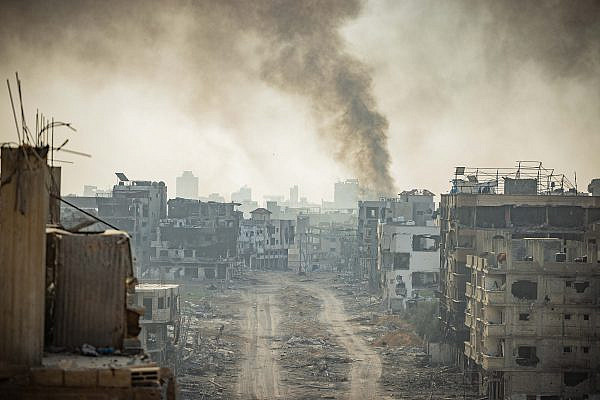


In this context, when Israel’s leadership is being pursued by the enforcers of international law, perpetual war carries implications beyond strategy. It influences incentives, binding political survival more tightly to the continuation of the crisis.
The end result is a closed conceptual loop. Defensive technologies like interceptors shield the population; the stability of the population sustains the political order; and together they reduce the pressure to resolve the conflict itself.
The vision of “super-Sparta” distills this condition of existential anxiety into a single, sterile engineering solution, in which securing the present with increasing precision allows an indefinite deferral of resolution in the future. With a success rate of 97 percent, the Iron Dome is intercepting any chance we may have of a normal future.
A version of this article was first published in Hebrew on Local Call. Read it here.