

In partnership with

“Nazis. Nazis. Nazis.” One of the most charged words in the Israeli lexicon becomes a pulsing beat in the song titled — well, you guessed it — “Nazis” on Regev Baruch’s new album. Its verses are composed from recordings of Israeli politicians, media figures, and musicians calling for the mass extermination of Gazans. In the chorus, Baruch answers them one by one: “You hear me? Shut the hell up, you fucking Nazi!” Guitars and drums hammer away underneath, all drive and distortion.
When I met Baruch at his studio in southern Tel Aviv, the first thing I asked was whether he was afraid to release the album — doubtless projecting some of my own fear onto him. “I was,” he replied, somewhat amused. “I’m still afraid, but I’m doing it anyway.”
Baruch, 38, is a musician, composer, drummer, and music producer who grew up in the Galilee and studied at the Jerusalem Academy of Music and Dance. Best known for his work with the Israeli bands Bint El-Funk and Baba Ganesh, he has spent his career moving between groove, Mizrahi music, fusion, and Indian music. He lives in northern Tel Aviv with his partner and a cat and describes himself on Facebook as a gentle, “easygoing” person. “Easygoing” is not the first word that comes to mind while listening to “Super Sparta,” the edgy, subversive and unapologetically political album he released last month.
“Super Sparta” — a phrase coined by Israeli Prime Minister Benjamin Netanyahu last year to describe his commitment to eternal war — ranges from hip-hop to rock, funk, and groove, with parodic tributes to familiar Israeli music. It is propelled throughout by Baruch’s drumming, its half-hour runtime passing almost in a single breath. The album’s lyrics are steeped in rage, despair, absurdity, and revulsion at a society Baruch sees as growing more fascist by the day. Yet they also express his belief that the mechanisms producing that reality can still be dismantled.
“There’s this graffiti that says, ‘Grandma, what were you doing during the genocide?’” Baruch said, recalling the period in which the album began to take shape. “I was looking for a good answer to that — something I could do to prove I wasn’t part of the silent majority.”
He was already posting his political views on Facebook, attending protests, and joining protective presence actions in the West Bank. But carrying on with his ordinary life and musical projects increasingly embarrassed him. “I’d write, ‘They’re destroying a region of two million people — a national project that we all need to acknowledge and shout about,’ and then say, ‘Come to a jazz-fusion concert.’ It was embarrassing. I asked myself: ‘If you really think that’s the reality, then why aren’t you going out there, doing something, lying down in front of tanks?’”
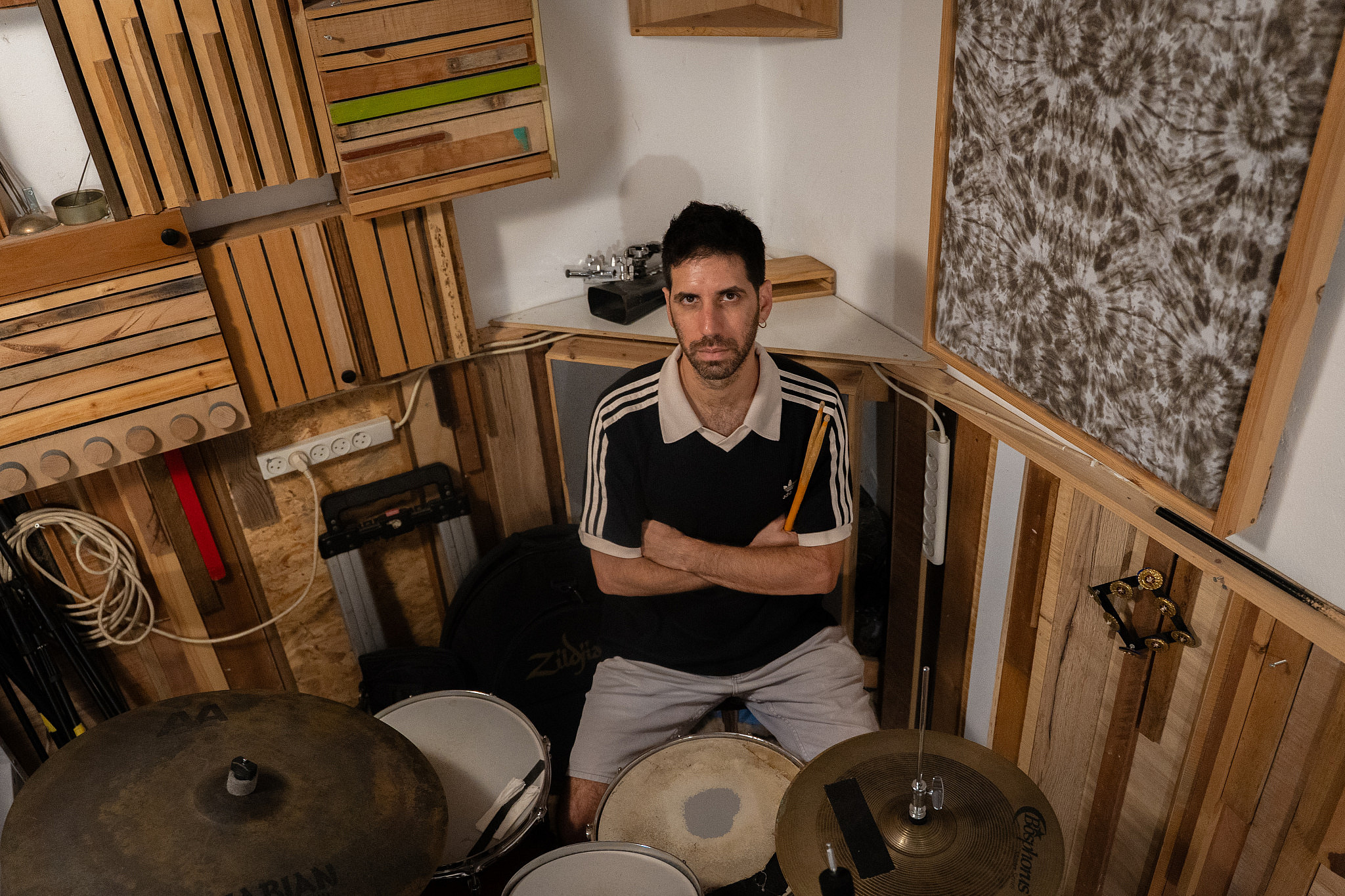
For Baruch, the answer eventually lay in refusing the distinction between his politics and music. “I didn’t want art to be entertainment for people, a means of distracting them from what’s happening,” he said. “In the end, I said, ‘Okay, there are journalists; they’re investigating. There are lawyers; they’re fighting a legal battle. You’re a musician — just make music.’ That’s the most powerful thing I can do.”
‘A cult of death-eaters’
Baruch insists that the album’s bluntness was less a calculated artistic choice than a necessity. He did not begin with a political message and then search for the most effective way to deliver it. “I felt like I had to get it out of me,” he said. “I made the album like a detox workshop. I took my gear, went to the desert, and that’s how I coped; I screamed.
Indeed, “Super Sparta” is not an attempt to gently coax an Israeli audience toward a political conclusion, nor is Baruch particularly interested in making arguments easier to swallow. If anything, the provocation is intentional.
“The fascist right is constantly drawing a red line beyond which everything is taboo. And that line is constantly shifting,” he said. “The whole point of the album — including the provocativeness — is to completely break through it. Screw it, you’re not going to dictate to me. I’ll speak freely.”
While Israelis can publicly advocate for killing Palestinians en masse, he said, those opposing the war are expected to speak in painstakingly cautious language. “On the other side, people feel so free to say ‘we should kill them all,’ to say such horrifying things, while on this side, everything has to be measured and delicate. It can’t be like that.
In “Cult Refugee,” Baruch takes the familiar Israeli song “Children of Life,” and transforms it into an anti-militarism anthem. “We are all children / of a cult of death-eaters,” he sings. “This expression, ‘a cult of death-eaters,’ has become very common and popular in the context of messianism and Kahanism, but I’m extending it to the general public,” he explained. “It’s easy to rally large segments of the public against messianism and Kahanism, but militarism is truly a sacred cow. Everything the IDF does is sacred because all our family and friends are part of it.”

Another song is titled “Liebowitz Was Right,” a reference to the Israeli philosopher and public intellectual Yeshayahu Leibowitz, who became one of the fiercest critics of Israel’s occupation after 1967. Baruch sees Leibowitz’s warning — that prolonged rule over Palestinians would elevate the military into a sacred institution and nurture fascistic tendencies — as a prescient diagnosis of Israel today.
“A Kahanist terrorist in a police uniform / Messianists slowly taking over positions / A corrupt dictator who never stops lying / And legislation is eroding individual rights,” he sings. Meanwhile, the public drinks beer at Hakaseta, a Jerusalem dive bar located across from the Shin Bet compound where Palestinians are routinely tortured.
Then Baruch imagines where this trajectory might lead: “The day is not far off when every traitor will be put on trial / And the Shin Bet, following orders, will arrest me too / And you, soon / So if you have something to say, you’d better say it now / Because soon it will already be forbidden.”
Still, he is surprisingly reluctant to condemn fellow artists who have remained silent. The more fundamental problem, as he sees it, is that most Israelis are not willing to come to terms with what has happened in Gaza.
“Most of the camp that sees itself as liberal tells itself all sorts of stories: that we fought against a terrorist organization hiding among the civilian population, that maybe there were a few ‘disciplinary issues’ here and there, but overall we acted appropriately. They’re in a state of denial that’s primarily emotional,” he said. As for those who do recognize what is happening but remain silent, “I understand that it stems from fear, and I don’t judge them for it.”
Mainstreaming dissent
There is almost no subtext in “Super Sparta.” Baruch takes ideas and expressions that have become commonplace in conversations among the radical Israeli left over the past three years, and transforms them into songs. We have heard these things before; many of us have said them. But not like this: explicit, catchy and organized into a coherent musical work.

In “Rap for Peace,” there’s no subtext whatsoever. “Two years of war — it’s time to stop,” Baruch cries. “Global isolation — it’s time to stop / Apartheid in the West Bank — it’s time to stop / Genocide in Gaza — it’s time to stop.”
And then comes the fantasy. “I still hope that day will come / Instead of ‘Harbu Darbu’ [the genocidal Israeli hip-hop song] we’ll rap for peace.” Supporters of the war have their own anthem; Regev Baruch is trying to offer an alternative.
That is perhaps the most interesting thing “Super Sparta” is attempting — to take a language that already exists on the fringes of Israeli society and turn it into popular culture. Over the past three years, a small camp has taken shape here that opposes genocide, fascism, and Israeli militarism while also trying to redefine what it means to remain in this place.
In this sense, the album’s bluntness is not merely a provocation, but also an attempt to reject the linguistic boundaries imposed on that camp: to call things by their proper names, and in doing so carve out a place for this camp amid political and moral collapse.
This idea takes on a moving expression in “Role,” the album’s most minimal track: an acoustic guitar, three chords, and a recording of remarks by Dr. Assaf David at a B’Tselem event in September 2025.
“I am an Israeli Jew, and I believe that in this era of genocide, this identity is also a role,” David says in the recording. “When I operate within it — even if on the very fringes […] — I believe that I, and all of us who choose this role, have more power to influence than if we simply operate completely outside of it, in which case we no longer make a difference.”
When Baruch asked David for permission to use the recording, he told him: “I want you to be mainstream.” That is, in many ways, the wager behind the entire album: the hope that ideas currently confined to the fringes of Israeli discourse might one day become self-evident.
“Super Sparta” makes almost no effort to soften itself for listeners who do not already share its premises. Yet Baruch insists that beneath all the anger, the album is not fundamentally against something so much as it is for something. “I want things to be good for everyone,” says Baruch. “Even though it sounds like opposition, it’s actually in favor of something. In favor of acknowledging the situation, taking responsibility for our crimes, and creating a reality here that’s good for everyone, regardless of religion, race, or gender.”
‘I’m not alone’
The tension between confronting the reality around him and continuing to imagine something different runs throughout the album. In “Sinking Ship,” it turns into an internal debate. One voice declares: “I’m abandoning a sinking ship / What do I have to do with all these stupid fascists? / If they want to keep dying and killing, then let them have their fun,” Almost immediately, another interrupts: “Abandon what?! / Fifteen generations in this land / They won’t uproot me, they won’t tear me away / I have no other country.”
Then the song allows itself an even greater fantasy: “Peace will yet come to the land of Palestine.” Barch imagines a direct train from Tel Aviv to Beirut. “Winter will yet end and spring will come / We’ll yet learn to let go, we’ll yet learn to listen.”
For all the disgust with Israeli society coursing through the album, leaving it behind is not the conclusion he draws. “First and foremost, on the simplest and most primal level, this is my home and I’ll fight for it,” he told me. There are the immediate attachments — his family, friends, work and life here — but also a stubborn belief that the political reality itself can change.
“Just as apartheid ended in South Africa, there will eventually be significant change here,” Baruch insisted. “In that regard, I’m very optimistic.”
He does not pretend to know what such a transformation would look like here. “But I hope the path to widespread recognition that we need peace and equality won’t require a few more catastrophes,” he said. This is another reason why he feels Israeli militarism must be confronted. “The majority of the public believes that what will bring security is continuing to bomb the entire Middle East — it’s truly dangerous.”
Baruch seems perfectly aware that his hope can sound naive. “I hope to help bring about such a broad understanding, as ambitious as that may be,” he said. “I’ll do my small part. I’m not alone.”
Near the end of the album, Baruch confronts the genocide in Gaza through an experience of suffering that Israeli listeners are far more accustomed to recognizing as their own. “The Gaza Holocaust” begins with the return of Yarden Bibas from captivity. Baruch recalls crying as he watched a man return to a life that could never be restored.
“An Israeli man — I’m programmed, like everyone else, to identify more easily with someone from my own tribe, whose language is my language and whose history is similar to ours,” Baruch recites in the song, which is one long monologue.
The song then tries to apply that instinct of identification beyond the borders of the tribe. It moves from Bibas to the names and stories of Palestinians in Gaza. “There are several thousand Yarden Bibases today in Gaza … people who are the only survivors of their entire families.”
The song ends with a prediction of how another generation will look back on the present: “My children will still be so ashamed / The Gaza Holocaust will not be forgotten.”
Most read on +972
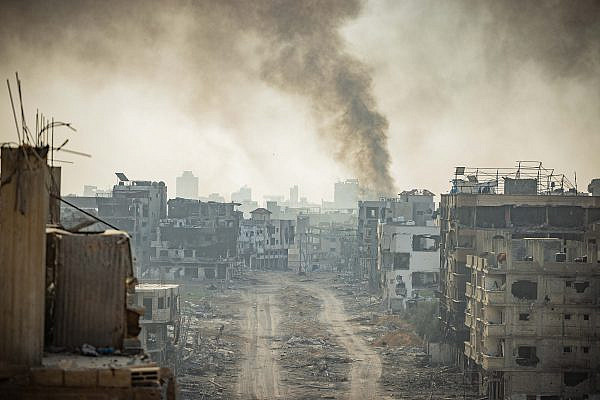
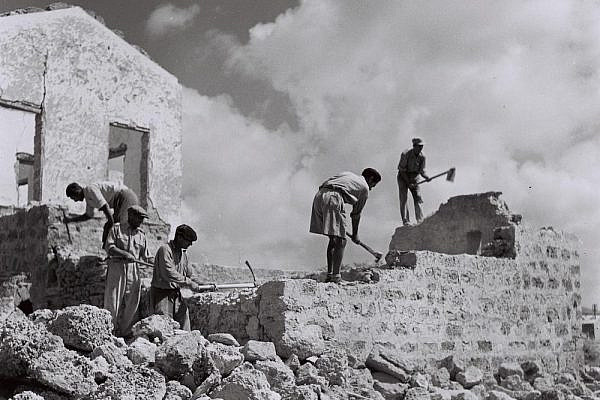
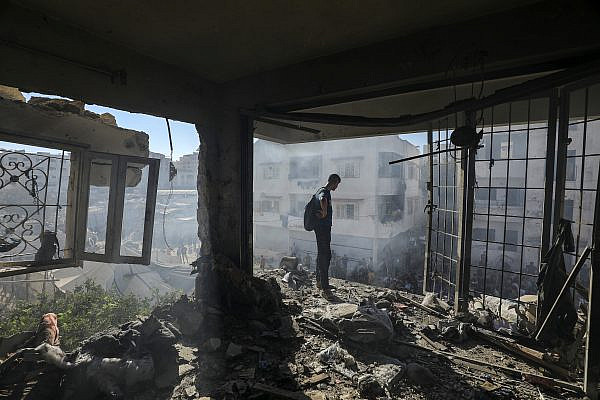
Baruch’s attempt to bridge this distance did not end with the song. Assaf David later wrote on Facebook that Baruch had asked him to translate it into Arabic and reach out to acquaintances in Gaza for photographs and videos of their lives before the war, which Baruch hoped to incorporate into a music video.
According to David, responses began pouring in within minutes. One person told him that all his photographs and digital records had been buried under the rubble of his home, along with his young daughters. Others sent materials. Some asked David to pass a message to Baruch: “He’s a brave man. He touched my heart. I won’t forget this. Please convey to him my heartfelt thanks.”
In other words, Baruch had already begun doing his small part.
A version of this article was first published in Hebrew on Local Call. Read it here.