


For the first time in years, Palestinian politics is showing signs of life. On July 9, Palestinian Authority President Mahmoud Abbas issued a decree calling elections for the Palestinian Legislative Council (PLC) — the PA’s parliament, which he dissolved in 2018 — for Nov. 28.
Alongside a looser pledge to hold a presidential election in early 2027, Abbas has also moved to reconstitute the abeyant Palestinian National Council (PNC), the Palestine Liberation Organization’s parliament representing Palestinians both inside and outside the occupied territories. On June 4, Abbas issued a decree ratifying a new 350-seat structure: 200 seats for the occupied territories, to be filled by winners of an expanded, 200-member Legislative Council, and another 150 for the diaspora.
These announcements follow several other political developments earlier this year. In February, a provisional constitution for the State of Palestine was released for public review, the product of a drafting committee Abbas established in August 2025. Two months later, municipal elections were held across the West Bank and, amid the ruins of Gaza, in Deir Al-Balah. And in May, Fatah held its first general conference in nearly a decade, electing a new Central Committee.
Also worth noting, though not directly related: Hamas elected Khalil Al-Hayya as head of its political bureau on July 20, filling a position that had lacked a permanent leader for nearly two years.
Yet despite the unprecedented crisis Palestinians face, none of Abbas’ decrees are the product of an organic effort to revive a moribund polity or confront Israeli aggression. They are primarily a response to misplaced external pressure for “PA reform,” aimed at reviving the defunct two-state solution — pressure landing on an institution that is financially destitute and searching for a seat at the table where it no longer has one.

In response to the crisis sparked by October 7, several states, led by Saudi Arabia and Norway, have sought to revive the diplomatic peace process centered on Palestinian statehood, including by granting formal recognition. Abbas has latched onto this initiative, known as the Global Alliance for the Implementation of the Two-State Solution, as a political and economic lifeline. Abbas’ embrace of the initiative has included a commitment — half-hearted though it may be — to institutional reform and elections.
Regardless of the motivations behind them, however, the prospect of elections presents an opportunity Palestinians should not miss. The genocide in Gaza and accelerating ethnic cleansing in the West Bank have done little to generate the change Palestinian politics urgently needs, and the public remains paralyzed by fear, exhaustion, and an absence of direction. Elections are limited in what they can accomplish, but they remain the most straightforward opportunity to break a corrupt and complacent leadership’s stranglehold over Palestinian institutions.
For years, Abbas and his inner circle have successfully obstructed factional reconciliation, institutional revitalization, and a pivot in the national liberation strategy. It is clearer than ever that only by dislodging these obstructionists from power can Palestinians kickstart a genuine political revival.
Elections for relevance
Since October 2023, the PA has become more marginalized than ever: Already staggeringly unpopular among Palestinians, the institution has faced a political and economic assault by an Israeli government content to see it toppled, while being excluded by the Trump administration from its Board of Peace-led initiative in Gaza — the main theater of international attention and activity. Its leadership has thus been left desperate for relevance, and open to democratization as a path back to international good graces.
This is not dissimilar to early 2021, when Fatah — in coordination with Hamas — agreed to hold elections in part to win the support of the incoming U.S. administration under President Joe Biden. Yet Washington proved ambivalent, more concerned with keeping Hamas out of the PA than with democratic revitalization. Abbas ultimately canceled the elections just 23 days before the vote.

This time, however, could be different. The states pushing the current reform agenda are explicitly demanding elections. Navigating that pressure without ceding power, rather than any broader national good, appears to be Abbas’ primary motivation. Hamas’ military and political decimation only makes the maneuvering easier.
Still, some of that external pressure has produced notable improvements in the electoral framework. Alongside expanding the PLC, Abbas’ June 4 decree lowered the minimum candidacy age from 28 — one of the highest in the world — to 23, while reducing the electoral threshold for gaining a parliamentary seat to 1 percent.
But even as Abbas has widened the formal avenues for participation, he has moved to narrow who can actually use them to challenge his party. Months earlier, he amended the municipal election law to require all candidates to sign a declaration of allegiance to the PLO’s political program, including its Oslo-era commitments to recognize Israel and renounce armed resistance. Five factions, four of them PLO members, rejected the requirement outright. Hamas, which sat out the April municipal elections, could not have met either of the stipulations.
And just weeks after ratifying the new structure of the PNC, Abbas already appears to be walking back one of its most significant reforms. According to The New Arab, the plan is to restore the PLC to 132 seats and convert the 68-seat difference into a PNC bloc chosen not by election but by “consensus” — most likely meaning appointment by Abbas himself. That would give him direct say over nearly 20 percent of the PNC’s makeup.
It is precisely the kind of machination that undercuts one of the clearest potential gains of this electoral process: more democratic political representation within the PLO.
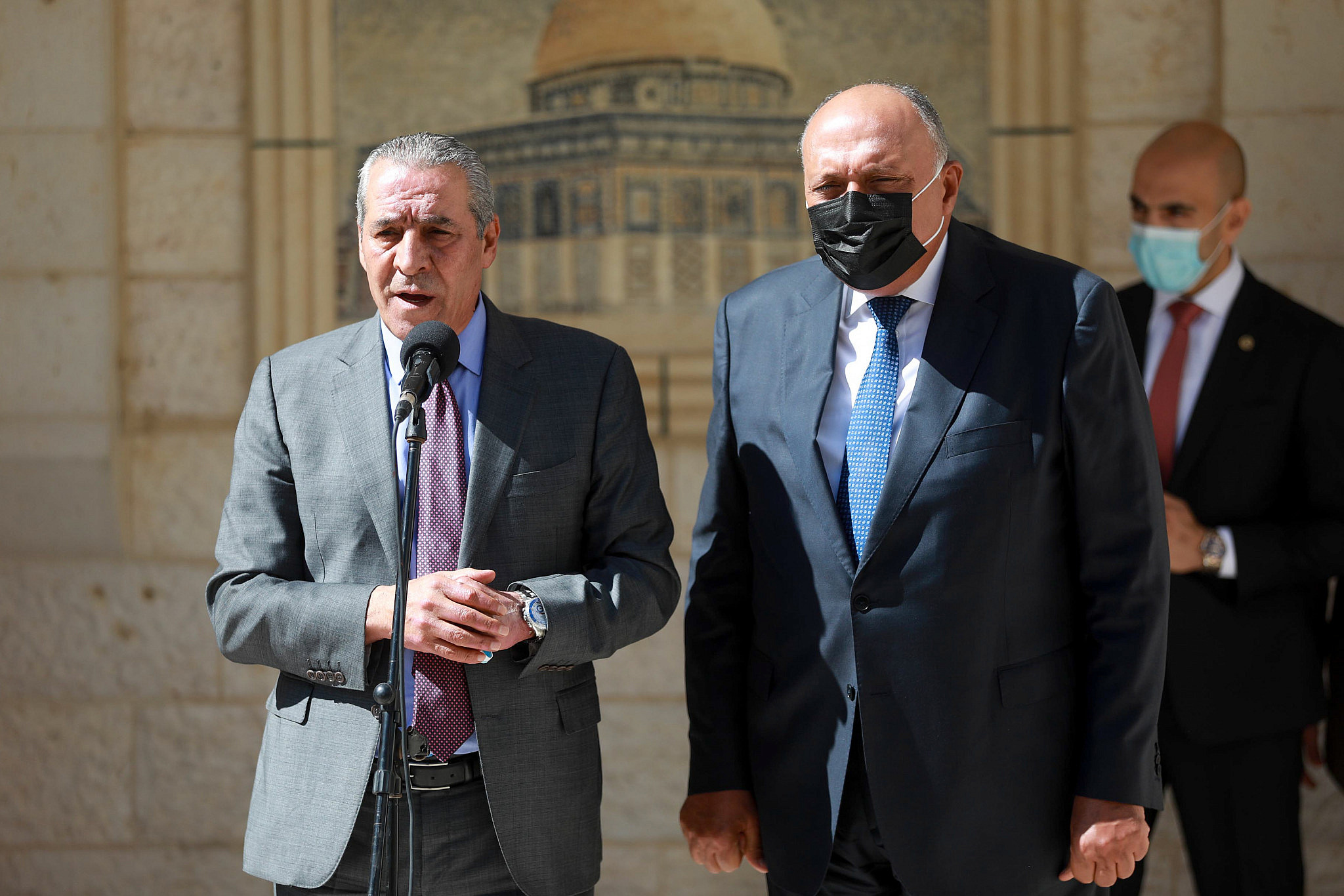
The 90-year-old Abbas has also been steadily building a succession plan around his right-hand man, Hussein Al-Sheikh. First installed on the PLO’s Executive Committee and made its secretary-general in 2022, Al-Sheikh was then handed two newly created offices in April 2025: vice president of the State of Palestine and vice chairman of the PLO Executive Committee. Then, in October 2025, Abbas decreed that Al-Sheikh would serve as acting president for up to 90 days should Abbas die or become incapacitated, a provision with no basis in the interim Palestinian constitution known as the Basic Law.
Following Fatah’s general conference this past May, Al-Sheikh was also elected the movement’s deputy leader, rounding out his prospective accession to the top of virtually every relevant institution of Palestinian political power. At the conference, Abbas orchestrated the election of his son Yasser to the Central Committee, installing another loyal lieutenant to steer the ship, and giving the family a useful perch from which to protect its business interests.
Still, for all this careful election engineering, an actual election carries risks that Abbas may not be able to contain. If campaigning moves into full swing this fall, the process could escape Fatah’s control, just as it did in the 2021 election cycle before Abbas pulled the plug in the face of significant public political engagement: Nearly 1,400 candidates and 29 new party lists were contesting 132 seats. More threatening still for Abbas, notable Fatah figures had broken ranks to form rival lists.
The external reform agenda
Behind all of this, the external pressure pushing Abbas toward the ballot box is itself of dubious value and motivation. Many of the states involved in the Global Alliance for the Implementation of the Two-State Solution may be earnest in their stated aims. But there is a long history of performative international engagement that leaves the status quo untouched, shifting the burden of action onto the weaker Palestinian side, which has little choice but to comply. Even at its best, the broader PA reform agenda is misguided, as it fails to confront the principal obstacle to the political settlement it claims to seek: Israeli intransigence.
This echoes the often-overlooked 2009–11 period when Salam Fayyad, Abbas’ then-prime minister, sought to build high-functioning institutions of a Palestinian state from the ground up — complete with free market reforms and enhanced security coordination with Israel — betting this would ultimately be rewarded with independence. That project collapsed for the same reason the current one is likely to fail: It was never matched by commensurate pressure on Israel to actually allow a Palestinian state to emerge.
Today, the absence of such pressure is more glaring than ever. Despite the gravity of Israeli crimes since October 7, there has been no meaningful international action to stop the genocide or compel Israel to end its illegal occupation and apartheid rule, as required by International Court of Justice rulings.
In September 2025, the European Commission proposed suspending trade preferences under the EU-Israel Association Agreement; the measure has never been adopted, blocked by divisions among member states after more than 350 former European officials demanded action in April 2026. The bloc’s only enacted response has been sanctions imposed in May on four Israeli settler organizations — a fraction of the leverage it proposed wielding eight months earlier. Arab states that normalized relations with Israel, meanwhile, have not moved to sever those ties.
What connects these failures is a broader unwillingness — among most European governments, Arab states, and Washington alike — to actually advance the two-state solution, assuming such a solution remains possible at all. Demanding reform from a captive, bankrupt PA costs nothing. Challenging Israeli intransigence would cost something. That disparity is the real history behind the reform agenda, and helps to explain why many Palestinians do not see it as credible.

It is unclear how far these outside parties will push Abbas to follow through with elections if he begins to feel his grip on power truly slipping. In 2021, Abbas cited Israel’s refusal to allow Palestinians in East Jerusalem to vote as grounds for canceling the elections, effectively handing Israel a veto over Palestinian democracy. There is very little reason to expect Israel’s current government to allow Palestinian voting in the city this time around.
The timing could provide Abbas with the same escape route. While Israel’s own elections are slated for a month before the Palestinian ones, it takes an average of 50 days to form an Israeli coalition, likely leaving the current government in office to thwart Jerusalem voting. Abbas could thus ostensibly invoke the Jerusalem pretext again, if the Global Alliance lets him off the hook or if he simply chooses to defy it.
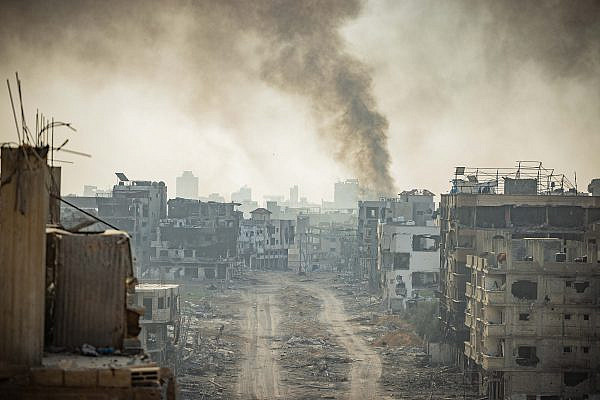
Even more importantly, elections cannot answer the deeper question of whether the PA itself remains relevant — a question that should be part of a broader and much-needed reckoning over Palestinian national liberation strategy. Where does the Palestinian national movement actually stand today, and where is it headed? Should the PA even have a place in its future? And what does it mean to hold elections amid an ongoing genocide and campaign of ethnic cleansing, with Gaza destroyed and large swaths of the West Bank being emptied out and annexed in real time?
Most read on +972


Yet the deep entanglement of the PA and the PLO means that elections to the former bear directly on any attempt to reconstitute the broader Palestinian national movement. Set against three years of shocking inactivity, it is difficult to see where else meaningful political change might begin.
The PLO failed to muster a response to genocide. The PNC did not convene once during the onslaught. And the Palestinian leadership proved incapable of mounting a unified diplomatic response even as it was nearly erased from discussions over the postwar political order.
Neither Palestinian communities under Israeli rule nor those in the diaspora have so far managed to challenge the prevailing power structure from below. Organic change has not materialized, and so opportunities have to be seized where they present themselves, even ones borne of dubious circumstances.
An election, however cynically called into being, is the one internal mechanism available to Palestinians that could bring meaningful change: If it indeed takes place, which is admittedly doubtful, Abbas would be forced to expose his hold on Palestinian institutions to genuine contestation, or at least open space for that hold to be chipped away at. The task now is to pressure the outside powers demanding elections to ensure that they actually happen and that, once they do, Palestinians are allowed to make them count.
A version of this article was also published on Afkar. Read it here.