

In a viral clip from a recent episode of the “Shu Kaman?” podcast, Palestinian historian Rashid Khalidi drew a distinction between Palestinians debating the means of their own liberation, and outsiders turning that debate into a test of ideological purity. While Palestinians in Gaza or Nablus have every right to discuss the merits of armed struggle, he argued, the same debate becomes meaningless and even counterproductive when waged from afar.
“What the hell business is it of ours in the United States?” Khalidi asked. “To make that a debate between us divides us and brings unspeakable joy to our enemies: ‘Let them fight about armed struggle, because they’re not going to struggle or be armed.’”
Khalidi went on to criticize those who make support for armed resistance a dividing line within the pro-Palestine movement. He terms this “purity politics” — an approach that may produce a righteous camp, but one that remains small, isolated, and devoid of actual influence. Instead, he urged activists to “figure out a strategy that brings you together with people you don’t entirely agree with, but with whom you agree on a specific objective. Is our objective stopping arms sales? I can agree with some Zionists on that.”
Anyone who listened to the full interview can see that, at its core, Khalidi’s message is about power: the tremendous potential that exists within the Palestinian camp, provided it learns how to translate its resources and support into real political force.
Khalidi’s remarks are particularly relevant in the context of the disproportionate time and energy spent on recent internal Palestinian debates — especially those surrounding Basel Adra and Yuval Abraham’s film “No Other Land,” and Irish author Sally Rooney’s decision to publish her new novel in Hebrew.
These two cases generated hundreds of posts on social media and thought-provoking critiques by talented writers, many of whom have dedicated their lives to the Palestinian struggle. However, it is crucial to recognize that these debates tended to ignore the more important question: How can we build tangible political power to confront the disproportionate might of Israel and the Zionist movement?
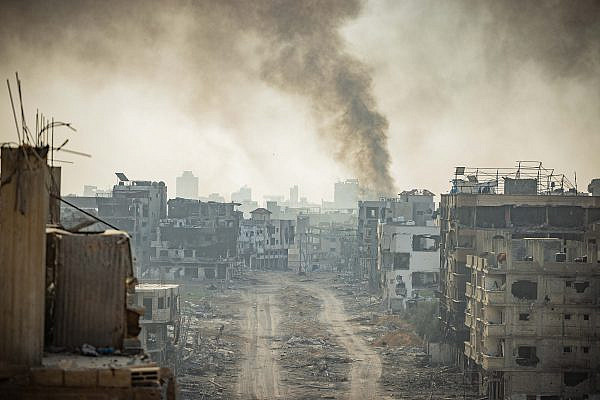
Nearly three years have passed since the beginning of the war in Gaza, and two decades since the split between Fatah and Hamas — a period in which Palestinian politics has been completely fragmented and hollowed out. These are also the two decades during which Israel has deepened its occupation and ethnic cleansing in the West Bank, committed grave crimes in Gaza, and continued to erode the civil status of Palestinian citizens within the Green Line.

This reality requires us to acknowledge existing power imbalances and to understand the importance of building broad coalitions to achieve defined goals. We must also recognize that this is a long and complex struggle, one that requires achieving small victories across a range of political arenas, while continuously evaluating how we manage our resources to produce results on the ground.
The debate that must be held now is about power. How can the pro-Palestinian camp integrate into centers of influence and decision-making, wherever they are? And how can we build bridges and act together — rather than at cross purposes — with potential partners?
The reality on the ground
If we take as an example the recent saga surrounding Sally Rooney — a supporter of the Palestinian struggle and the Boycott, Divestment, and Sanctions (BDS) movement — much of the criticism was based on the mere fact that her recent novel was translated into Hebrew, even though the translation and publication strictly adhered to the official boycott guidelines of the BDS movement.
According to data from the National Library of Israel, between 1,000 and 1,500 books are translated into Hebrew in Israel every year. The vast majority of authors in the world continue to authorize the translation of their books without preconditions. As a renowned novelist, Sally Rooney went against this trend and chose to take a moral stance, lend legitimacy to the Palestinian struggle, and strengthen the mechanism of the boycott. Even if there are strong arguments against the way it was done, one cannot ignore the precedent set by her action, which can serve as a model for conditioning translations for hundreds of other authors globally.
Some have also suggested that the debate over translating Rooney’s novel into Hebrew is actually a proxy for the question of the future of the Jewish collective in the region. This is a question we cannot ignore, or suggest that it is not our problem — indeed, this collective bears direct responsibility for Palestinian suffering, and their future will shape our own destiny as Palestinians.
It must be simply affirmed that Jews are here to stay in Palestine. Their expulsion would be not only immoral, but impractical: Between the Jordan River and the Mediterranean Sea, there are approximately 7 million Jewish inhabitants — roughly equal to the number of Palestinians.
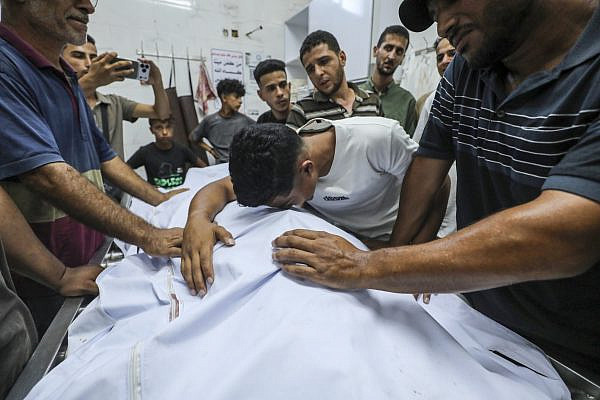
But crucially, engaging with such questions should not distract from the present reality of genocide and ongoing dispossession. The Palestinian struggle can not be treated as a theoretical or intellectual debate while Palestinians themselves are struggling to stay alive.
Then there is the case of the Oscar-winning film “No Other Land,” which documents Israel’s ongoing ethnic cleansing of Masafer Yatta in the occupied West Bank. One of the central criticisms against the film was that it transforms Palestinian suffering into an international cultural event while the territory itself is being erased in practice.

Over time, it became clear that this criticism was partially correct: Despite international awards and widespread exposure, nothing prevented Israel from continuing its policies on the ground. And yet, one cannot dismiss the global exposure the film brought to Masafer Yatta, as well as its importance as an act of historical documentation.
A related critique of the film, most prominently from the Palestinian Campaign for the Academic and Cultural Boycott of Israel (PACBI), was that it promotes “normalization” with Israelis. Back in 2014, PACBI published specific guidelines rejecting forms of collaboration with Israelis and Israeli institutions when such partnerships present an image of coexistence, one that obscures the realities of oppression and colonial violence.
One can fundamentally oppose models of Palestinian-Israeli cooperation that distract from or cover up these realities, but “No Other Land” does the opposite: It shows how Israeli activists’ ability to document and circulate the violence in Masafer Yatta rests on Jewish-Israeli privilege, even as some use that privilege in service of the Palestinian struggle. Rather than presenting coexistence, it exposes the unequal power relations that persist even within joint resistance.
It is also impossible to ignore — as the film itself depicts — that dozens of Israelis risk their lives every week trying to protect Palestinian communities in the West Bank. True, one can argue that their presence only highlights the asymmetry, or point to the way the international media loves to spotlight the Jewish activist protecting the Palestinian farmer.
But those who truly matter are the isolated communities themselves. Left alone on the ground without even minimal protection from the army and settlers, these communities need whatever amount of media coverage they can secure — not to mention an Oscar-winning film. And sometimes, they need that very Jewish activist whom the military hesitates to arrest, in order to deter settlers and prevent harm to life and property.
Centers of power
When we think about how power operates in the world we live in, we must acknowledge that tragically, popular protests and moral appeals are not enough. It is clearer than ever today that our world does not truly recognize and uphold human rights, especially the rights of peoples in the Global South.
In recent years, we have witnessed the tremendous success of Palestinian grassroots movements in mobilizing the masses, as hundreds of millions of people across all continents took to the streets to protest against Israeli actions in Gaza. Yet Israel’s military destruction continues unabated, even exploiting the events of October 7 as a pretext to advance its operations into Lebanon and Syria, and into direct confrontations with Iran.

Look, for instance, at what occurred at universities across the United States: Student activists organized historic protests against the genocide in Gaza, demanding that the federal administration end its support for Israel and that the university administrations divest. Yet the result was the exact opposite: Successive U.S. administrations under former President Joe Biden and now President Donald Trump pressured and sanctioned the universities and students themselves, seriously undermining freedom of expression.
This has also manifested at the level of international law. The move led by South Africa in early 2024 to appeal to the International Court of Justice to stop the genocide garnered support from countries such as Spain, Mexico, Belgium, the Netherlands, and Iceland. The legal proceedings at the International Criminal Court even led to the issuance of arrest warrants against Israeli Prime Minister Benjamin Netanyahu and former Defense Minister Yoav Gallant. However, the immediate American response was to sanction the international judicial institutions themselves.
Worse still, it is highly doubtful whether Israel would have succeeded in achieving its military objectives in the region without the indirect support of Arab states.
Since the beginning of 2024, following the Houthis’ effective closure of the Bab Al-Mandab Strait to Israeli ships in the Red Sea, it was Bahrain, the United Arab Emirates, Saudi Arabia, and Jordan that provided Israel with a bypass land route for the transit of goods. While Arab states condemned Israeli aggression in Gaza at a rhetorical level, a Washington Post investigation revealed how they actually deepened their security ties with Israel during that same period.
An unprecedented step occurred last September, when Israel bombed senior Hamas official Khalil Al-Hayya and the negotiating team in the very midst of the ceasefire talks in Doha. This was an act that even superpowers like the United States, Russia, or China would avoid committing. Yet just months later, those same Arab nations functioned as Israel’s first line of defense against Iranian missile attacks.
This sequence of events illustrates the current absurdity in both the Arab and international spheres. Despite Israel’s crimes and its territorial expansion, Western nations (with a few exceptions) continued the arms trade; India, which historically supported the Palestinian cause, made sure to supply Israel with arms and ammunition; and Arab countries provided Israel with a logistical and strategic safety net.
Most read on +972

Yet however absurd they may be, these events help clarify how power functions within state and international institutions, and emphasize that bodies such as the U.S. Congress and elected officials in the countries of the Global North still wield disproportionate influence.
The task, especially for those in the United States, is to translate the media and political power accumulated in recent years into measurable achievements: supporting pro-Palestinian candidates, building lobbying groups, influencing existing elected officials, and forming broad coalitions around a shared platform that works toward both short-term and long-term goals. In Khalidi’s words: “We live in the belly of the beast. We live in the country that sustains this genocide. Our work has to do with the United States.”
What is needed is a strategic view of how to bring as many centers of power as possible to support the rights of the Palestinian people. Those in Gaza, who have suffered the ongoing nightmare of genocide for nearly three years, cannot wait any longer.