


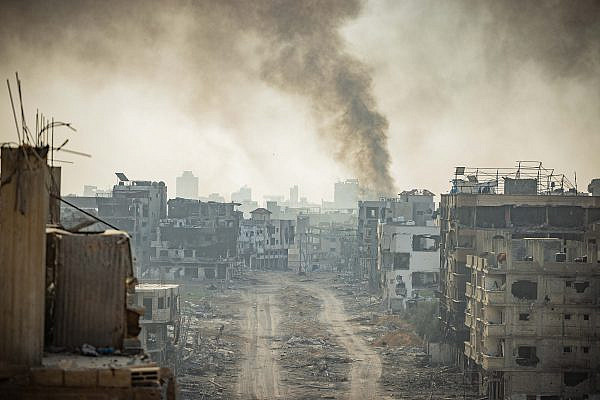
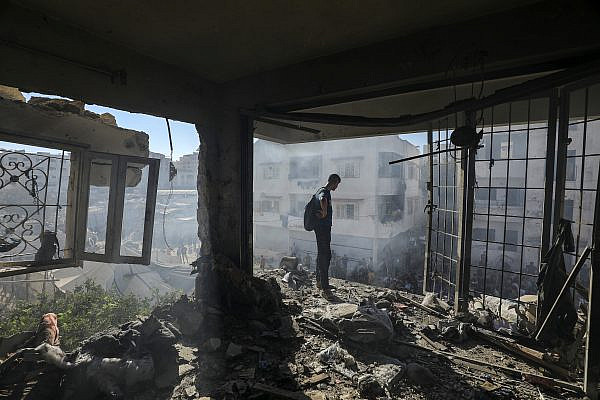
During the first two years of Israel’s genocidal war, nearly all of Gaza’s cultural centers and institutions were destroyed, and at least 150 of its leading cultural figures were killed. In recent months, despite the fragility of the so-called ceasefire, several initiatives have begun to emerge to revive the Strip’s once-thriving literary and arts scene.
Among them is the Phoenix Library, which opened in late April after its founders raised more than $100,000 through a crowdfunding campaign to renovate a surviving building in central Gaza City. Founded by two friends, Omar Hamad and Ibrahim Al-Masri, Gaza’s newest library, aims to salvage what remains of the Strip’s literary life from beneath the rubble.
“During the genocide, the occupation pursued a policy of eradicating education by destroying schools, universities, and libraries. It destroyed hundreds of thousands of books — many of them old books that are part of Palestinian heritage and legacy, some printed before 1948 and others dating back to the Ottoman era,” Hamad, 30, told +972. “The idea for the library came about because we wanted to preserve what survived, and revive reading, writing, and research in Gaza amid the immense educational void created by the war.”
Al-Masri, 31, said the project grew out of the same sense of responsibility. “As people who read and write and care about culture, it was difficult for us to see educational centers and libraries destroyed, and books burned,” he explained. “Luckily, we were able to retrieve books from under the rubble of private and university libraries. Other books belonged to people who were martyred during the war and were donated to us by their families. They wanted people to benefit from those books, and for them to serve as a lasting act of charity [in honor of their loved ones].
“We named the library ‘Phoenix’ because it conveys rising from the rubble, and hope amid pain” he added. “We want to live our lives normally, and to show the world that, despite the circumstances, we remain steadfast in our knowledge, our culture, and our country.”
For Hamad, the library was also an attempt to share the refuge that books had offered him during the war. “I was displaced several times, and I was very keen to have my books with me. I would spend hours reading, and I looked for people who had books so we could exchange them,” he said. “I kept thinking about how I could put these books in a suitable place where everyone could benefit from them, just as they had helped me to alleviate the hardship and bitterness of displacement.”
The library now houses more than 6,000 books in Arabic and English, spanning fields such as science, language, media, education, management, economics, medicine, mathematics, law, and history, alongside Arabic and international literature — with a particular focus on Palestinian and Gazan writing. It has quickly become a refuge for avid readers seeking peace and tranquility, as well as a study space for students whose university libraries have been destroyed.
Khaled Radwan, a 20-year-old university student, said he frequents the library both to study and out of a lifelong love of reading. “I needed many books for my studies, and all the university libraries were completely destroyed,” he told +972. “I’ve also been interested in reading since childhood. My father had some books, and I loved going to the Old City of Gaza to find old ones. I’m most interested in books about history and civilizations; I love reading about the different eras in Palestine and other countries.”
Radwan now hopes to help expand the library’s collection by searching for books under the rubble of destroyed libraries and cultural centers. “It’s important to preserve our history after the Israeli army destroyed so many books,” he added. “They deliberately burn history so that nothing remains for us, but we care about culture and knowledge — and that it won’t be lost because of their attacks and wars.”
For Sarah Al-Taweel, 24, who used to frequent university libraries during her studies, the Phoenix Library has offered solace. “I was studying at Al-Azhar University, and I used to move between libraries to pick up books to read,” she told +972. “I stopped doing that during the war. I tried to get books and novels online, but the feeling is different when I hold a book. I feel psychologically at ease, as if I am free among the words and lines. I wished I could find just one book to keep me busy.”
When she learned that the library had opened, Al-Taweel said she was among the first to visit. Seeing the books arranged on shelves as they had been before the war brought back a sense of normalcy. “Now I can spend time reading,” she said. “Isolating myself from the difficult reality we are living in is important so that we can preserve our minds. That’s why for me the most important achievement after the ceasefire was the opening of the library.”

‘Music is a balm for the soul’
Throughout the war in Gaza, musical training remained one of the few cultural and artistic activities to continue in spite of the unimaginably harsh conditions.
Ismail Daoud, an oud teacher and academic director of the Edward Said National Conservatory of Music in Gaza, was among those trying to keep music alive. Along with other teachers from the conservatory, he traveled between children’s tents in the Al-Mawasi area of Khan Younis to teach singing and musical instruments.
“At the beginning of the war, I was displaced from my home in northern Gaza with my children and a few essential belongings, and I left my musical instruments behind. Everything was bombed and destroyed,” he told +972. “For the first seven months of the war, I didn’t hear or play music. But in May 2024, my colleague Ahmed Abu Amsha told me that the conservatory wanted to revive music activities in Gaza.”
The conservatory’s own home was among the cultural spaces destroyed. Opened in 2012 in a Palestinian Red Crescent building in Tel Al-Hawa, west of Gaza City, the institute was bombed, looted, and burned during the war, the furniture and instruments lost. Its administration is now searching for the funding needed to rebuild and reopen the space.
In the meantime, the conservatory has resumed offering lessons to children, first in northern Gaza and later in improvised learning spaces across the Strip. Over time, Daoud said, music, which he describes as “a universal language of peace,” became an important tool for helping children cope with the psychological trauma of war.
“The beginning was difficult,” he said. “We lost a student named Youssef Salman from Khan Younis. His father was traveling abroad, and he used to communicate with him online. One day, Youssef was absent from class because he had gone to a cafe to speak with his father, and he was targeted there. His sister was with us, and she was devastated by the loss of her brother, but music was our support and consolation in those circumstances — it is a balm for the soul.”
Today, the conservatory offers lessons to children and young adults, aged 8 to 20, in instruments such as the tabla, oud, guitar, and flute, as well as choral singing. Abu Amsha, a teacher and coordinator at the conservatory who also leads the musical group Gaza Birds Singing, went viral last summer for his haunting song that harmonizes with the constant buzz of Israeli drones — now part of the global campaign to boycott the Eurovision song contest.
“There is a significant increase in the number of people seeking musical training,” Daoud said. “We are currently planning to organize concerts and cultural festivals with local organizations in Gaza, such as UNICEF. This work has been our primary source of support since the start of the war. We want to continue spreading hope and life.”
‘Not a luxury, but a human necessity’
Before the war, Palestinian theater director and cultural producer Jamal Abu Al-Qumsan had dedicated part of his home in western Gaza City to what he called a “cultural gallery” — a space where he hosted intellectuals, writers, musicians, and artists for various events.
“Theater in Gaza was vital for artistic expression and community awareness, despite limited resources and the blockade,” he told +972. “There were regular performances, workshops, and initiatives for children and young adults, and theater provided a window of hope and a place for expression and dialogue.”

Al-Qumsan staged performances throughout the year, especially for children. “For kids, theater wasn’t just entertainment, but a space for learning and reclaiming childhood,” he said. “During the war, they were deprived of these safe spaces, creating a huge psychological and cultural void that we still feel today.”
Gaza’s once-active performing arts scene has been almost entirely erased by Israel’s war. Among the venues demolished was the Rashad Al-Shawa Theater in Gaza City’s Al-Rimal neighborhood — the Strip’s main site for theatrical productions.
During the Israeli army’s ground invasion of Gaza City in late 2023, Al-Qumsan’s house and gallery were destroyed. He was displaced to a tent in the Al-Zawayda area of central Gaza, where he remains today.
Yet even in displacement, Al-Qumsan has continued to organize film screenings and art workshops for children in displacement camps in different parts of the Strip. “These activities give children a chance to laugh and help them regain some psychological balance, reinforcing their sense that they are cared for and have a right to joy and life,” he said. “Theater for them is a means of expressing emotions and regaining a sense of security during war.”
The loss of the gallery left an indelible mark on Al-Qumsan, “on both a personal and professional level.” Still, he is trying to find alternative ways to continue his theatrical work, which he described as “not a luxury, but a human necessity.”
Most read on +972
“Jamal’s Cultural Gallery wasn’t just a place, but a home for artists, children, and creative people,” he said. “But I believe that culture is not only about buildings, but also about will. I am currently working on designing a new cultural gallery using simple, locally available materials.
“There is a great longing among children and families for theater and cultural activities,” Al-Qumsan concluded. “Every time we present a performance or activity, we witness the extent of the need for these spaces. People are not just looking for entertainment, but for hope and a sense of normalcy. This confirms that theater will remain a societal and cultural necessity, no matter the challenges.”