
In partnership with

Jaffa in the 1990s — and especially the Ajami neighborhood where I grew up — was a difficult place to be. Those were the years before gentrification, before it became trendy for Israeli Jews to move into the stolen Palestinian villas, when crime still ran rampant.
There, in Ajami, stood my grandparents’ house. As is customary in many Arab homes, the living room walls were adorned with photographs alongside verses from the Quran. One such photo was of the former Egyptian President Gamal Abdel Nasser, whom my grandfather always admired; beside it was a photo of my grandfather’s brother, who had been persecuted by the Israeli authorities going back to the 1960s, and whose fate has remained unknown to us ever since.
Next to both of them was another picture: an old man, barefoot and dressed in worn clothes, walking into the wilderness and carrying an entire city on his back.
My cousins and I were convinced that this was my grandfather’s father. After all, to us kids, the picture looked just like him: a man who had worked hard his whole life, his skin sunburned, his hands large but weary, his feet bare.
But more than anything, the photo sparked repeated arguments about what we were actually looking at. Why does he keep walking despite all the hardship? What is the city he’s carrying on his back, and why is it so important to him that he refuses to put it down?
We grew up and learned that the man in the picture wasn’t my grandfather’s father; it was the 1973 painting “Jamal Al-Mahamel” (“Camel of Hardship”) by the Palestinian artist Sliman Mansour. And the city the old man is carrying on his back is Jerusalem.
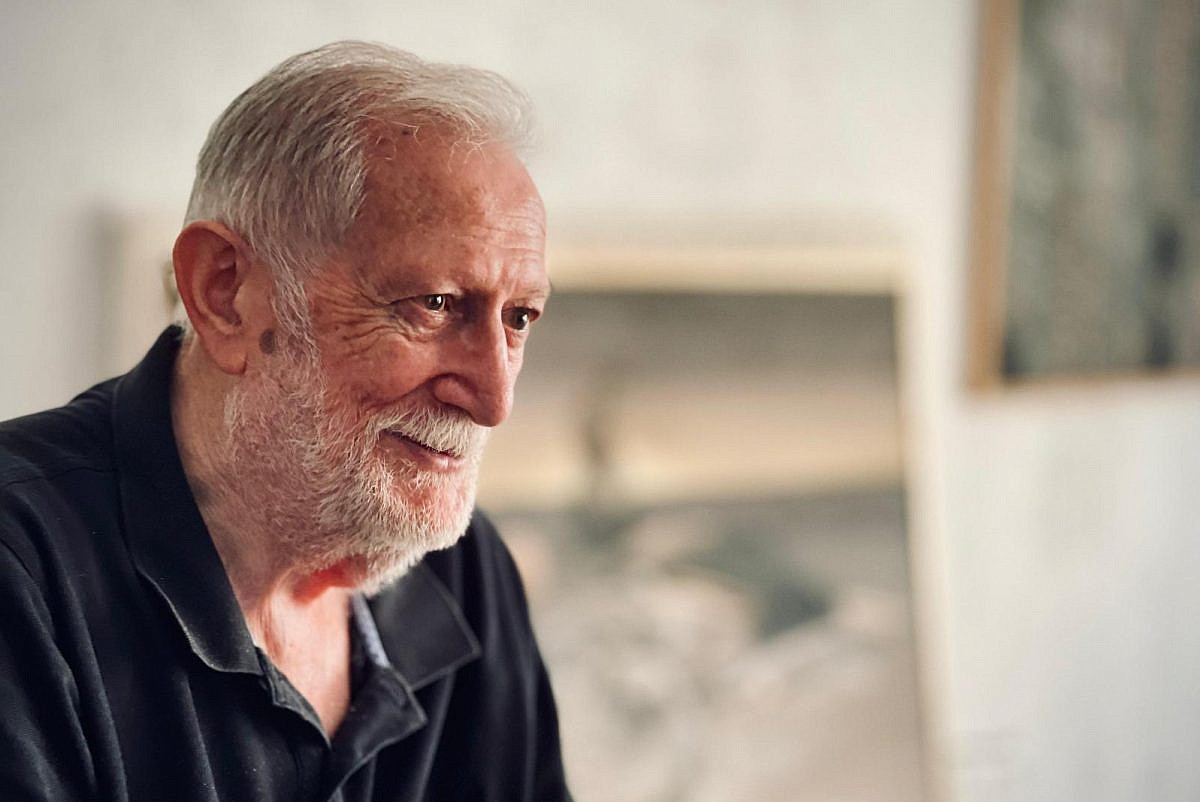
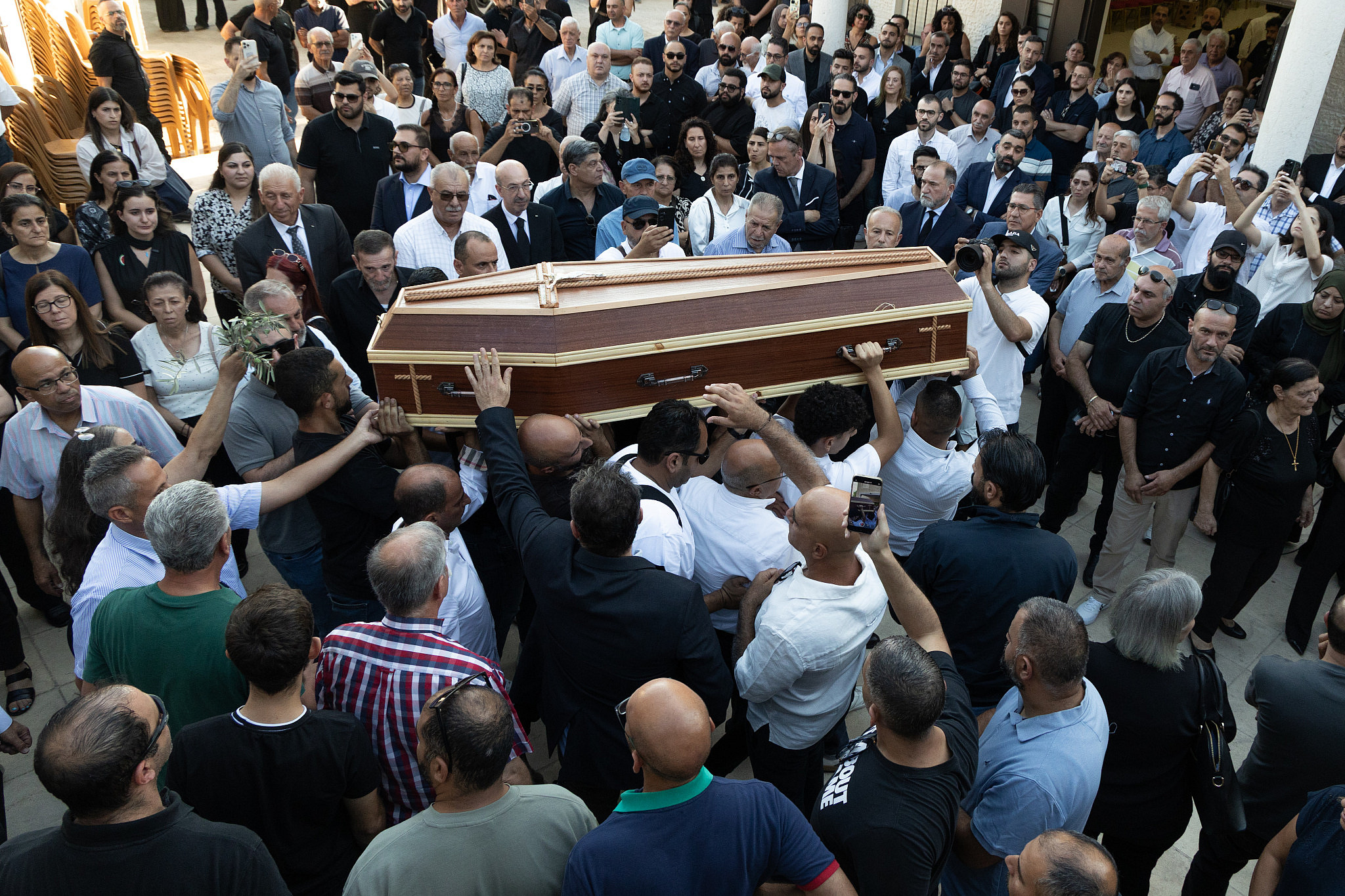
On Monday, Mansour — one of the most important Palestinian artists of recent generations — passed away in Jerusalem, and was buried in his hometown of Birzeit in the occupied West Bank.
Mansour was born in 1947, just one year before the Nakba. His father died when he was a child, and he and his brother were sent to a Lutheran church boarding school in the Bethlehem area. His artistic talent was evident from a young age, and following the 1967 War, he began studying art at Jerusalem’s Bezalel Academy.
Mansour belonged to a generation of Palestinian artists who, in the wake of the Nakba, sought to use art to rebuild the connection between Palestinians and their land, memory, and sense of place. That is why the olive tree, the orange, the Palestinian village, traditional embroidery, the Palestinian woman, and other things that represent the connection between people and their land recur throughout his works.
In this sense, Mansour was not merely a painter: He helped create the visual language through which generations of Palestinians have learned to imagine Palestine — and ourselves.
A shared story
A few months ago, the Arab Culture Association and Al-Saraya Theater in Jaffa organized an evening in his honor. Despite the difficulty of attending such events with two small children, my partner and I insisted on making the necessary arrangements to be there. Sliman was physically no longer at his best, but throughout the evening he smiled a lot and seemed optimistic.
Toward the end, the floor was opened for questions and comments. I raised my hand. I just wanted to say thank you. I wanted to tell him how “Jamal Al-Mahamel” had cultivated in me a deep connection to the Palestinian cause — without explanation, without context, and without a single word.
I wanted to tell him that as a child in Ajami, I grew up in a small Palestinian community surrounded by a vast Jewish-Israeli metropolis, and physically distant from many other Palestinian communities. Amid a reality of crime, neglect, and racism, a single picture on the wall forged a profound sense of connection between us and the rest of our people.
In a sense, I feel fortunate to have encountered that picture as a child, at an age when the imagination is not yet completely bound by the limitations of logic. We could look at this man and construct our own story around him. And so, without understanding the concepts themselves, the picture allowed us to connect our family’s trauma to the collective trauma of our people.
It was only when I grew up that I learned my grandfather’s father had died of a stroke about two decades before I was born, after watching Israeli bulldozers uproot the orange trees from his land, which had been expropriated after 1948.
I wanted to tell Sliman all of this. But before it was my turn, a young woman from Jerusalem raised her hand and said that as a child she was convinced that the old man in the painting “Jamal Al-Mahamel” was her grandfather. After her, a young man from Wadi Ara spoke, and he, too, told an almost identical story.
Palestinians who grew up in different places, different families, and different realities discovered that the same painting had hung on the walls of their homes, and that many of them had been certain as children that the old man in the painting was their relative.
I realized something that evening about the greatness of Sliman Mansour. Art can shape consciousness without telling us what to think. It can take the private memories of people who have never met and give them a shared story. Mansour’s old man was specific enough to be Palestinian, and universal enough that each of us could see our own grandfather or great-grandfather in him.
Most read on +972
Mansour has created hundreds of fascinating works dealing with memory and the homeland. But “Jamal Al-Mahamel” has become more than a painting: It is a symbol of Palestinians’ ability to carry a weight that is almost impossible to bear.
The old man is barefoot. He is tired. His back is hunched. The weight of the city he carries on his back — Jerusalem — makes every step excruciating. But he does not put it down. He keeps walking.
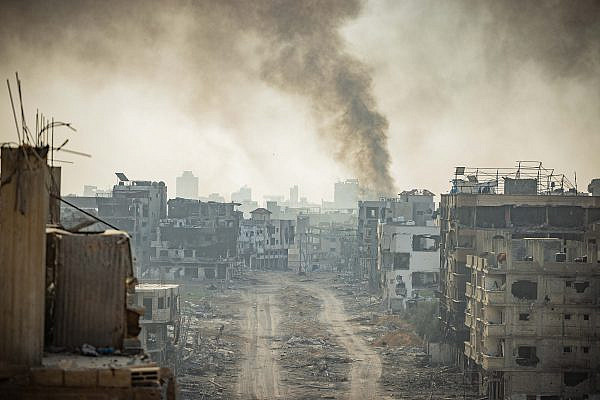
And perhaps that is why the painting speaks to us today with such great power. In the face of the genocide in Gaza, state-backed settler pogroms in the West Bank, and the violence and crime plaguing Palestinian society in Israel, we look once again at that stooped old man. Not because we want to idealize his suffering, but because he reminds us that, even under immense pressure, we can still refuse to let go of what matters to us.
Sliman Mansour taught us this without writing a single word. In his honor, we will continue to carry, we will continue to struggle, and we will continue to walk.