

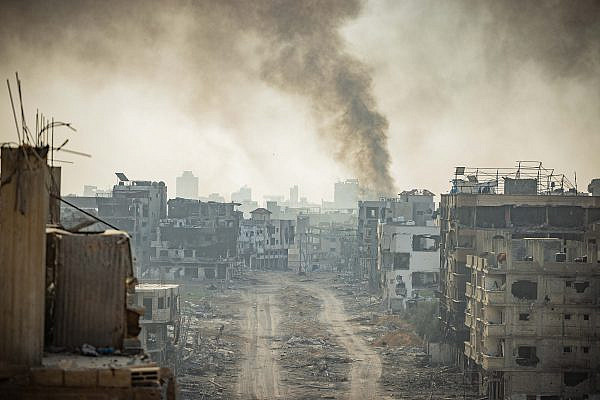
For the third consecutive year, the holy month of Ramadan arrives in Gaza bearing painful memories of the life we no longer have. A holiday once marked by lively streets, plentiful meals, and easy moments with loved ones now takes place amid streets scarred by bombs and swallowed by darkness.
Food and water are scarce, and many of the people we once celebrated with are gone. Over the past year, my beloved mother, uncle, and grandmother have all died from medical conditions — deaths that were likely preventable were it not for the conditions imposed on us by Israel. Their absence has turned this month, once a time of joyful gathering, into a season of lonely grief.
Before the war, Ramadan was the most peaceful time of the year. My soul was nourished by crowded family tables, long visits with friends, and the quiet discipline of teaching my body to endure hunger and thirst. I could never have imagined that only a few years later, such deprivation would be forced upon us year-round.
As a child, I clung to my parents on the eve of Ramadan, unable to contain my excitement for the celebrations spilling into the streets. We would walk to Souq Al-Zawiya, Gaza City’s historic, bustling market, to purchase everything we needed for the month: decorations, tablecloths, meat, spices, pickles, trays of Ramadan sweets, and mulukhiyah, the beloved stewed greens traditionally served in Palestinian households’ first Iftar.
I remember lingering in front of the souq’s lantern seller, picking one up and putting it back, unable to decide which color I loved most. In the end, I always chose the one that shone the brightest. We hung it from our apartment balcony facing the sidewalk. Families and shopkeepers did the same, until entire streets glowed with soft yellow light.

After the first Iftar, I would meet my friends to debate which mosque we should go to for Taraweeh, the special prayers of Ramadan nights. We carefully mapped out our evenings, squeezing in visits between one family home and the next. The month, wrapped in prayer, laughter, and community, unfolded gently.
It was, in every sense, a time of peace.
This year, even after four months of a so-called “ceasefire,” Ramadan in Gaza remains unrecognizable. Israeli forces still dominate the skies over the Strip, carry out intermittent bombings, and push the so-called “Yellow Line” deeper into Gaza day by day.
At least 618 Palestinians in Gaza have been killed in Israeli attacks since the ceasefire began on Oct. 10, including nine since the start of the holiday last week. Families struggle to find the basic ingredients for nightly meals, as food entry remains tightly restricted and subject to Israeli approval. What little is available is priced far beyond reach. And the threat hangs in the air: Israel appears terrifyingly close to shattering the ceasefire again, or once more choking off the entry of food, as it did last year.
Since the start of the war, I have refused to evacuate northern Gaza. Through Israel’s relentless bombing, ground incursions, and restrictions on aid, I have remained in Gaza City. I carry a heavy survivor’s guilt — I am here to witness another Ramadan in Gaza when more than 72,000 people killed in Israeli attacks over the past two and a half years are not.
A stolen holiday
The first Ramadan after the war began arrived during a period of acute, forced starvation. With Israel’s siege preventing aid from reaching hungry hands, finding a single loaf of bread felt like a miracle; my family had run out of meat, fish, vegetables, and fruit long before the month even began.
Displaced for the third time, we crowded into my aunt’s home in eastern Gaza City’s Al-Sahaba neighborhood — 11 of us from my immediate family alone: my parents, two sisters, and their children. In total, 48 people shared the 120-square-meter apartment, with only a single toilet. There was little room for celebration. We broke our fast with whatever food we could find: lentils, beans, and rice. When even that ran out, we began cooking collected grass just to have something for Iftar.
Israel relentlessly bombed many of Gaza’s mosques, forcing worshippers to perform Taraweeh in tents, school classrooms, or hospital shelters. But even these spaces were not safe. On multiple occasions, the army targeted makeshift prayer areas during hours of worship.

With each scarce Iftar, conditions in Gaza deteriorated, and so did my mother’s health. Her diabetes and asthma medications were unavailable at the few pharmacies still operating, and she began suffering from new pain that, three months later — when Israel finally granted permission for her evacuation to Egypt — doctors diagnosed as late-stage pancreatic cancer.
Last year, Ramadan again began during a fragile ceasefire, inviting a flicker of hope. I thought those brief, uncertain days of calm might offer space for reflection and healing. I did not expect the genocidal war to resume less than three weeks later.
In the days leading up to the first Iftar on Feb. 27, 2025, I walked through Gaza City, taking in the Ramadan atmosphere we had been robbed of the year before. A few homes — some partly destroyed — hung weak, flickering colored lights from their balconies. But most of Gaza City remained without consistent electricity, shrouded in darkness.
Drones hovered above us almost every day, especially around Iftar. Their constant buzzing followed us as we broke our fast, interrupting the holy nights with a familiar reminder: In Gaza, danger is never far. Still, vendors lined the streets, trying to sell whatever vegetables or sweets they could obtain.
As a journalist, I spoke to dozens of people, asking them about their preparations for Ramadan after more than a year of war. Many spoke of trying to revive the spiritual calm and social unity that define the month, clinging to memories of happier years and to hope for brighter days. But no one escaped the grief of the genocide. Nearly everyone had lost something invaluable — relatives, neighbors, entire families.
I, too, thought constantly of two of my closest friends, five cousins, and dozens of relatives and friends killed in Israeli attacks. I longed to reunite with my displaced family, especially my parents, who had evacuated to Egypt for my mother’s treatment.
Each Iftar, I remembered the hundreds of Ramadan meals we once hosted at our home, how it overflowed with chaotic energy. I used to set the table while my mother hurried to finish cooking; we always broke our fast together, cleaned up, then made coffee. Even though we spoke frequently by phone throughout the month, the physical distance made the loss of Ramadan feel heavier still.

But the worst was yet to come.
On March 2, Israel again sealed Gaza’s borders, halting all deliveries of food, aid, fuel, and medical supplies. Grocery shelves emptied. The price of the little food that remained skyrocketed. When our cooking gas ran out, we once again resorted to preparing meals — mostly canned food — over makeshift wood fires.
Normally, people gather outside after Iftar — to stroll, talk with neighbors, share food. But last year, after sunset, the Israeli-imposed blackout swallowed Gaza City in darkness. Some people carried battery-powered lamps; others, like my family and me, lit candles. Even so, stepping outside after dark was a risk.
Still, one night after Iftar, I rode my bicycle to visit my friend Ibrahim. He was living in his partially destroyed home on Al-Nasser Street in western Gaza City, about eight kilometers from my house.
I used my phone’s flashlight to illuminate the road, but I fell off the bike twice after striking torn pavement I could not see in the dark. When I reached his neighborhood, I circled the streets searching for his home but could not find it until neighbors pointed me in the right direction, even though I had made the trip hundreds of times.
When I finally arrived, Ibrahim laughed bitterly. Even he sometimes struggled to recognize his own house at night. Partially collapsed and surrounded by makeshift tents, it looked nothing like it once had.
We sat on the rubble that had once been his balcony, where we used to drink tea and laugh with our friend Ahmed Kaid, who was killed in an airstrike early in the war. We spoke little. Our silence and shared glances said enough.
Most read on +972
Nothing can bring back the lives we lost. Yet we still hold onto hope for a future shaped by peace, for a Ramadan no longer defined by wounds. Above all, we are grateful that we survived.
Today, where tables once overflowed with rich dishes shared among relatives and neighbors, Gazans struggle to feed their children from scarce humanitarian parcels. People still bless their simple meals. Families still break their fast together. Worshippers still perform Taraweeh in the ruins of mosques or on carpets laid in the street.
In this third Ramadan in the shattered Strip, people are still finding ways to hang a few lights, put up simple decorations in their makeshift tents, and hold on to dignity, faith, and the quiet determination to live among what remains.
But all of us still here cannot help but wonder: Will we live to see the next Ramadan in Gaza?