


In partnership with

On the eve of the 61st Venice Biennale, which opened earlier this month, several of the festival’s most anticipated artists announced that they were refusing to exhibit their work. The 24-hour strike, in protest of the festival’s decision to include official pavilions from Israel and Russia, was organized by the Art Not Genocide Alliance, which had already galvanized hundreds of activists days earlier to block the entrance to Israel’s pavilion with banners reading “No artwashing genocide.”
About a week before the opening, the Biennale’s five-member jury resigned, declaring that they would not judge pavilions representing countries “whose leaders are accused of crimes against humanity by the International Criminal Court” — namely Israel and Russia.
This year’s edition of the prestigious international art festival featured 100 different national pavilions, each showcasing artists representing their country. Israel, which has maintained a pavilion since 1950, was represented by Romanian-born Israeli sculptor Belu-Simion Fainaru. Russia’s pavilion, meanwhile, was reinstated after being barred following the invasion of Ukraine.
“Here, the only veto is pre-emptive exclusion,” Biennale president Pietrangelo Buttafuoco said in response to criticism of the countries’ inclusion. Appointed by Georgia Meloni’s government in October 2023, the right-wing journalist and public intellectual defended the decision, adding: “This is a Biennale that does not seek to resolve issues, but to showcase them.”
While the Biennale’s main exhibition, “In Minor Keys,” by the late Cameroonian-Swiss curator Koyo Kouoh, contains some references to Israel-Palestine (visitors encounter the poem “If I Must Die” by slain Gazan writer Refaat Alareer at the entrance, alongside an installation by the queer women artists’ collective fierce pussy featuring a dismantled Palestinian flag), Italy does not recognize the State of Palestine, leaving Palestinians without an official national pavilion.
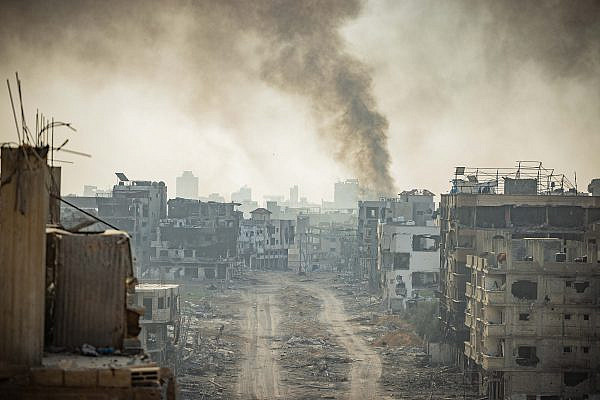
In addition to the 100 national pavilions, however, there are 31 collateral events — and one of them insists on centering Palestinian voices. “‘ _____________’ * * Gaza – No Words – See the Exhibit,” organized by the Palestine Museum US and officially recognized by the Biennale, brings 100 works of tatreez (traditional Palestinian embroidery) to the heart of Venice. Each embroidered panel recreates an image from Israel’s genocide in Gaza and was handmade by Palestinian women living in refugee camps across the West Bank, Lebanon, and Jordan. Together, the panels form what organizers call “the Gaza genocide tapestry.”

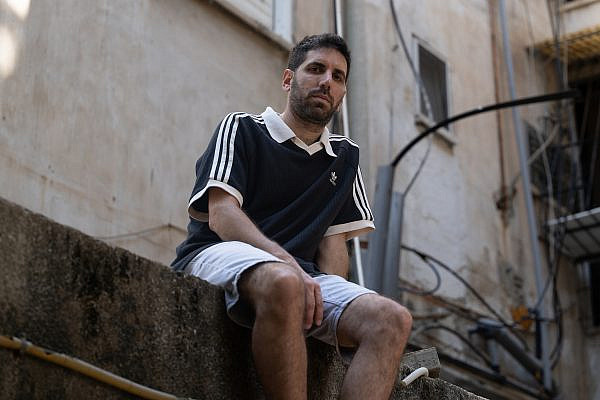
Faisal Saleh, a Palestinian-American entrepreneur and founder of the Palestine Museum US in Woodbridge, Connecticut, is one of the exhibit’s four curators. His family is originally from the village of Salama, near present-day Tel Aviv, and was displaced during the Nakba of 1948. Saleh grew up in Ramallah and lived through Israel’s occupation of the West Bank in 1967 before moving to the United States to study. He eventually built a career as an entrepreneur and, after retiring, founded the first Palestinian museum in the United States.
As protests disrupted the Biennale’s turbulent opening days, thousands of visitors — including many tourists who had not come to Venice for the festival itself — passed through the centrally located free exhibition each day. Moving through the gallery, viewers recognized the haunting images on which the embroidered works are based. Up close, the intricate stitching draws the eye, but as the viewer steps back, a full image is revealed.
In an interview at the exhibition, Saleh spoke with +972 Magazine about the process of conceptualizing and executing the project within one of the world’s most politically charged artistic spaces. The interview has been edited for length and clarity.
What was the intention behind the exhibition?
We [the curators] want the world to come face-to-face with what it allows to unfold. We hope that the [artworks] will make people think about the need for accountability and justice. In other words, we don’t want these things to be forgotten. These are reminders and they will be preserved forever.
And we wanted to bring Palestinian art to the summit of the art world. The Venice Biennale is the Olympics of the art world. We wanted to bring the [art of] Palestinian women who labor in the refugee camps to the same level as women artists from other countries. Their names matter. Most of them did a lot of commercial projects where dealers would take their work and sell it. But now this [is displayed publicly] under their name. They get credit.

Why did you choose tatreez as the main artistic medium?
The idea is to promote and present the Palestinian story and political narrative. We came up with the concept of using tatreez because it’s done by Palestinian women in the refugee camps in Lebanon, in the villages of the West Bank, and in Jordan. We have seven groups, and we assign work to them, and the coordinator would commission specific women to do specific pieces. The West Bank [work] gets collected and sent to Amman. The Ain Al-Hilweh [work] goes to Beirut, and we have people transport them when they’re traveling to Europe.
I told my group that we wanted to create 100 pieces of embroidery in one year. I knew it took 12 years to create the 100 that we had in the museum about Palestinian history. But I said, ‘There’s a sense of urgency with regard to Gaza.’
Why not photography? And how did you choose which images to base the embroidery on?
I didn’t want to do a photography exhibit because people saw all these photographs on social media. A photo is very explicit often, but a painting would have abstraction in it. So does this: This is made out of dots. If you stand two meters away from it, you’d see it like a photo. But if you get closer, you start seeing the dots. There are 55,000 stitches in each piece.
The [embroidery] technique slows down the way you see the horrific reality presented in these images. It takes a long time to do: A woman is looking at each of them for two and a half months, seeing the image develop bit by bit and having to live with that image for that long.
Somehow, it’s a lot more touching when you see it in the embroidery and you think about who did it and how they did it; it’s just a different feeling than looking at a photograph. The women [who embroidered them] are refugees from 1948, and they see what’s happening in Gaza as an escalated version of what happened in 1948, a continuation of the same policy.

We have seen mass protests and a strike calling for Israel not to take part in the festival, but the president of the Biennale said the festival is not going to ban anyone. How do you see these two political approaches as an artist?
I think up until now it was okay to follow the thinking [that anyone can participate]. But what Israel has done has reached certain depths, certain levels of atrocities and horrific unspeakable things that call for a new standard of human behavior. Below [this standard], nobody should be allowed to participate in international competition — not just the Biennale, but Eurovision, FIFA, the Olympics, all the international gatherings, and Hollywood film competitions. The Biennale, along with all other organizations, needs to define where the human condition begins and where it ends.
At what point will [a country] disqualify itself from being among the nations of the world who believe in human rights, and who are not willing to go below a certain level? The ones that exceed that [threshold] should not be allowed to participate. In my opinion, at this point, Israel should not be allowed. I would not want to be in the same place as the people that did all these horrible things. It’s not fair to expect other artists in other countries to be there [either], because you are putting them in an awkward situation where they have to choose between respecting human life and exhibiting their artwork.
How do you see the fact that Palestine does not have an official pavilion at the Biennale?
You know what will happen if Italy eventually recognizes [the State of] Palestine, and Palestine becomes eligible for a pavilion? Guess who’s going to try to control that pavilion: the Palestinian Authority. That’s a problem for us because those people do not represent the Palestinians. They represent themselves, and they don’t work for the people. They do Israel’s bidding and Israel’s dirty work in the West Bank.
Under no circumstances will we Palestinians accept them being in charge of something important like that. So hopefully, if something like that happens, there will be some sort of democratic process that determines who will be exhibiting and how that works — an open process without any corruption and control by any one particular party.

How did your family’s history of enduring the Nakba of 1948 influence your work?
We’re from Salama village — Kfar Shalem as Israel renamed it — in what is today southern Tel Aviv. Our village was totally emptied and destroyed [in the Nakba]. We ended up in Al-Bireh [near Ramallah], where I was born in 1951. I was the 11th child in my family, and we lived in one room. [It was] not an easy life, but we all made it.
In 1967, we could see from Ramallah the bombing of Nabi Samwil and Jerusalem. [The Israeli army] entered Ramallah and bombed it, causing the Jordanian army to run away.
I came to the United States in 1969, studied, worked in business for 40 years, and then retired and started working for the Palestinian cause. I worked with some people who wanted to set up a museum, but I didn’t like how they were doing it, so I left them and worked on my own, creating the first [Palestinian] museum in the western hemisphere.
Most read on +972
Do you think this exhibition is itself a kind of response to those who say art should be apolitical, that it should be neutral?
Gaza broke all the rules. I was faced with the question, how do you curate a genocide? There’s no manual. There’s no book that tells you how to do it.
I had to do a lot of thinking, connect a lot of points, and come up with something that was powerful, that tells the Palestinian story in Gaza beyond any doubt. I can assure you, anybody that walks through this [exhibit] comes out a different person.