


Since October, we journalists in Gaza had hoped that the declaration of a ceasefire would finally give us space to catch our breath. We did not dare to dream of a permanent peace, but only to go out to work without minding every step as if walking through a minefield, and without saying goodbye to each other every morning as if it were the last time.
We knew that over 250 of our colleagues had been killed by the Israeli army since October 2023. And we saw Israel continue to kill hundreds of civilians over the past three months, in clear violation of the ceasefire. Yet we had clung desperately to the belief that the end of the war meant an end to our systematic targeting.
The killing of three more journalists on Jan. 21 shattered this belief.
That day, Muhammad Qishta, Abdel Raouf Sha’at, and Anas Ghneim were on a media assignment for the Egyptian Committee, a humanitarian organization working under Egyptian government supervision to provide aid and relief in various areas of the Gaza Strip. All three journalists were documenting the Committee’s efforts to build a new camp in the Netzarim area in the central Gaza Strip. After departing the site in their car, they were struck and killed by Israeli forces, who accused them of operating a “drone affiliated with Hamas.”
For me, this news was not just another number in the growing toll of journalists Gaza had lost to Israeli attacks during the war. Abdel Raouf Sha’at and Muhammad Qishta were not only colleagues, but part of my daily life. Their voices are still clear in my memory; I can still hear their laughter from just days before they were killed.
I remembered the last message from Abdel Raouf (Abed, as we used to call him): “If you need any number of medical cases or martyrs in the eastern region [of Gaza], I am available.”
I remembered Muhammad’s calmness as he said, “Write quietly: The war is long, but the just word lives on.”

Today, they are no longer there to provide a number, a tip, or a link to a source. But what they leave behind is even greater: a model of what it means to be a journalist in Gaza, to work knowing that every time you leave to cover a story may be the last, and yet you go anyway.
I write these words now, in part, as a professional duty to colleagues — to ensure that Muhammad, Abed, and Anas are remembered as individuals, and not just numbers on a news bulletin. But I also write out of a personal debt to two friends who were part of my journalistic life, present in the few moments of joy we experienced amid this destruction.
‘We don’t have much time for joy’
Abdel Raouf Sha’at was originally from Rafah and was displaced in April 2024. At 35, he had been working for several years as a freelance cameraman for Agence France-Presse (AFP) and CBS News.
I met Abed years ago through our work in journalism, and we quickly became friends. He was a cheerful person, and someone ready to help even before you knew to ask. I would often text him late at night when I was on deadline, asking him if he had specific data. He would reply within minutes: “Just a few seconds, I’ll check the source, and I’ll get back to you.”
He knew how to gather information — and more importantly, how to verify it before sending it out. He did not treat the numbers as cold data, but always tried to convey the stories of real people behind them.
I remember, too, that Abed was there when an Israeli airstrike targeted a journalists’ tent in Khan Younis in April 2025. A fire broke out and journalist Ahmed Mansour, paralyzed by shrapnel, was burning alive. Abed dropped his camera while it was still rolling and succeeded in dragging his colleague out of the tent, burning his own hand in the process.
When I asked him why he risked his life, he told me, “I moved without thinking — I only thought about how to save him. He is a friend and colleague, and it was hard to watch him burn.” Sadly, Mansour later succumbed to his wounds.

On Jan. 3, only 18 days before his killing, I attended Abed’s wedding. It now feels like a scene from another life: Abed laughing, greeting family and friends, talking passionately about his future plans, and about stories he wanted to cover “after the war calms down a little.”
When I met him during the previous ceasefire in January 2025, I said to him, half-jokingly: “It’s time to get married, isn’t it?” “I don’t want to leave my wife a widow,” he replied. “We have to wait until the war stops.” And he waited, too, after the ceasefire announcement in October, wanting to be certain that the hostilities had ended before saying his vows.
Just five days after the wedding, he returned to work, writing in a Facebook post: “We don’t have much time for joy — we have to go back to document the crimes of the Israeli army against our displaced people [living] in tents in the Gaza Strip. Our joys may be postponed, but our message cannot, and the mission will not stop. This is our promise.”
The last time I saw Abed was when we met at the Gaza Journalists’ Syndicate, less than a week before he was killed. After joking about our shared journalistic exhaustion, he said to me: “We are not just reporting news, we are witnesses, and the witness does not have the luxury of withdrawing.” Now another witness is gone.
‘He always checked on me’
Muhammad Qishta, 36, was also a resident of Rafah, displaced to the Al-Mawasi area of Khan Younis in May 2024. He was a father of three boys, and five days before he was killed, his wife gave birth to a girl, whom they named Wafa. I remembered him telling me that he had prayed to God for a daughter.
Muhammad worked for the Egyptian Committee, and he was another example of a journalist who was calm, organized, and always eager to help anyone in need. He didn’t speak much — but when he did, he always said something worthy of your attention.

I worked with him on several articles related to the Egyptian Committee, and was impressed by his consistent focus on accuracy over speed. If he was not sure about certain information, he would tell me frankly: “I cannot confirm the number 100 percent — let me refer to a second source.”
Muhammad did not seek glory, nor a scoop at any cost; he knew when to speak and when to be silent, and was always concerned not to harm anyone with an unconsidered word, and not to add to an already chaotic reality. As a colleague, he was easy-going, but in fact he was deeper than that — always respectful of people’s pain, his colleagues, and the profession itself.
During the funeral for Abed, Muhammad, and Anas, I met Muhammad’s second cousin Wissam Qishta, 27, who lives in the same camp as Muhammad did. In tears, she told me, “Muhammad was my neighbor in Rafah [before the war] and also in our displacement. He always met the needs of anyone who knocked on his door — but he did not wait for me to approach him, he always checked on me.
“I remember our last Ramadan in Rafah, on the night before the Eid, he knocked on my door and gave my children sweets,” Wissam added. “And during the famine and drastic rise in food prices, as I was sitting in my tent, I was surprised to see a young man bring me a package of vegetables without me asking. He told me, ‘Abu Salah [as Muhammad was also known] sends you greetings, and says: Enjoy it in good health.’”
Just a week before he was killed, Wissam contacted Muhammad to tell him that her tent had been worn out and soaked through by rain. “He came and provided me with a fully equipped tent, as well as food.”
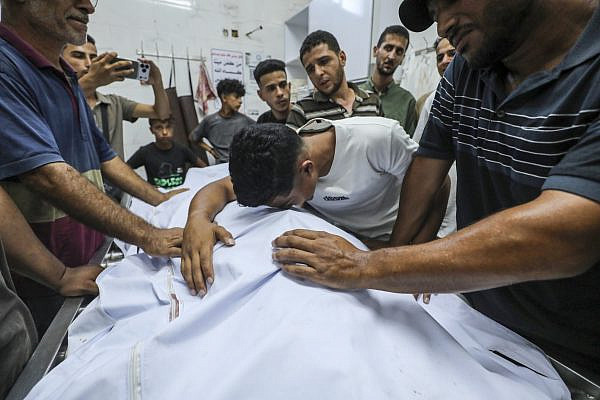
Now, Wissam says she no longer knows who will check on her or help her when she is in need. We cried together as we laid Muhammad to rest.
‘My heart breaks for Anas’
Like Abed and Muhammad, 25-year-old Anas Ghneim was from Rafah, and was displaced to Khan Younis with his wife and two sons in May 2024. He was his mother’s only son, and his father was killed when he was just 50 days old. When Anas was killed, his youngest son was also 50 days old, as if orphanhood is a hereditary condition in the Gaza Strip.

While I didn’t know Anas personally, those who did described him as a special person and journalist, as well as a highly skilled drone operator. “My heart breaks for Anas — he was a hard-working, dedicated, and loyal person,” his friend Yasser Adwan, a freelance journalist, told me. “We used to meet a lot, most recently when we were documenting a ceremony in Khan Younis for students who had memorized the Quran.”
Imad Abu Shawish, an administrator at the Egyptian Committee, offered more details about the site that the three journalists were documenting before they were killed. “We are working to establish camps for people who were displaced from their homes as a result of the Israeli aggression, where we can provide them with aid and give them some relief. We have 17 camps in different areas of Gaza,” he told me.
“The Egyptian Committee demanded clarifications about what happened,” Abu Shawish continued. “Our colleague Muhammad Qishta was on a routine humanitarian mission to photograph the camps that are being established in the area of Al-Zahra and Netzarim, in the western part of the Gaza Strip, far from the places where the Israeli army is present. How did they pose any danger?”
The killing of Anas, Abed, and Muhammad is no exception in Israel’s continued targeting of Palestinian journalists: In the final months of 2025, even after the announcement of the ceasefire on Oct. 10, Israeli strikes killed production engineer Ahmed Abu Mutair, reporter Mohammad Al-Munirawi, and photojournalist Mahmoud Wadi.
Each time, we told ourselves it might have been a mistake or coincidence. But the repetition of the crime — particularly during the so-called truce — leaves no room for doubt. It proves that there is no safe time to be a journalist in Gaza, no “post-war” period, and no guarantee that tomorrow will be less dangerous than yesterday.
Most read on +972
Under international humanitarian law, journalists are civilians, and targeting them is a crime. Their continued killing raises serious concerns about impunity, the lack of international accountability, and the failure of protection mechanisms. But this cold legal language, however important, will not bring back Abed, Muhammad, Anas, or any of our colleagues who were killed before or after the ceasefire.
When journalists are killed, we lose not only individuals and colleagues, but deep expertise, reliable sources, and witnesses to crimes who protect the truth with their bodies. As long as Israel continues this practice, the question is not when will the war end, but when will the killing of witnesses stop?