

The Defense Tech Expo, hosted over two days last week at a convention center in Tel Aviv, was Israel’s largest weapons exhibition since the beginning of its war of annihilation in Gaza. Sponsored by Israel Aerospace Industries, it welcomed dozens of Israeli arms and security companies to show off their latest technological advances to prospective buyers from around the world.
Greeted at the entrance with complimentary champagne, international delegations moved between the different booths with their translators, stopping to listen to each company’s sales pitch. At one of the larger displays organized by the company Smart Shooter, an Israeli teenager — probably just before military service — played with a rifle, looking through the sight and marveling at the promise of what it could do: shoot down drones, chase moving targets, and turn every soldier into a sharpshooter.
As if to showcase the absurd reality of Israel in 2026, the exhibition took place in the very same pavilion that only a day earlier had played host to a conference on how to treat trauma in the shadow of the war. As trauma experts discussed their ideas, staff at the convention center were busy laying out missiles and drones in preparation for an exhibition aimed at selling more of the weapons that made this war possible.
The exhibition represented something of a paradox: While Israeli arms sales have surged by more than 18 percent since 2022, this year’s conference was significantly smaller than its counterparts prior to 2023.
For comparison, the most recent iteration of ISDEF, Israel’s largest arms exhibition, which was held in 2022, boasted 12,000 visitors and delegations from 36 countries. Official numbers for this year’s Defence Tech Expo have not yet been published, but the hall inside the convention center that hosted it accommodates only 450 participants. Moreover, according to a leaked internal document, organizers appear to have struggled to even bring the roughly 20 international delegations that were invited to attend, with several of them seeming not to show up at all.
Walking around the exhibition, one could easily notice far fewer attendees and official delegations from foreign states, and generally much less English spoken. The overwhelming majority of attendees were Israelis — from companies hoping to sell their latest wares, or to scout out the competition from other companies — but not the foreign state procurement delegations that were once the core of these exhibitions.
So how does this square with the uptick in arms sales over the past two years?

‘Elbit and Rafael aren’t here at all’
On the one hand, some two dozen countries have announced that they will halt or restrict arms trade with Israel. In the past year, Spain, the United Kingdom, and the Philippines have all canceled deals already signed with Israeli companies, apparently due to political pressure. On the other hand, Israeli defense exports rose from $12.5 billion in 2022 to $14.7 billion in 2024 — and although figures for 2025 have not yet been published, this number is expected to continue rising.
According to The Database of Israeli Military and Security Exports (DIMSE), a project by the Israeli anti-militarism movement New Profile, the majority of these exports (accounting for 54 percent of the total) are to European countries; in the past year alone, Germany signed procurement agreements for Israeli weapons systems worth €7 billion.
In other words, while major arms exhibitions are shrinking and foreign guests are not arriving, sales of weapons systems used in the genocide in Gaza are skyrocketing. While Israel is increasingly seen as a pariah and boycotted around the world, the Tel Aviv Stock Exchange recently launched a new index of Israeli defense companies. How do we make sense of this?
An American accountant who works with defense companies, standing next to me in the line at the exhibition entrance, inadvertently provided a clue. “It’s just disappointing that Elbit and Rafael aren’t here at all,” he said. Indeed, two of Israel’s three largest weapons companies didn’t have displays at the largest arms exhibition held in the country in nearly four years.
This is the crux: Israeli weapons companies do not need public arms exhibitions to sell their technology, and their main buyers are not interested in being seen at them. Arms trade with Israel has neither ceased nor diminished; it has simply gone underground.
This is reflected not only in the absence of major sellers and buyers from arms exhibitions, but also in the establishment of more subsidiaries and partnerships in Europe that allow countries to purchase Israeli weapons systems on European soil — while still claiming to their voters that arms deals with Israel have been canceled.

Spain, which stands at the forefront of the arms embargo on Israel, canceled a €285 million deal in June to purchase Spike missiles from the Israeli company Rafael. Yet last week it was reported that Spain will instead purchase the missiles from EuroSpike, a joint venture between German and Israeli companies in which Rafael owns a 20 percent stake. By transferring weapons production to Europe, Eurospike essentially enables broader sales of Israeli Spike missiles (under their new name) to European countries that are required to procure locally, prefer not to admit that they are buying Israeli weapons, or both.
Another example can be found in Croatia and Serbia: both announced that they would stop arms deals with Israel, yet continue to purchase Spike missiles, and Croatia continues to purchase the Trophy weapon system (also produced by Rafael).
Although most examples here are from Europe, even Colombia — leader of “The Hague Group,” a bloc of countries calling for clear sanctions against Israel, including a full arms embargo — continues to use technology purchased from Cellebrite, the notorious Israeli phone-hacking company.
A different demand
Spain, Croatia, and Colombia are not alone. Again and again, we see examples of countries announcing a halt to arms trade with Israel or the cancellation of deals, before finding quieter ways to obtain the weapons. This fact requires anyone active in support of an arms embargo on Israel to pay attention not only to what happens at arms exhibitions but also behind the scenes, and to demand accountability from states that violate their own stated decisions.
At the same time, we need to develop a deeper understanding of the military economy. For decades, the Israeli arms industry has surged following military operations, but this is far from the only relevant indicator: its growth is tied to activity across the global military-industrial complex.

In February 2022, with the Russian invasion of Ukraine, Elbit Systems’ stock began a moderate rise. Its next increase did not occur until June 2024, in the midst of the genocide in Gaza and before the missile exchanges between Israel and Iran — seemingly a random date in the local context. But this was the month the European Union signed its security commitment agreement with Ukraine, which included pledges not only to arm Ukraine but to significantly increase European rearmament.
The next sharp rise occurred in March 2025, with EU leaders’ announcement of the ReArm Europe Plan; and again in November 2025, with the EU Council’s announcement of an incentive plan for investment in the military industry.
The stock of NextVision, which supplies optical systems for various drones used in Gaza over the past two years (among other places), shows very similar trends, with another jump in mid-2025 following NATO members’ decision to more than double their military expenditure target from 2 to 5 percent of GDP by 2035. Elbit’s stock, which has surged by 250 percent over the past two years, traces a similar trajectory.
In countries around the world, civil society succeeded in persuading their governments to stop selling weapons to Israel only after great efforts, and only during an ongoing genocide. Yet so long as the demand is merely to not buy weapons directly from Israel, governments will find the back door. The demand must be to stop buying these weapons, period.
Most read on +972

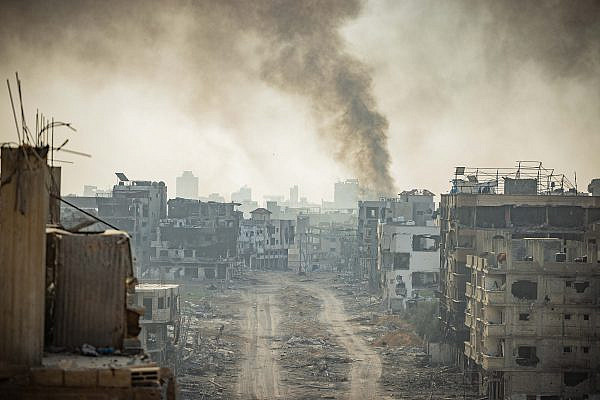

The military-industrial complex is a global system in which the defense industries of different states — and the war crimes of their armies — are intertwined. Stopping Israel’s crimes by halting the arming and financing of its military will not be possible without seeing the global picture.
Otherwise, all we will achieve are smaller exhibitions and fewer procurement delegations, while the Israeli defense industry continues to generate billions selling weapons involved in genocide to the entire world.