

In partnership with

The 21st Joint Israeli-Palestinian Memorial Ceremony, held annually on the eve of Israel’s Memorial Day and organized by Combatants for Peace and the Parents Circle–Families Forum, was held on Monday evening at an undisclosed location in Tel Aviv for the safety of participants. The ceremony offered bereaved Israeli and Palestinian families a rare space to jointly mourn loved ones lost to the conflict, and to raise their voices in calling for an end to war and Israeli occupation.
Since its inception in 2006, the ceremony has grown from a small gathering with a few dozen attendees into one of the largest joint Israeli-Palestinian peace initiatives. This year, it was broadcast live to more than 60 satellite screenings across Israel, the West Bank, Europe, North America, South Africa, and Australia.
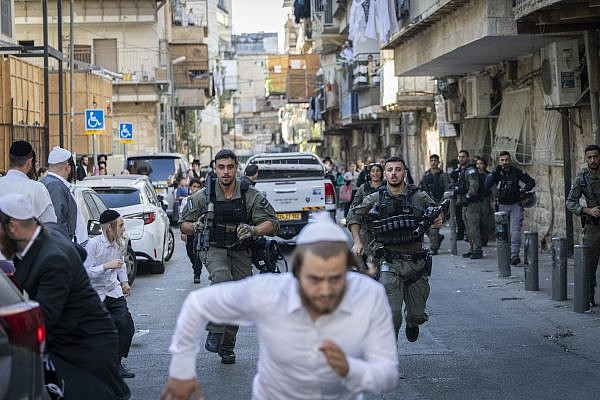
In recent years, the event has faced sustained opposition from Israeli authorities and right-wing groups, the former of which have rescinded permits of West Bank activists, blocking them from attending the Tel Aviv ceremony and prompting organizers to establish parallel events in Beit Jala and Jericho. Last year, far-right activists stormed a screening of the alternative ceremony at a Reform synagogue in the central Israeli city of Ra’anana, shouting slurs and hurling objects.
Although some of the screening locations were not announced publicly this year precisely for this reason, dozens of right-wing activists managed to locate one screening in south Tel Aviv, which they attempted to disrupt by playing loud music and chanting slurs including “death to leftists.” Earlier in the week, Communications Minister Shlomo Karhi demanded that Israeli public broadcaster Kan not advertise the ceremony.
On the other hand, some pro-Palestinian voices have suggested that the ceremony advances a liberal Zionist narrative of false equivalence between Israeli and Palestinian suffering.
Despite these criticisms, over 800 people attended Monday’s ceremonies in Tel Aviv and Jericho, in addition to the nearly 22,000 that tuned in online. As settler terror intensifies in the occupied West Bank and Israel continues to violate the ceasefire in Gaza — while more substantive but still fragile truces hold in Iran and Lebanon — the event offered a rare opportunity for collective grief and a shared rejection of violence.
‘One dream remains’
The ceremony was co-moderated by Sivan Tahel, an Israeli journalist and activist, and Ibrahim Abu Ahmad, a Palestinian human rights activist and host of the “Unapologetic” podcast. As in previous years, the program centered on testimonies from bereaved Palestinians and Israelis, punctuated with musical performances.
A video segment also highlighted the experiences of displacement and loss over the past two and a half years. Within Israel, it included footage of the destruction in the kibbutzim of Kfar Aza and Be’eri following the October 7 attack, as well as accounts from a resident of the Palestinian city of Tamra whose home was struck by an Iranian missile. On the Palestinian side, it featured Bedouin families displaced from Ras Ein Al-Auja by violent settlers, and residents of Silwan in East Jerusalem whose homes were demolished by Israeli authorities.
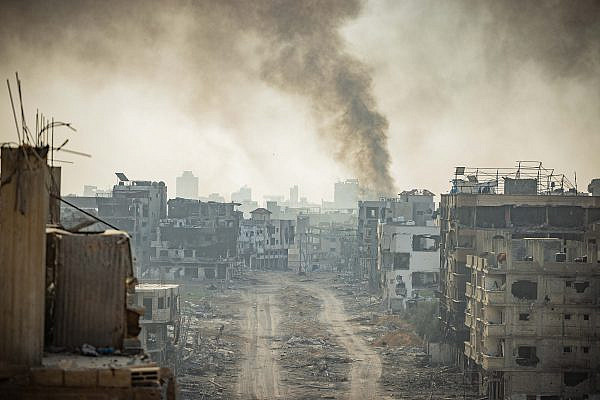
As in the previous two ceremonies, Gaza featured prominently in Monday night’s program. In a pre-recorded video, Nahil Hanuna, a 29-year-old photographer, spoke about the devastating toll that Israel’s assault has had on her family.
After the start of the war, Hanuna fled south with members of her family in search of safety, but her brother Rami and his wife Islam — who had become pregnant after seven years of trying to conceive — stayed in the north. They were killed just a day before planning to seek refuge in the south with the rest of the family. “Their building was bombed while they were inside,” Hanuna said. “Twenty-seven people were killed.”
Shortly afterward, Hanuna said, her brother Ramez was also killed, alongside his wife and children. “We got a phone call at around 1:30 a.m.,” she recounted. “Ramez, his wife, and children were all killed, and their bodies were torn to pieces.”

Despite the scale of her loss, Hanuna made a broader plea to the live audience in Tel Aviv: “After all the pain and loss I have shared with you … one dream remains in my heart. I hope the whole world hears it: We Palestinians are human beings just like everyone else. We want to live freely and in peace. We weren’t created to spend our whole lives at war.”
She described the future she longs for in simple terms: Waking without hearing the sound of shelling, living free from occupation, and loving her homeland without fear.
Ayala Metzger, whose father- and mother-in-law, Yoram and Tami Metzger, were abducted from their home in Kibbutz Nir Oz in the October 7 attack, shared Hanuna’s sense of rupture and longing for her deceased family member (Tami was released in the initial truce in November 2023; Yoram was killed in captivity in February 2024).
“Only in the afternoon [on October 7] we heard that Yoram and Tami were kidnapped to Gaza,” she recalled. “From that moment on, our family routine stopped. No more Friday night dinners and family gatherings — we stopped taking care of the house, cooking, and cleaning, and we were focused only on saving grandpa and grandma.”
Metzger said her family quickly became part of a small group publicly calling on the Israeli government to end the war through a deal to secure the hostages’ release. “Once we went public with that message, we faced heavy criticism from politicians, and were met with anger and hatred in the streets,” she said. “We were accused of cooperating with Hamas and harming Israel’s unity and the war effort.”

Following the devastation of Yoram’s murder, she continued, “I made a decision to ensure his death was not in vain. I will fight to create a reality here that guarantees a safe life for everyone.”
She described that vision broadly: “A world in which both nations acknowledge each other’s existence, promote tolerance, dialogue, equality, and partnership over perpetual war, death, hatred, and revenge. A world focused on rebuilding and healing over destruction.”
Looking ahead, she added, “I imagine that on this land, from the river to the sea, children of both nations will be raised healthy, happy, free, and safe, taught to respect every person no matter who they are. This is not a far-off vision but an achievable one, and every one of us has the power to achieve it.”
‘We were part of the change’
Kholoud Hushiya, a Palestinian woman from the outskirts of Jenin who spoke via video, recounted the loss of her son Mohammad, who was killed by the Israeli army in January 2023. “Mohammad filmed on his phone the occupation army’s raid at the town of Kufr Dan [near Jenin]. Without any mercy, an Israeli soldier fired a bullet at him,” she said. “The bullet pierced his heart.”

Her voice wavered as she continued: “At that moment, not only did Mohammad die, but my heart died with him. Life became bleak. My soul has died.” She buried her son in the family garden, she said, so she could “check on him morning and evening.”
But the violence did not end after her son was shot. In February 2025, soldiers entered Hushiya’s home, ransacked it, and arrested her 20-year-old son, Abdulkarim, who remains in administrative detention to this day. “I realized that the pain I carry could be turned into a voice,” she said. “This pain is not exclusive to one mother or one people — any mother who loses her son endures unbearable pain.”
Reflecting on her loss, she said: “I gave birth to my children to rejoice in them, but the truth is that I am in pain. I carried Mohammad on my shoulders, soaked in his blood. And Abdulkarim, I do not know when he will leave their prisons.
“I stand here today to say we have chosen the path of peace, after all these losses, because we believe that bloodshed only begets more bloodshed, and that killing and loss will not give us or our children a chance to live in peace,” she concluded.
Earlier in the ceremony, Liora Ayalon, 73, from Kfar Aza, opened the speakers’ remarks by reflecting on the loss of her son Tal, the commander of the kibbutz’s emergency response team, who was killed alongside 63 other members of the community on October 7. Standing before the audience, she described the gathering itself as a source of resilience.
Most read on +972
“Today I am here because here is where hope lies,” she said. “This is the place that gives me the strength to believe that we will one day sit down and talk, and this will all be over.”
For Ayalon, that hope is tied to the possibility of a truly shared society between Israeli Jews and Palestinians. “Thanks to this partnership, I might be able to someday sit by my beloved son Tal’s grave, and whisper to the cold stone: ‘Do you hear me, my son? It happened. We talk and live together in partnership and equality — and we were there too, we were part of the change.’”