

In partnership with

When a piece of bread is thrown into a pond, fish of all sizes surge toward the morsel in an instant, tear into it, and seconds later neither bread nor fish are left. When the water is murky, the spectacle is even more deceptive. The pond appears still and empty until suddenly the fish burst upward and the surface erupts before settling again as if nothing happened.
Now imagine those pieces of bread are plots of land in a hot real-estate market. Lyd — the mixed Palestinian-Jewish city I grew up in, now officially known as Lod — has come to resemble a murky pond, and developers are the fish. Ravenous for these plots, they rush in, ripping into them, such that soon, nothing of the past will be left.
In Ramat Eshkol, a low-income neighborhood in Lod, the latest eruption is difficult to miss. Banners declaring “We won’t sign!” hang from apartment balconies — evidence of an organized campaign in which residents spurned the contracts that would greenlight the city’s latest so-called urban renewal efforts, requiring them to move out of their apartments so developers can demolish the low-slung blocks and construct towers in their place.
Normally, residents would agree to vacate and move forward with this process, known in Hebrew as pinui binui, in exchange for new, modern apartments in the rebuilt complex. But in Lod, trust between residents and the municipality is virtually nonexistent — especially among Palestinian residents, who make up roughly 70 percent of Ramat Eshkol.
Their fear is simple: that the project will strip them of their property and drive them from their neighborhood, if not from Lod altogether. Such anxiety is not unfounded — the municipality regularly advertises its ambition to attract a “high-quality” population that will “strengthen” the city, openly suggesting its current residents are “weak” nuisances in need of replacement.

The new towers will likely attract residents affiliated with the Garin Torani (Torah Nucleus) movement — a national religious-Zionist organization committed to Judaizing Israel’s binational cities. In 2015, the municipality built the Elyashiv condo complex for the movement, a gated enclave a few hundred meters west of Ramat Eshkol ringed by a buffer of roads, fences, and gates.
The complex physically separates its residents from the “weak” populations surrounding it, especially their Arab nextdoor neighbors, who cannot live in the development even if they wanted to. These struggles against displacement, municipal neglect, and demographic engineering are bound up with another, quieter form of erasure: the city’s indifference to the historical ground on which it stands. The same municipality that treats long-standing Palestinian communities as disposable also treats Lod’s past as such.
Ramat Eshkol was built in the 1970s on the ruins of Lod’s Old City. In the 1960s, the Old City, which was then populated largely by Jewish families of North African descent who moved into the homes of Palestinians expelled during the Nakba, was razed in a sweeping clearance operation that left behind a landscape of ruin. Yet when Ramat Eshkol was built, it was constructed atop the ruins rather than in their place. The housing blocks rose directly over the remains, leaving the buried layers of the Old City and those below it intact — preserved, perhaps, for future archaeologists.
But the incoming buildings — two of which have already broken ground — are to be built roughly 10 meters below the current surface, if not more, in order to carve out lucrative underground parking lots. In practice, this means obliterating layer upon layer of the city’s 8,000-year-old past, down to the pristine sands of ancient Lod.

Selective preservation
Lod is an archaeological tel — a term we archaeologists use to describe a layered hill built up over millenium, with deposits that document the location’s historical periods. Archaeologists generally fight to protect such areas from development and the Israel Antiquities Authority (IAA) routinely halts projects that encroach on significant parts of a historic mound.
But Lod was denied this protection: To qualify as an archaeological mound in Israel, a site must contain layers dating back to the Bronze and Iron Ages, or the “biblical period.” Lod’s continuous layers stretch from at least the Roman era through the 1960s, and earlier pre-Roman layers lay north of the Old City, but none have yet been found beneath the Old City itself, although they likely exist. Without this proof, Lod’s Old City is dismissed as non-biblical — and therefore non-essential — even though heritage does not begin and end with the bible.
In early November, the municipality cleared one of Ramat Eshkol’s large squares and a residential block to make way for the initial pair of towers. In doing so, it demolished a small commercial center that once stood alongside it — where Aharon’s Grocery was when we were children, and where, on the nights I slept at my uncle’s house, we’d buy chocolate milk and cake. (My own neighborhood, Hashmonaim, was originally built by the British for railway and airport staff, and had nothing like those quaint, orderly shops.)
Now, archaeologists are conducting “test pits” in the area, a method to determine the depth of archaeological layers by mechanically digging into them and effectively destroying portions of ruins before they can be properly excavated. These pits help determine how much funding the IAA will require from the developer to effectively excavate the site before building commences, a practice whose implications deserve an article of their own.

Normally, the authority secures its required funding to begin the next phase of excavation, in which excavation squares are opened and archaeologists dig to the planned depth of the future building. But in an effort to restrict the scope of the IAA’s investigations, the developer minimized its budget and got court approval to bring in consultants instead, some of them ostensibly archaeologists. After IAA archaeologists excavate the little their budget allows for, the site will be released back to the developer, who is free to clear it entirely.
I am certain of what lies — and will be lost — beneath this land. From an excavation I once directed just around the corner from where the two towers are being built with local residents, and from closely following digs carried out by others in recent years, we know the layers contain not only remains of the Old City. There are also traces of the Ottoman period, representing roughly 500 years of human culture; the Mamluk era, with nearly three centuries of history; and Crusader, Fatimid, and Abbasid cities.
At the bottom lies evidence of Byzantine and Roman cities, reaching back to the first century CE. What remains below these layers has never been uncovered here, though much certainly exists — decades of archaeological work in Lod prove it to be one of the oldest cities in Israel, and the world. Yet nearly every morsel of evidence of its earliest inhabitants has been destroyed or abandoned in excavations, because they were carried out with the explicit, singular purpose of preparing the land for “development.”
The demolished square is home to remnants of the Ottoman-era governor’s house, the tomb of Sa’ad and Saied — a gathering place for Sufis and Islamic mystics — and countless other remains that are still unknown. All of it will almost certainly be lost during construction. The square’s 2,000 years of history will be crushed and shredded, and this method will soon be replicated across the entirety of Ramat Eshkol.

In 2018, I was part of a group of activists that tried to save a neglected stretch of ancient Lod from developers eager to build on top of them. It was a fruitless effort: The municipality was uninterested in heritage, and the developers’ executives cycled through the city without any personal investment in its history. The area was released for construction, and dozens of dunams of heritage vanished.
In Israel, there is no development without destruction; the past is not seen as serving the future, at least not economically. The Northern Industrial Zone of Lod was built above the remains of a Bronze Age city once connected to the Egyptian pharaohs. Its history is now buried beneath the glass facades of bank offices that flash past train passengers traveling from Modi’in to Ben Gurion Airport.
Aharon’s Grocery was left to the same fate. As the IAA completes its partial excavation, the archaeologists working will no doubt do everything possible to document the city’s past. But even if every centimeter is recorded from each angle using the most advanced techniques, nothing physical will remain of it.
A few mentions may go in excavation reports, but nothing will be left in the living fabric of the city. The cultural heritage embedded in these layers — which makes up the material culture through which those of us from Lod understand ourselves — will disappear beneath the newly poured concrete.
Most read on +972
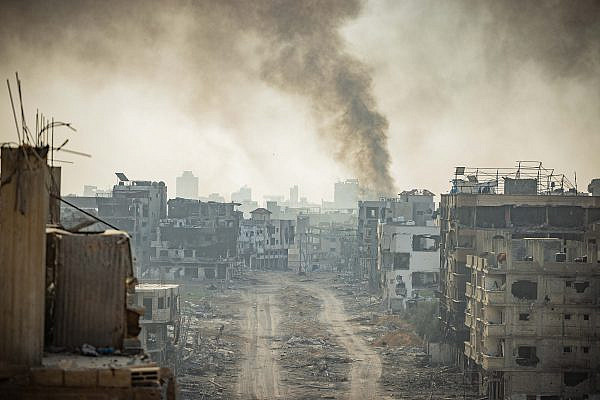
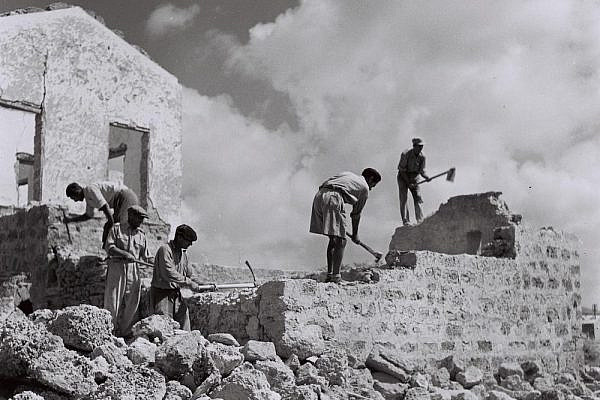
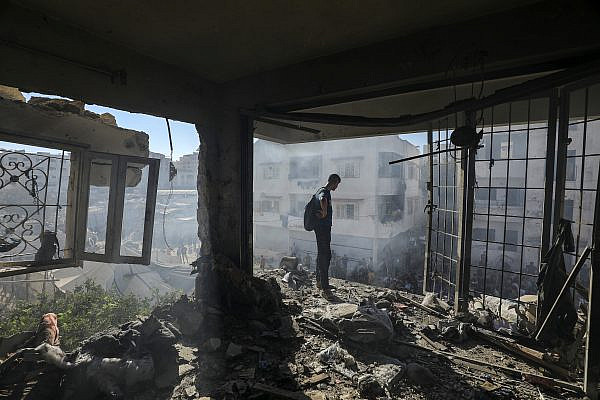
If Lod’s stewards cannot grasp the richness of a city with at least two millenia of documented life, they should not be allowed to destroy it beyond recognition. Our heritage is fragile. In the hands of real estate sharks, it will be swept away in an instant.
We need to stop and think. When the Old City is leveled — and when the same inevitably occurs across other parts of the city — we lose generations of history. What took thousands of years to accumulate will be wiped out in a single day of construction.
A version of this article was first published in Hebrew on Local Call. Read it here.