With Israel’s election just days away, it remains unclear what the next government will look like. But for Palestinian citizens, the boundaries of political representation inside Israel have already been redrawn.
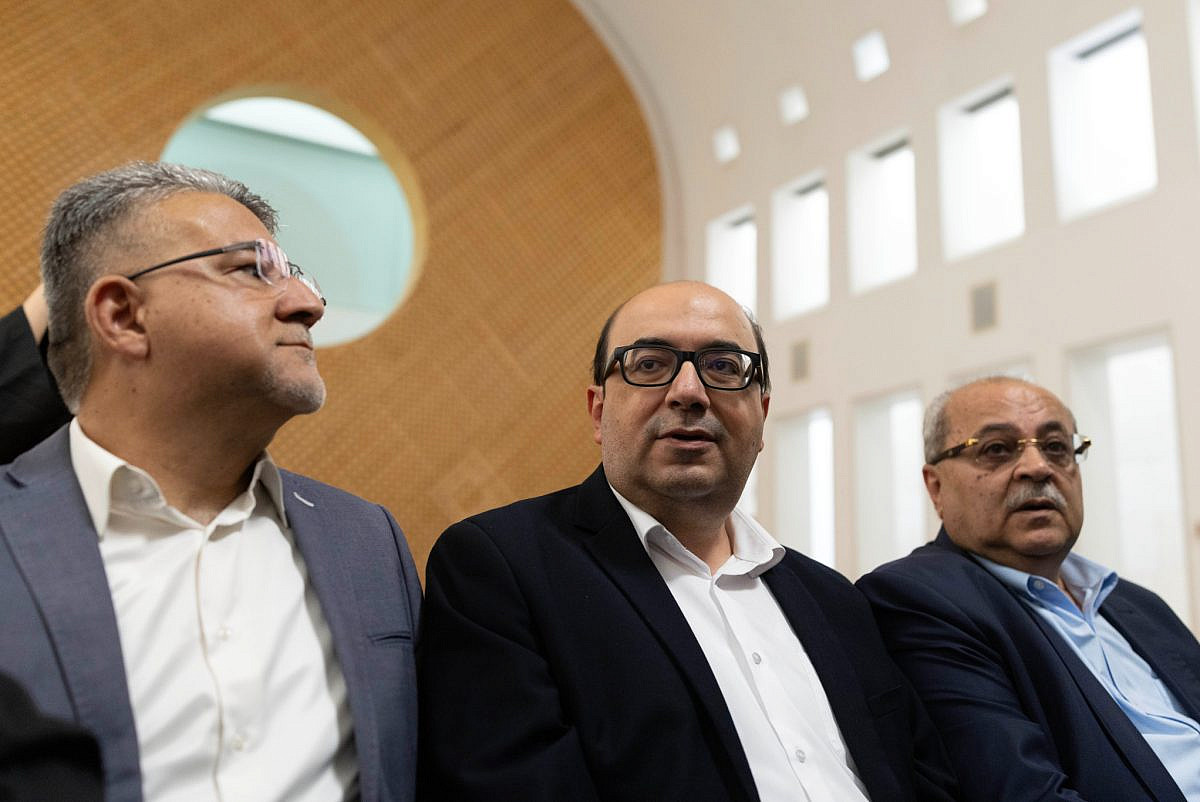
Sami Abu Shehadeh, a former Knesset member and chair of the Palestinian nationalist Balad party, was initially disqualified on Sept. 23 by Israel’s Central Elections Committee (CEC) on the basis of an article he published a day after October 7.
In it, he described the Hamas attacks as a historic event that should not have come as a surprise — and argued that if “small, besieged Gaza” could prevent Israeli intelligence from infiltrating its parties and political movements, “then others can do it more effectively and simply.” The Central Elections Committee interpreted his remarks as an endorsement of the attack and support for armed struggle, despite the absence of evidence establishing such support.
But the deeper significance of this case became apparent during the subsequent Supreme Court proceedings over the disqualifications. In addition to Abu Shehadeh, the CEC voted to ban the Joint List, Mansour Abbas’s United Arab List (Ra’am), and Ofer Cassif of Hadash. While the Court overturned those three disqualifications, Abu Shehadeh’s case followed a different trajectory.
During the hearing, a majority of the nine-justice panel indicated that it was inclined to uphold Abu Shehadeh’s disqualification, and recommended that he withdraw his candidacy rather than await a formal ruling. Confronted with the prospect of judicially-sanctioned exclusion, Abu Shehadeh and his party, Balad, ultimately decided that he would pull out of the election, and the Court consequently did not issue a final detailed ruling on the merits of his case.
According to Abu Shehadeh and his party, the decision to withdraw was motivated by concerns about the potentially far-reaching consequences of an adverse judicial ruling — not only for Balad’s political future but also the broader space of Palestinian political activism and representation in Israel.
They argued that a formal Supreme Court decision upholding his disqualification could establish a dangerous legal precedent, further narrowing the already restricted and steadily shrinking space of Palestinian political freedom. These restrictions have intensified in recent decades and particularly since October 7, 2023, amid the accelerating processes of fascistization within Israeli society and state institutions.

Nevertheless, the decision to withdraw generated considerable debate within Palestinian society in Israel. Critics argued that it effectively absolved the Supreme Court of the responsibility to issue a reasoned judgment that might have exposed its alignment with far-right political demands and challenged its self-presentation as a guardian of democracy. The Court’s intervention, they suggested, effectively facilitated Abu Shehadeh’s exclusion while preserving the appearance of democratic inclusion.
The withdrawal thus raised broader questions about the political consequences of allowing the judiciary to determine the limits of legitimate Palestinian representation while avoiding public accountability for its decisions.
Although the long-term implications of this decision remain uncertain, the immediate outcome is significant. It illustrates an emerging structure of political apartheid inside Israel: Palestinian citizens retain formal electoral rights and parliamentary representation while the boundaries of their political leadership, national identification, and collective political claims are increasingly defined and restricted by state institutions dominated by the Jewish majority.
A shrinking space for political representation
Palestinians inside Israel have never enjoyed equal citizenship. Their status is better understood through the concept of settler colonial citizenship, a term I developed with Nadim Rouhana, to describe a political structure where one group is granted greater power by the state over land, immigration, the distribution of resources, and the shaping of public space, while the indigenous group is given citizenship without equal national status. Citizenship does not abolish this hierarchy; it operates within it.
After 1948, the newly established state of Israel was engaged in a process of transferring Palestinian land into Jewish ownership and control, promoting Jewish immigration, consolidating a Jewish demographic majority and Jewish sovereignty, and preventing Palestinian refugees from returning to their homeland. Palestinians who remained in their homeland were eventually granted citizenship and certain political rights, including the right to vote and stand for election. But from the outset, this status existed within a clear racial hierarchy between Jews and Palestinians.
A Jew who comes to Israel under the Law of Return has access to citizenship in a way that is not available to Palestinians who were displaced from Palestine, or to their descendants. The state defines itself as the realization of the Jewish people’s right to self-determination. Land, state institutions, and immigration and settlement policies have been shaped over the years to preserve a Jewish majority and Jewish control. Jewish supremacy, then, is institutional and political: The state does not stand in the same relationship to the two national groups living under its rule.

The Knesset has also placed limits on political participation. Among the grounds for disqualification is the denial of Israel’s existence as a Jewish and democratic state. In other words, Palestinians may act within the political system, but their participation takes place from the outset within a constitutional framework that limits their ability to seek full individual and collective rights within the state.
This is precisely the significance of the Abu Shehadeh case. It is not as if his disqualification reflects a new kind of inequality where equality existed before — the racial hierarchy was already there. Balad itself has repeatedly faced attempts at disqualification. But an important boundary remained: Institutions in which Jews constitute the majority were not granted unlimited authority to determine for Palestinians who may represent them.
Over the years, the Supreme Court also maintained a high evidentiary threshold for disqualifying candidates and electoral lists. Within this hierarchical structure, a certain space for Palestinian political action was nevertheless preserved.
Abu Shehadeh’s case suggests that this boundary is eroding, and signals a possible shift in the way that hierarchy operates: from a form of citizenship that exists within Jewish national supremacy, while still leaving Palestinians a limited space in which to organize and elect their representatives, toward a situation in which state institutions have complete control over who may represent Palestinians and what the permissible boundaries of Palestinian politics are.
The implications extend beyond political participation. The case also raises the question of whether freedom of expression is a right effectively reserved for Israeli Jews, even when they incite violence against Palestinians, as exemplified by far-right National Security Minister Itamar Ben Gvir, who led the legal effort to ban Abu Shehadeh.
The asymmetry becomes particularly striking when considering that requests were also submitted to the CEC to disqualify Ben Gvir and his Otzma[ Yehudit party. One petition, filed on Sept. 14 by the Zulat Institute for Equality and Human Rights together with former senior government officials and legal scholars, sought their exclusion on grounds including incitement to racism. A separate petition was submitted by the Democrats party.
Most read on +972

Yet the CEC voted by a wide margin to allow Ben-Gvir and his party to participate in the election — a sign of the racism that sets the limits of political expression and representation within Israel’s electoral and judicial institutions.
The message to Palestinian citizens is clear: You may vote, but only within a political space whose borders are drawn for you by the Jewish majority. You may organize, but only within limits that institutions controlled by the Jewish national group define as legitimate. You may be citizens, but you do not possess equal power to determine the terms of your own political participation. Abu Shehadeh’s disqualification marks a transition from settler-colonial citizenship to political apartheid.
Versions of this article were first published in Arabic on Arab48 and in Hebrew on Local Call.