

Inside Israel, the reaction to ongoing talks between the United States and Iran can teach us quite a bit about the state of the Israeli collective consciousness nearly three years after October 7. Upon the signing of the memorandum of understanding earlier this month, perhaps the most difficult fact for the Israeli public to recognize, let alone accept, was that Israel is not a party to the emerging agreement.
The agreement and the negotiations that produced it represent a sweeping and unprecedented political shift in the regional balance of power. For the first time, the Israeli perception of reality and the actions derived from it — that Israel faces an existential threat from Iran and that any offensive action Israel takes against the Islamic Republic or its proxies is necessarily appropriate and justified — has not been met with immediate and uncompromising acceptance.
The consequences of these talks — conducted over Israel’s head — will implicate Israel in various ways, from national security to the economy. The attempt to forge a regional arrangement based on U.S.-Iranian agreements, with the active and discreet consent of Arab leaderships throughout the region, particularly in the Gulf, is itself unprecedented. That Israel could be sidelined from such an arrangement would have been unthinkable just a few weeks ago.
To be sure, the Trump administration still appears to be ready and willing to support Israel’s intensification of bombing in Lebanon, alongside the ongoing bombing and starvation in Gaza. But Vice President J.D. Vance’s harsh words for the Israeli government — that “you cannot kill your way out of solving every national security problem that you have” — offer a sense of how U.S. policy toward Israel may be shifting.
The U.S.-Iran talks have been described in various ways in Israeli media, but many converge around a sense of an American betrayal. Commentators on the Israeli right, especially the religious right, have not hesitated to express their disappointment with Donald Trump, going as far as to accuse him of “abandonment.” Similar remarks have also been heard among prominent voices on the American religious right, who have insisted that without Israel, the United States would not even exist, and that God Himself created Israel and planted it in the Middle East to ensure world peace.

War without end
As the talks continue and even appear to be envisioning a horizon significantly broader than simply “ending the war,” the Israeli media has returned to covering them from the angle particularly favored by the Israeli public: domestic politics.
The talks are generally considered to be a failure for Netanyahu. When a news site that defines the Israeli mainstream as much as Ynet publishes a piece entitled “The arguments and the truth: The failure in the agreement with Iran and the threats that remain — Fact checking Netanyahu,” it signals a broad suspicion of Netanyahu’s method and execution.
However, there is a wider consensus within Israel as to what should come next. The prevailing view is that, given the Islamic Republic’s unwavering commitment to Israel’s destruction, Israel has no choice but to continue acting on its own to eliminate Iran’s influence throughout the Middle East. In other words, Israel’s primary task now is to find a way to act alone to ensure its security, given Washington’s lack of commitment.
The most refined expression of this consensus was articulated by Netanyahu himself in a rare interview this week to Israeli TV’s Channel 14, a channel devoted to the personal glorification of Netanyahu alongside a vigorous celebration of hard-right values and strongly worded attacks against Israel’s liberal camp.
The interview was given to the most popular show on this channel, “The Patriots”: a rapid-fire polemic format based on brief and violently phrased answers to political questions. It is not an environment one would necessarily identify with a prime ministerial interview, and was very clearly constructed as a means for Netanyahu to convey brief, pointed, and aggressive statements.

When asked when “the war” would be over, Netanyahu replied: “The pursuit of total victory will never be over. If you want to live in the world and in the Middle East you have to be very, very strong.”
Netanyahu’s choice of words is worth pausing over. He did not provide contextual statements, such as “We will stay in Lebanon until Hezbollah has been totally disarmed.” He leaves chores like those to his loyal defense minister, Israel Katz, who is only too happy to be his master’s voice.
Rather, Netanyahu provided a paradigmatic articulation of Israel’s post-October 7 national security doctrine. The war will never be over. War is the condition of life — not of a good life, but of life as such. This doctrine requires tremendous strength, measured above all by the ability to attack one’s enemies with “complete freedom of action” (a phrase coined by Netanyahu’s predecessor Ehud Barak — now, ironically, among his fiercest critics). Such impunity is both the condition and the result of being, in Netanyahu’s own emphatic terms, “very, very strong.”
Israel against the world
Israel is on the verge of official campaign season. There is no time like the present to stand out with an alternative political message, to try and shape a new base and work to gain votes.
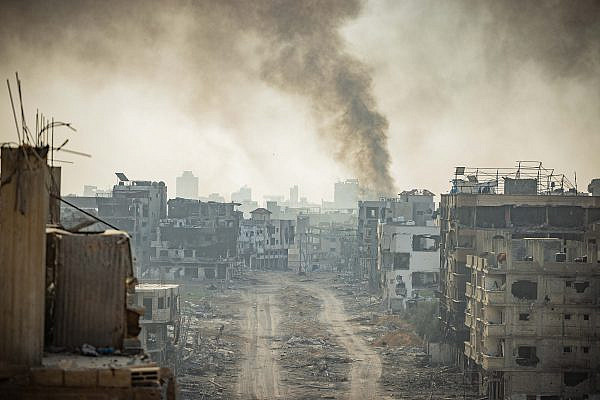
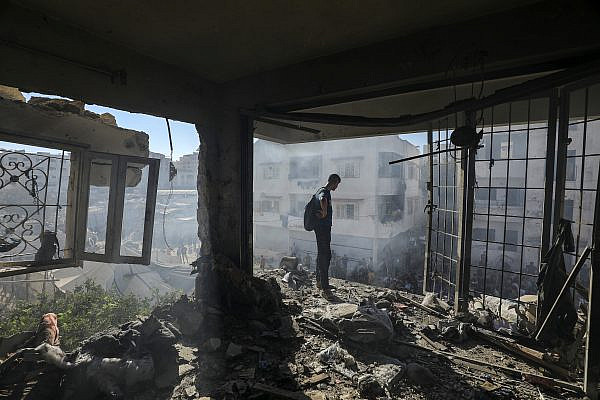
And yet, as far as Netanyahu’s rivals are concerned, crickets: Not a word of criticism has emerged that challenges these remarks. Nor has such criticism come from Israeli liberals and civil society more broadly — regarding the MoU between Iran and the United States, the resulting negotiations with Lebanon, or the continued genocide and ethnic cleansing in Gaza, as well as in the West Bank.

After nearly three years of war, there is a broad and deep consensus among the Jewish public in Israel regarding the nature of the State of Israel. According to this consensus, Israel requires that same “complete freedom of action” in order to continue to exist. There is, in this view, no other way forward, because at the beginning and end of every discussion lies the ahistorical hostility of “the world” toward “Jews.” Israel has no real way to dispel this hostility other than by remaining constantly vigilant and launching attacks without restriction whenever it deems necessary.
If Israel has been passed over even by the Trump administration, then, according to this worldview it can expect absolutely nothing from the “world.” It is unlikely to be accidental that Netanyahu included the “world” alongside the Middle East in his description of the strength required to stay alive. He does not usually do so. More often, he includes Israel within that “world” to present it as the West’s forward outpost in the battle against the savages that threaten “Judeo-Christian civilization.”
This time, however, he made it clear that not even the world was safe from Israel’s wrath. Why? Because the world had abandoned Israel.
Israel remains quite capable of killing many thousands more Palestinians and Lebanese, and torpedoing the U.S.-Iranian agreement, although I sincerely doubt Israel is capable of simply attacking alone in Iran without Trump’s consent. Yet the main message conveyed by Netanyahu’s words, and by his opponents’ tacit acceptance of them, is different.
Israel’s resources will dwindle, and sooner rather than later it will discover itself friendless. The most important message sent by Israel — by its prime minister as well as the great majority of its Jewish citizenry — is that the country is bowing out of any international horizon. It no longer sees itself bound by any laws or rules other than those of the eternal war it claims to be fighting.
Most read on +972

This was not said outright: Israel continues to maintain a semblance of international activity, from reportedly stationing troops in Somaliland to building strong relationships with authoritarian regimes through the export of cyber-surveillance tools, military expertise, and weapons. Still, Jewish Israelis are united in their support for perennial war, which effectively means charting an increasingly solitary regional and global path.
The more Israel persists, the less goodwill it will find. Alone, Israel cannot sustain this effort indefinitely. The gap between sentiment and reality will grow. There is no telling what end, if any, awaits.