
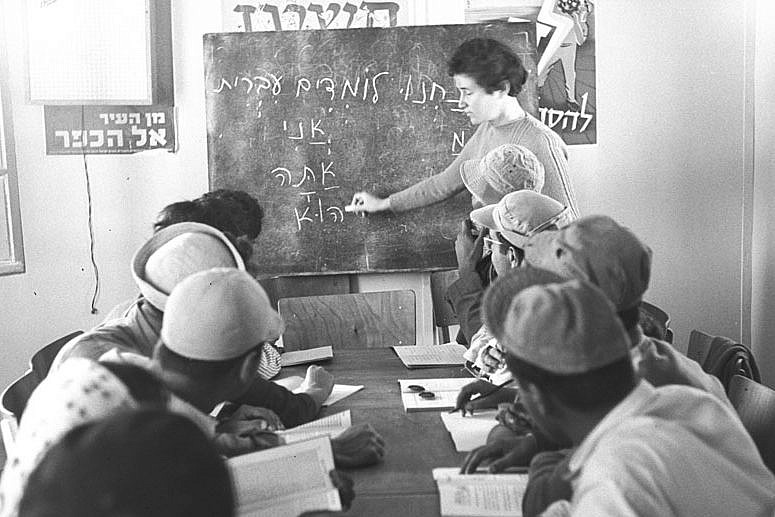
Earlier this year, a fellow Jewish activist in Tsedek!, a French collective of decolonial Jews, asked in our group chat: “Is learning Hebrew a problem?”
The question had been prompted by a debate she was following on social media. A person taking Hebrew classes in France had described feeling deeply uncomfortable in a classroom where every other student was openly pro-Israel. The responses on X, as one might expect, were swift and dismissive. What had she expected? Hebrew, many commenters insisted, was a language invented by Zionists.
The activist in our group chat was at a loss. Like many Jews, she felt a deep connection to Hebrew even as she rejected — and actively opposed — Zionism. If Hebrew was inseparable from Zionism, where did that leave people like her?
She is not alone. Since October 7, Hebrew has increasingly come to be seen as bound up with Zionism and the violence carried out in its name. For many non-Zionist and anti-Zionist Jews who remain attached to the language, that shifting perception has created a genuine dilemma: Can Hebrew be separated from the Israeli state? Does learning or speaking it implicate someone in the Zionist project? Is there a place for Hebrew in the politics of Palestinian liberation?
The anger directed toward symbols of the Israeli state is understandable. But the conflation of Hebrew with Israel is itself a consequence of Zionism’s success in appropriating the language for its nationalist project. Hebrew did not begin with Zionism, nor does it belong exclusively to the State of Israel.
At the same time, modern Hebrew, as it exists today in Israel-Palestine, functions as a colonial language. Compared with the continuing atrocities in Gaza and the ongoing ethnic cleansing inflicted by settlers and the army across the West Bank, questions about language can seem trivial or abstract. Yet language is one important way in which power becomes common sense.
Far from standing outside the structures of dispossession that shape life between the river and the sea, Hebrew helps facilitate and sustain them. Through the names it privileges, the histories it centers and those it erases, Hebrew has become one of the mechanisms through which the ongoing Nakba is normalized.
But Hebrew was not always a colonial language, and it does not have to remain one.
The myth of Hebrew’s disappearance
Contrary to Zionist mythology, the movement did not “revive” Hebrew. The language had never died. Hebrew emerged more than 3,000 years ago in the kingdoms of Israel and Judah. Although it ceased to function as an everyday vernacular after the destruction of Jerusalem in 586 B.C.E., it remained a language of prayer and liturgy, as well as of literature, commerce, and communal life — at times in both written and spoken form.
Hebrew continued to evolve across the centuries. Medieval poets in Palestine and Italy developed new sentence structures to serve their literary styles. Jewish scholars and rabbis in Al-Andalus translated works of science, philosophy, and linguistics from Arabic into Hebrew, creating thousands of new terms in the process. Travelers, merchants, and rabbis used Hebrew to communicate with faraway Jewish communities; others wrote letters and business records in the language.
Beginning in the 16th century, Hebrew entered a new phase of growth and development, with the publication of the first Hebrew play, “A Wedding Frolic” by Italian author Judah Leone Ben Isaac Sommo, and the first Yiddish-Hebrew dictionary. In the 17th and 18th centuries came the first Hebrew newspapers and the rise of a flourishing literary culture. By the time political Zionism emerged in the 19th century, Hebrew had already achieved what one linguist called a complete “communication infrastructure”: Written Hebrew was used in journalism, literature, science, and education, and small groups of fluent speakers existed throughout the Jewish world.
What Zionism did accomplish was something different: It transformed spoken Hebrew into the language of an entire society for the first time in nearly two millennia.
For Zionist leaders, Hebrew was central to the project of building a Jewish homeland in Palestine. It was a nation-building tool: Reviving spoken Hebrew would help forge a new Jewish collective identity while displacing what many Zionists dismissed as the “weak” and degraded languages of exile — Yiddish, Ladino, Judeo-Arabic, and others.

But the language of a colonial movement could only become a colonial language. Hebrew became the language of Jewish settlers who sought not to integrate into existing Palestinian society but to replace it. In the process, Hebrew itself was transformed into the modern Israeli Hebrew we know today: a language adapted to modern life, and positioned to supplant Palestinian Arabic as the dominant language between the river and the sea.
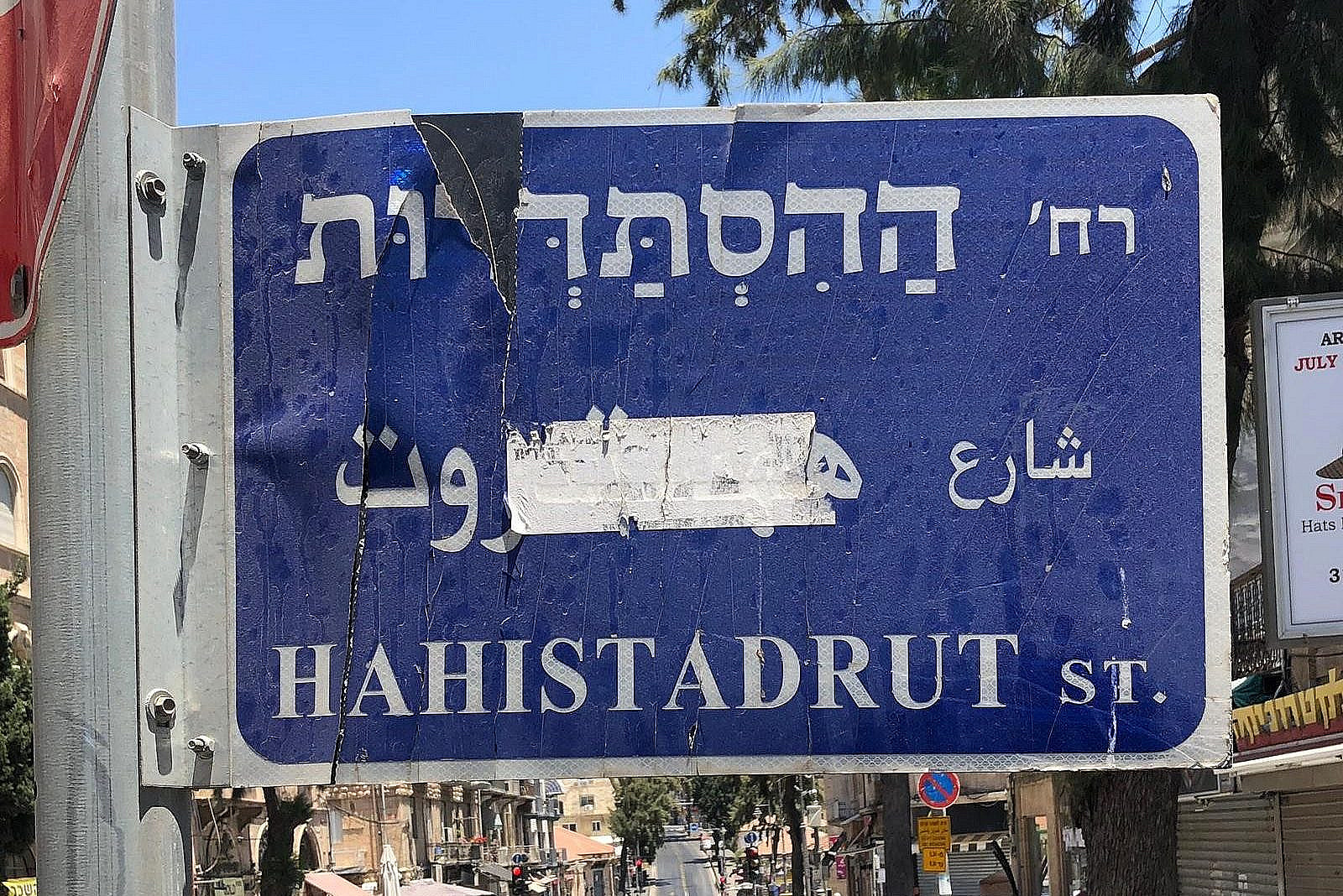
That project began with the systematic renaming of Palestine after 1948. The Arabic names of some 9,000 towns, villages, rivers, hills, springs, and other geographic features were replaced with Hebrew ones. Al-Haram became Herzliya. Al-Bassa became Rosh Hanikra. Yafa became Yafo. Lyd became Lod. Yahudiyya became Yehud. Even the Arabic name of Jerusalem, Al-Quds, was changed on many road signs to “Urshalim,” a name invented out of thin air and presented as ancient heritage.
This renaming was not a formality. It reshaped how Israeli Jews understood the country around them. Palestinian history was made invisible as Palestinian names disappeared from maps, road signs, and everyday speech.
Nor is Hebraicization confined to the past. For decades, the West Bank was referred to in mainstream Hebrew as “the territories,” a term that obscured both the occupation and the Palestinians living under it. Though many parts of the West Bank lie a mere 20 kilometers from Tel Aviv, the phrase evoked a remote, vaguely dangerous area. More recently, alongside the radicalization of Israeli society, “the territories” has increasingly given way to “Judea and Samaria,” the biblical terminology favored by the settler movement.
To the uninformed listener, the constant use of “Judea and Samaria” in public discourse suggests that Jews have the deepest and most meaningful connection to that land. If that connection is taken for granted, it can seem only fair that Jews should live there. And if Jewish presence there is seen as a right, then the “transfer” of the Palestinian communities who call it home can begin to appear reasonable. Hebrew speech, then, plays a key role in legitimizing the ongoing dispossession of Palestinians.

Linguistic resistance
Efforts to challenge Hebrew’s colonial character are hardly new. Since the early days of Zionism — and all the more after 1948 — Palestinians have had little choice but to learn at least some Hebrew: to access public services, find work, or navigate the education system. But beginning in the late 1960s, and much more actively after the 1980s, Palestinian authors began engaging with Hebrew not merely as a practical tool for survival in a Jewish state, but as a medium of resistance and self-expression.
In 1986, Palestinian writer Anton Shammas published “Arabesques,” a Hebrew-language novel that imagines a post-Zionist Israel belonging equally to Jews and Palestinians. For Shammas, writing in Hebrew, as integral to his identity as it was, was a political act: a refusal to cede the language to Zionism.
Shammas was clear-eyed about his intentions: “What I’m trying to do … is to un-Jew the Hebrew language … to make it more Israeli and less Jewish, thus bringing it back to its semitic origins, to its place. This is parallel to what I believe the state should be. As English is the language of those who speak it, so is Hebrew; and so the state should be the state of those who live in it.”
Shammas’s project offers a useful starting point for asking: What would it mean to decolonize Hebrew?
In Israel-Palestine, linguistic resistance begins with restoring Arabic — and specifically Palestinian — names to everyday speech, and refusing the state’s laundered vocabulary. Saying Yafa instead of Yafo reminds listeners that the city is, first and foremost, Palestinian. Referring to the West Bank as the “occupied Palestinian territories” leaves little room for ambiguity about either the nature of Israeli rule or the Palestinians living under it.
But our choice of words goes far beyond naming the immediate violence faced by Palestinians under occupation. It also means reframing the relationship between Jews and the land itself. Rather than “aliyah,” which presents immigration to Israel as a form of spiritual ascent from the diaspora, decolonial Hebrew speakers can simply speak of immigration. Rather than referring to Israel as “the land,” a term that carries an implicit Jewish claim, they can use the more open-ended “Israel-Palestine.”
Hebrew’s colonial character also operates, perhaps most insidiously, through euphemism. The Israeli military’s targeted assassinations of Palestinians are called “focused prevention,” obscuring what they are: extrajudicial executions. Palestinian resistance — violent and nonviolent alike — is described as “breach of order,” while those who engage in it, however nonviolently, are referred to as terrorists. In recent years, this logic has been pushed even further with the phrase “diplomatic terrorism,” most notably in response to Palestinian efforts at the United Nations to seek recognition and statehood. The imprisonment of Palestinians, including children, without trial is softened into “administrative detention.”
Linguistic resistance, therefore, can be as simple as rejecting these euphemisms that turn daily violence into routine, bureaucratic processes, and calling a spade a spade: occupation, ethnic cleansing, resistance, and genocide.
This is precisely the kind of work being taken up today by Sabra. Launched in 2023, the magazine carries forward the tradition of Shammas and earlier Palestinian artists and intellectuals. Its Palestinian contributors write in Hebrew about Palestinian life within Israel, the West Bank, and Gaza, speaking directly to Jewish readers without the mediation, filters, and biases inherent to Jewish-Israeli editors and translators.
A site of political struggle
The struggle over Hebrew also takes place in classrooms. Traditionally, Hebrew has been taught through the ulpan model — a hyper-nationalistic framework designed to prepare Jewish immigrants for life in Israel. In practice, ulpan classes, which are often sponsored by the Israeli government, teach students much more than grammar and vocabulary: They teach the norms and culture of Zionism.
Ulpan classes, tasked with presenting the Zionist version of history and politics as fact, largely pretend Palestinians do not exist — from maps presenting the entire land between the river and the sea as Israel to curricula centered around the daily life of Israeli Jews while excluding Palestinian citizens of the state. In ulpan, Hebrew instruction becomes a means of advancing the Jewish national project.

But a new generation of activists and teachers is challenging that model. Rather than pretending Hebrew can be separated from the realities of Israel-Palestine, they teach the language within its social and political context, drawing attention to the power relations embedded in it.
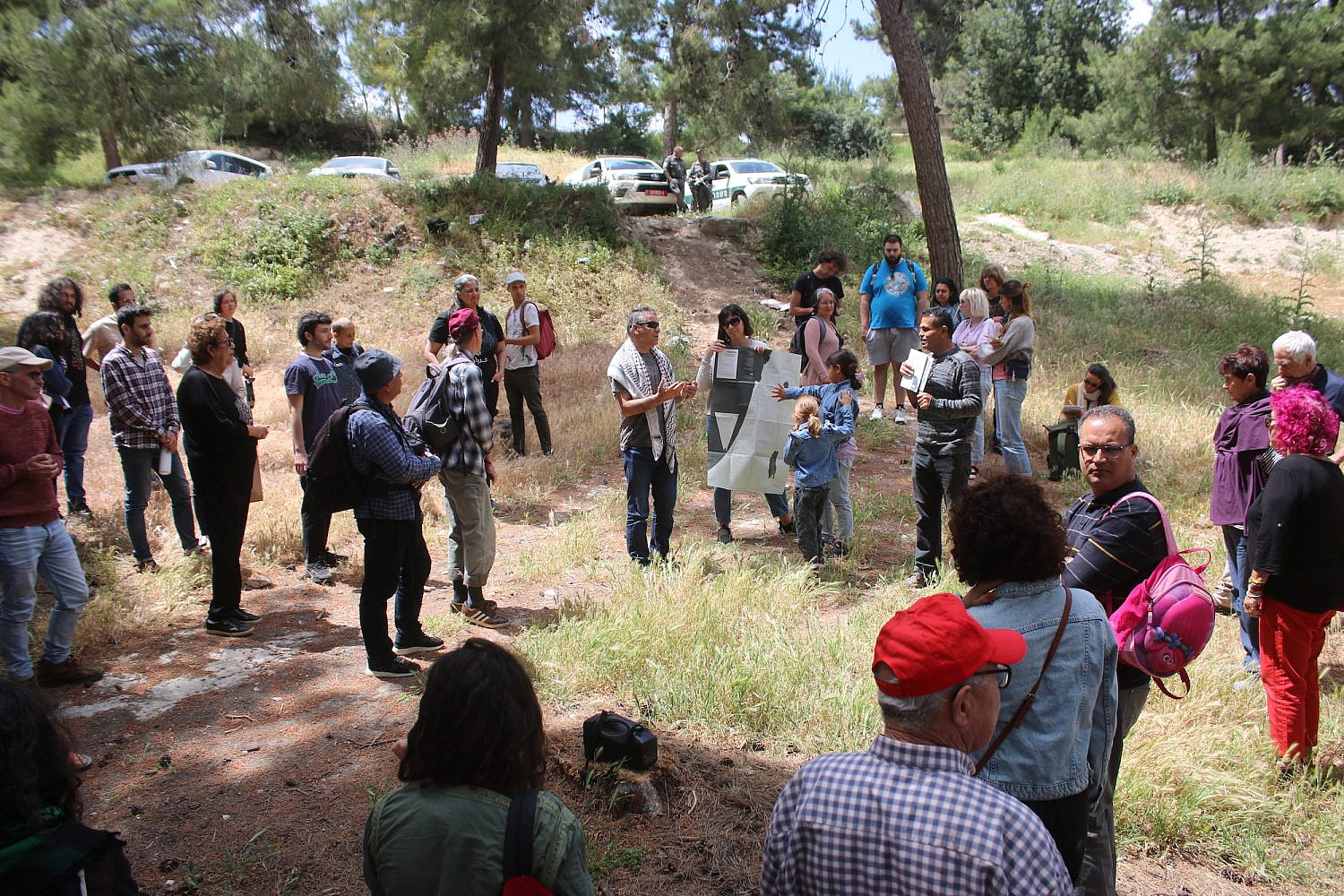
This Is Not An Ulpan (TINAU), an alternative language school in Israel-Palestine, is among the most prominent examples. Its classes use Hebrew instruction as an opportunity to explore social and political issues through a critical lens, making it possible for Palestinians, diaspora Jews, and other language learners to study Hebrew without embracing a Zionist ideological framework.
Radical educators also challenge Hebrew’s dominance over Palestinian Arabic. Although Arabic formally retained official status after 1948, with Israel preserving the British Mandate’s recognition of Arabic alongside Hebrew, the two languages were never treated equally.
Hebrew quickly came to dominate government, higher education, the courts, and public life. Court decisions were published only in Hebrew, administrative forms and procedures remained accessible solely in Hebrew, and, for most of Israel’s existence, many street signs appeared only in Hebrew and English — including in Arab towns. (Only after sustained pressure from minority-rights organizations and a resulting Supreme Court decision in 2002 did Israeli authorities expand the use of Arabic on road signs.) All 11 of Israel’s universities use Hebrew as their primary language of instruction, and, outside Arabic language and literature departments, none teach in Arabic.
The de facto supremacy of Hebrew in public space was eventually enshrined in law. In 2018, Israel’s Nation-State Law downgraded Arabic from an official language to one with only “special status.” The result is a linguistic order in which Palestinians are expected to master Hebrew while few Israeli Jews learn Arabic. Among the small minority of Israeli Jews who do speak Palestinians’ native language, many learned it through the army or intelligence services, as a tool for “understanding the enemy.”

In this hypermilitarized context of apartheid, learning Arabic becomes a political act. It cannot undo colonial relations on its own, but it is a prerequisite for more reciprocal relationships between Israeli Jews and Palestinians. Schools such as TINAU therefore increasingly teach Palestinian Arabic alongside Hebrew, and interest in these programs is growing among anti-Zionist and decolonial Jews in Israel-Palestine and the diaspora.
Decolonizing Hebrew also means challenging the place it occupies within modern Jewish identity. For nearly a century, Zionism has made both Israel and Hebrew central to how many Jews understand themselves. Undoing that legacy requires building — or rebuilding — a form of Jewishness rooted in the languages, cultures, and histories that Zionism marginalized, a task already being taken up by Yiddish and Ladino activists around the world.
Most read on +972
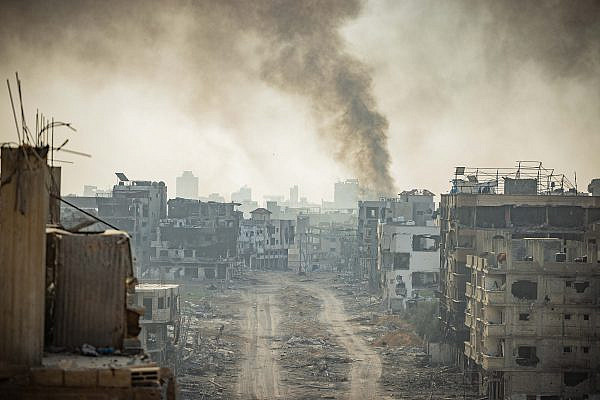
None of this will end colonization or genocide on its own. Language follows power as much as it shapes it. But language is one of the terrains on which political struggle is fought.
Across Israel-Palestine and the diaspora, activists, writers, educators, and ordinary speakers are already showing that Hebrew need not remain affixed to the colonial project that shaped it. Whether by transforming Hebrew from within, rethinking its relationship to Palestinian Arabic and the Palestinian people, or loosening its hold on Jewish identity, this budding movement proves that the language can be transformed again.