


In partnership with
Let’s start with the good news: Despite reports of disagreements, all four of Israel’s Arab-majority parties — Hadash, Balad, Ra’am, and Ta’al — want to revive the Joint List and renew their alliance in the upcoming Israeli election, set to be held by this October. On April 3, representatives of the four parties met to advance the framework their leaders had sketched out at the beginning of this year in Sakhnin, following a mass demonstration of Palestinian citizens against the state’s failure to curb rampant organized crime in their communities.
These developments have offered us Palestinians in Israel a rare sense of relief. It has seemed possible that the familiar status quo of political fragmentation, seen in the alliance’s temporary 2019 split and the more decisive break-up in 2022, might give way to something durable by the time polling for the election begins in earnest.
Within Palestinian society, a supermajority supports the re-establishment of a Joint List. The desire for unity is so strong that no politician in the Arab community today is willing to be responsible for the alliance’s failure. That reluctance, borne partly of guilt and partly of fear of public criticism, is an encouraging sign and has become a powerful political force in its own right.
Segments of Israel’s Jewish public are also following these developments with cautious optimism. Yet to muster a defiant opposition to Prime Minister Benjamin Netanyahu’s government, they are counting on their Arab neighbors to “rescue Israeli democracy” from the ultranationalist right.
Now, the bad news: The ideological orientations of the four Arab parties, ranging from secular Palestinian nationalism and socialism to Islamist and accommodationist approaches, leave them divided on the terms of a revived Joint List. The dispute is less about the allocation of Knesset seats than about electoral strategy and, crucially, whether to join an anti-Netanyahu coalition government. And that may prove far more difficult to resolve.
I spoke with representatives of all four factions: Ra’am chairman Mansour Abbas, Balad chairman Sami Abu Shehadeh, Ta’al chairman Ahmad Tibi, and Hadash secretary-general Amjad Shbita. The divisions are clear: Abbas, who in 2021 joined Israel’s ruling coalition led by Naftali Bennett and Yair Lapid, is racing toward a spot in another “change government”. Balad’s Abu Shehadeh understands Abbas’ impulse but is unwilling to offer him a blank check, while Shbita of Hadash occupies a more ambivalent middle ground.
בלחץ המפגינים בסח'נין: ראשי המפלגות הערביות רע"מ, חד"ש, תע"ל ובל"ד חתמו על הסכם להקמת הרשימה המשותפת pic.twitter.com/ChseyuWi8d
— מוחמד מג'אדלה محمد مجادلة (@mmagadli) January 22, 2026
For Tibi, despite these disagreements, “there’s a greater chance the Joint List will be formed than not. You’d have to be crazy to go against the will of the people and the chance to bring down the Netanyahu-Ben Gvir-Smotrich government.” Over the coming months, it will become clear if that objective — toppling the current coalition and securing an unprecedented number of Knesset seats in the Israeli election — can keep the alliance together.
‘I’ve learned my lesson’
Tibi has signaled a willingness to go along with any arrangement, so long as it leads back to a unified Joint List. Still, he warns that “there are people willing to take the risk” that the alliance won’t be re-established — a not-so-subtle nod to Mansour Abbas.
This may be Abbas’ last major political battle. He is offering Palestinian citizens of Israel, and the broader Israeli system, a deliberately minimalist proposition: budgets over political vision, civic inclusion without challenging the state’s Jewish character, participation without confrontating existing power structures. It is a strategy designed to be palatable to potential Jewish partners, and shaped by Abbas’ time in the last governing coalition.
Abbas came away from that experience with several lasting impressions. The first was the experience of exercising real influence: control over budgets and sustained media attention. He also found backing among parts of the Jewish-Israeli center left and many Jewish communities abroad, despite facing resistance from much of Jewish-Israeli society — for whom the idea of a Jewish state with Arab partners in power proved hard to swallow.
A second lesson was more cautionary. Abbas faced harsh criticism from fellow Arab politicians and public figures, who accused him of trading the Palestinian cause for budget allocations. He rejected that characterization, arguing that he was never given the political space to deliver. Indeed, some local Arab leaders now claim that, for all its shortcomings, the Bennett-Lapid government was preferable to the current one.
That coalition ultimately collapsed not because Arab MKs withdrew their support, Abbas insisted, but because of internal Jewish disagreements. “I want to avoid another shaky ‘change government,’” Abbas told me. “I’ve learned my lesson. I want to be part of the next one — but only if it’s stable and lasts four years. A 60–61-seat government won’t survive, and Netanyahu will come back easily.”

Abbas sees the upcoming election as a make-or-break moment: If his approach fails, he believes, the brief opening for Arab participation in government could be blocked for years. “I wanted the Joint List before the Sakhnin agreement and after it,” he said to me. “All I’m asking is to understand the direction: Where are we going with the power we gain?”
Many within the political system argue that a strong electoral outcome for the Joint List — securing 15 seats or more in the Knesset, as current polls predict — would push Zionist parties in the so-called “change bloc” toward a unity government with Netanyahu’s Likud, rather than rely on Arab parties to form one. Abbas disagreed: “Anyone who leaves the change bloc gets burned by Bibi,” he argued, pointing to the political trajectory of centrist Blue and White head Benny Gantz.
Abbas believes there is still a viable path to a coalition in which Ra’am plays a decisive role. To pave his way into such a government, Abbas is calling for “political pluralism and freedom of action,” a formulation that would allow him to negotiate independently and court potential partners without being constrained by the Joint List framework. He worries that his mere nominal alignment with Hadash and Balad could weaken his standing with Zionist parties.
At the same time, he is well aware of the risks of running alone. Ra’am could fail to cross the electoral threshold, and become irrelevant to center-left Jewish parties. But perhaps most consequentially, Palestinian voters would not forgive him for undermining the Joint List — the one thing that might bring them back to the polls after the war on Gaza.
‘We agree on principle’
Along the ideological spectrum, Balad sits at the farthest distance from Ra’am among the four Arab parties. For Balad chairman Sami Abu Shehadeh, reconstituting the Joint List is a “national mission.” “Balad’s institutions are ready to remove obstacles and show flexibility, because this goal is critical right now,” he said. “The Joint List could become the second- or third-largest bloc in the Knesset, with real influence.”
Working in coordination with Hadash and Ta’al, who had previously drafted a similar proposal, Abu Shehadeh brought a 10-point document to the talks at the beginning of April, a “framework for formation.” Ta’al chairman Ahmad Tibi and Hadash secretary-general Amjad Shbita described the principles as broadly consensual and thus unlikely to derail the talks.
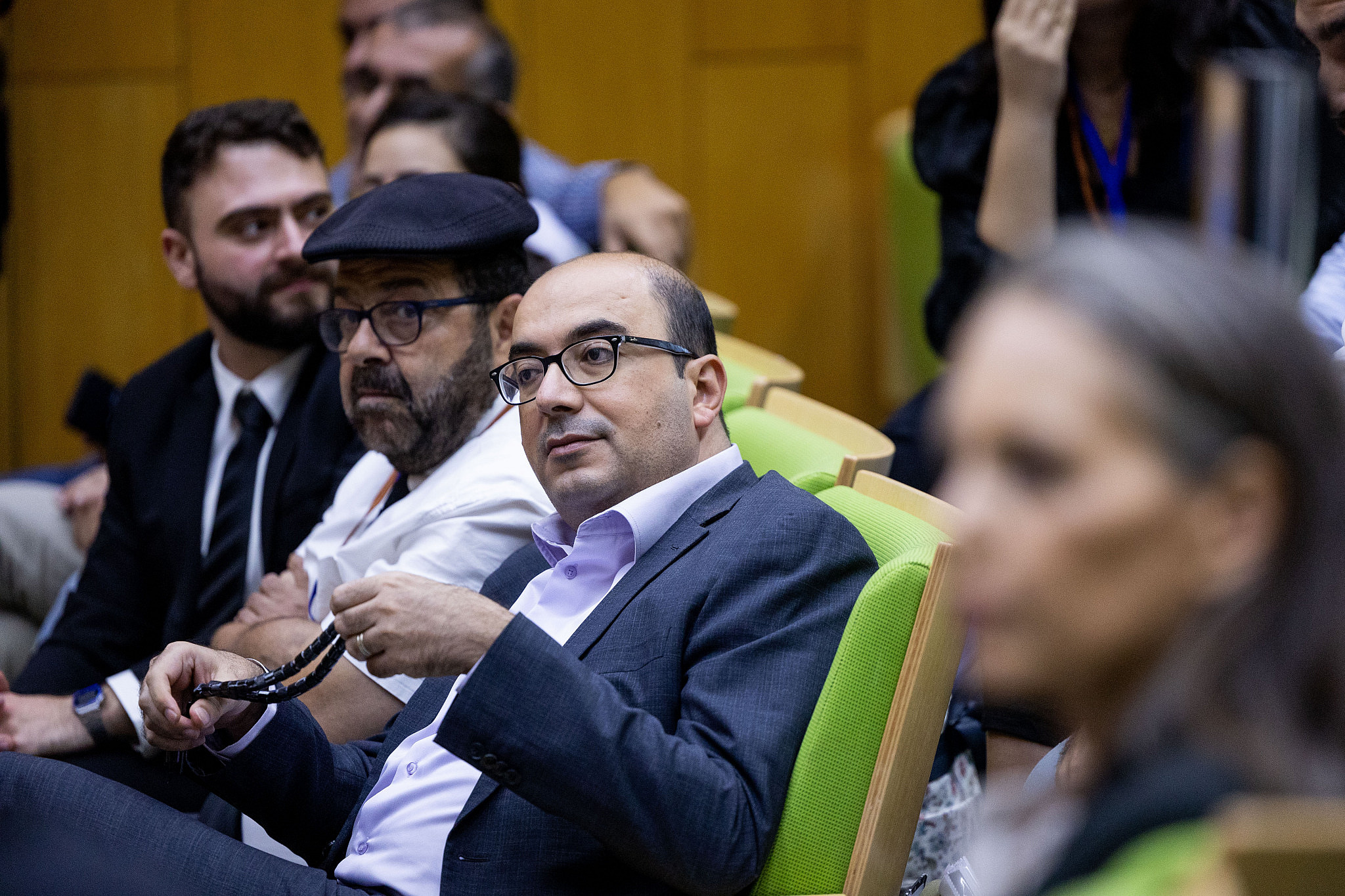
“They don’t even include ‘a state for all its citizens,’” Shbita noted, pointing to the extent of Balad’s concessions. Since the party was formed in the 1990s, that demand has stood at the center of its political project — rooted in the argument that equality for Israel’s Palestinian minority cannot be achieved within a state that defines itself as Jewish, and that Palestinian citizens require not only formal rights but recognition as a national minority, with cultural autonomy.
Now, in an effort to rebuild the Joint List, Balad has set aside its most identifiable slogan. In its place, they are talking about civil equality, a two-state solution, government investment in Arab society, and measures to combat crime. “No one can object to those principles,” said Shbita.
According to Abu Shehadeh, Abbas was given the green light to revise the framework — to add, remove, or expand its provisions — but that he hesitated, steering the discussion away from the document.
“We agree on the principle,” Abu Shehadeh said, referring to unity, but he maintained that there have to be limits. “Ra’am has the right to split off and join a government — we’ve accepted that,” he noted. “But expecting us to commit in advance to supporting such a move from the outside is unrealistic.”
Shbita agreed. His party, he said, has already made a significant concession by accepting Abbas’ ambitions to join a coalition. “Our position is that Hadash will not sit in the government, but will support efforts to bring down a right-wing coalition, with or without Abbas.”
For Abbas, however, this does not suffice. “The Joint List should serve as a platform for coordination, cooperation, and division of roles so we can advance programs, budgets, and legislation for our community,” he said. “We don’t just want to prevent a government; we want to form one.”
Most read on +972

From the perspective of his Joint List partners, Abbas is asking for a degree of pre-commitment they cannot offer, support for a coalition whose policies are not known. “We need to see what such a government would actually do,” Shbita said. “It might continue annexation or the war. We can’t commit blindly.” And in any case, he noted, negotiators are bound to their party institutions; such decisions cannot be made unilaterally.
So at the end of the day, all sides profess commitment to unity, and all recognize the political cost of its failure. Yet beneath such talk lies a more fundamental question: Is the Joint List merely a vehicle to mobilize Arab voters, or does it represent a shared political vision and strategy?
As long as that question remains unresolved, the real test will not come when the agreement is signed, but the day after the election. And then, as always, we’ll find out whether the hope was real, or whether that photo in Sakhnin was just another nice photo-op.
A version of this article was first published in Hebrew on Local Call. Read it here.