In partnership with

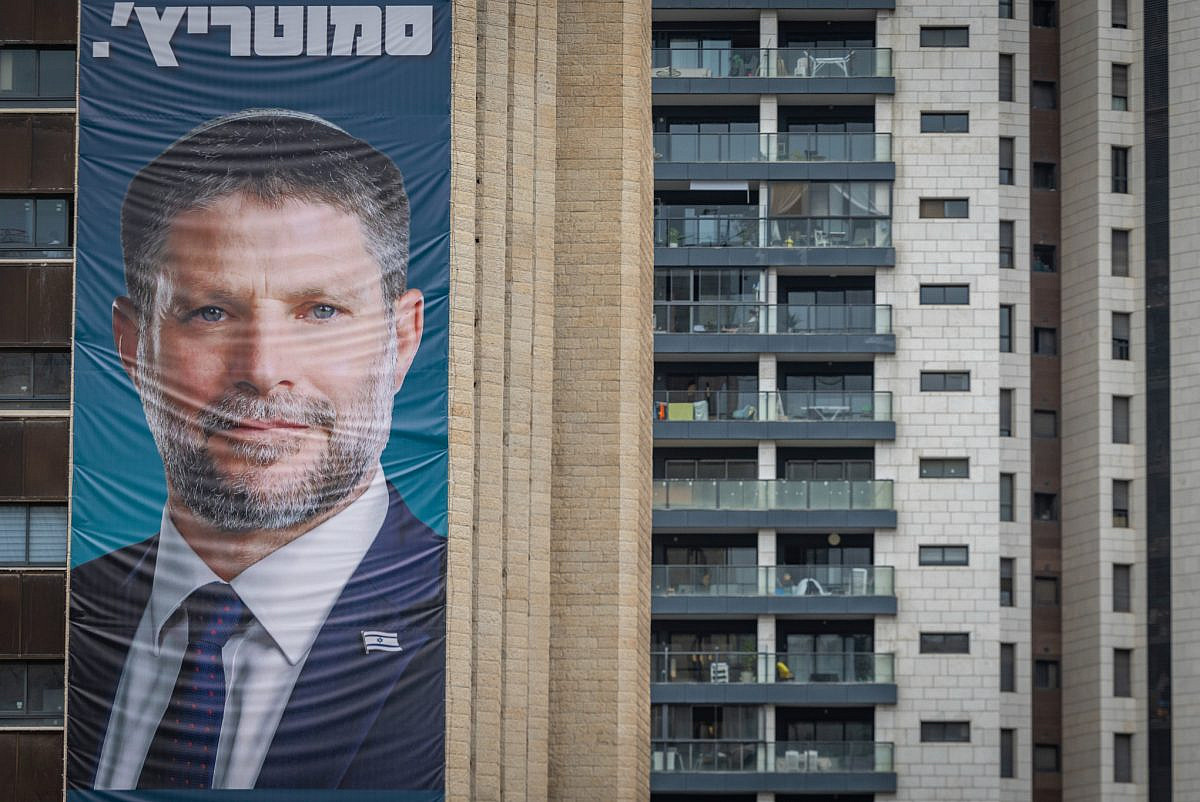
In September 2017, Bezalel Smotrich — then an MK for the religious-Zionist Jewish Home party — published an article in the journal HaShiloach titled, “The Plan for Decisive Victory: The Key to Peace Lies with the Right.” In it, he laid out a political program for resolving the Israeli-Palestinian conflict, but by rejecting “the notion that this land is destined to contain within it two collectives with conflicting national aspirations.”
The core of the plan would involve annexing and exercising “full Israeli sovereignty” in the West Bank, and moving hundreds of thousands of new settlers to live in the territory. Such “victory by settlement,” he argued, would convince Palestinians and indeed “the entire world that a Palestinian State will not emerge.”
Those Palestinians “who wish to forgo their national aspirations,” Smotrich affirmed, would be allowed to stay but only enjoy individual rights, self-governed by fragmented municipal administrations with no promise of full citizenship. Others could choose to emigrate abroad, and receive financial support in the form of a “parting grant” from Israel. But for those who refuse either option and resist, Smotrich advocated a crushing military defeat — “killing those who need to be killed.”
Smotrich made a point of presenting the proposal as pragmatic. Despite his religious-Zionist identity, “you will find nothing in this article based on that faith,” he assured readers. Rather, he described it as “a realistic, geopolitical, and strategic plan” based on “historical, democratic, security, and political considerations.” At the same time, while accepting that “those who wish may view it as a political solution and nothing more,” he noted that others could “view it as a convergence of faith and realism.”
Smotrich’s insistence on the irrelevance of his religious identity was crucial to transforming his vision into a concrete political program. In omitting any religious pretence, the man who would become Israel’s finance minister and minister overseeing the occupied West Bank articulated his ambitions in a language that would resonate well beyond the religious right. And the intellectual and political environment in which he presented the plan was particularly receptive to it.
Nine years later, and three years after the Hamas-led attack of October 7 and Israel’s subsequent genocide in Gaza, Smotrich’s vision has moved from the apparent fringes of Israeli politics toward its center — helped in large part by the fact that the liberal camp, conceived broadly as the Zionist opposition to Prime Minister Benjamin Netanyahu’s far-right bloc, has offered remarkably little challenge to the premises of his plan. Its opposition has largely focused on who exercises state power and how, while leaving intact the broader consensus around Jewish supremacy, exceptional military force, and the continued denial of Palestinian national rights.

A look at the reception of Smotrich’s plan and the political struggles that followed reveals the core assumptions that Israel’s liberal camp now share with the religious right. It also raises the more important question of what it would take to establish a political alternative to the future Smotrich envisioned.
A respectable platform
At the time it published Smotrich’s plan, HaShiloach was bankrolled by the Tikva Fund, an American foundation that supported several right-wing academic and political programs. Among the groups that Tikva funded was the Kohelet Policy Forum, a far-right and libertarian think tank considered the driving force behind the 2018 Jewish Nation-State law, and whose policy papers helped lay the groundwork for the right-wing’s 2023 judicial overhaul.
The journal enjoyed considerable legitimacy in Israeli intellectual and academic circles, where it was regarded as a platform for serious right-wing thought. Its racist and anti-poor positions received scholarly criticism rather than outright condemnation, while academics who identified as liberals encouraged students to attend Tikva Fund study circles and even participated themselves.
Yoav Sorek, the journal’s editor, similarly maintained a reputation among Israeli liberals as a respected intellectual, unlike the rabbinical figures associated with the settler movement. Sorek’s intellectual appeal was partly rooted in the approach he articulated in his book “The Israeli Covenant” — a vision of Jewish existence that puts Israeli sovereignty at its center, rather than the observance of Torah and the mitzvot.
This vision resonated with the liberal circles that saw loyalty to the Israeli nation-state as the core manifestation of Jewish collectivity, especially through military conscription. As Michael Manekin has argued, this approach also aligned with trends in pre-military preparatory programs that sought to develop a model of “Israeli Judaism.” (Later on, in February 2024, Sorek would co-author a position paper with Noga Arbel advocating that Israel facilitate the “voluntary migration” of at least 75 percent of Gaza’s population.)
It was within this supposedly respectable intellectual and political environment that Smotrich’s “Decisive Plan” found a home — one aligned with the religious Zionism advocated by the likes of Naftali Bennett, who would soon become a darling of the liberal public and its preferred candidate for prime minister.
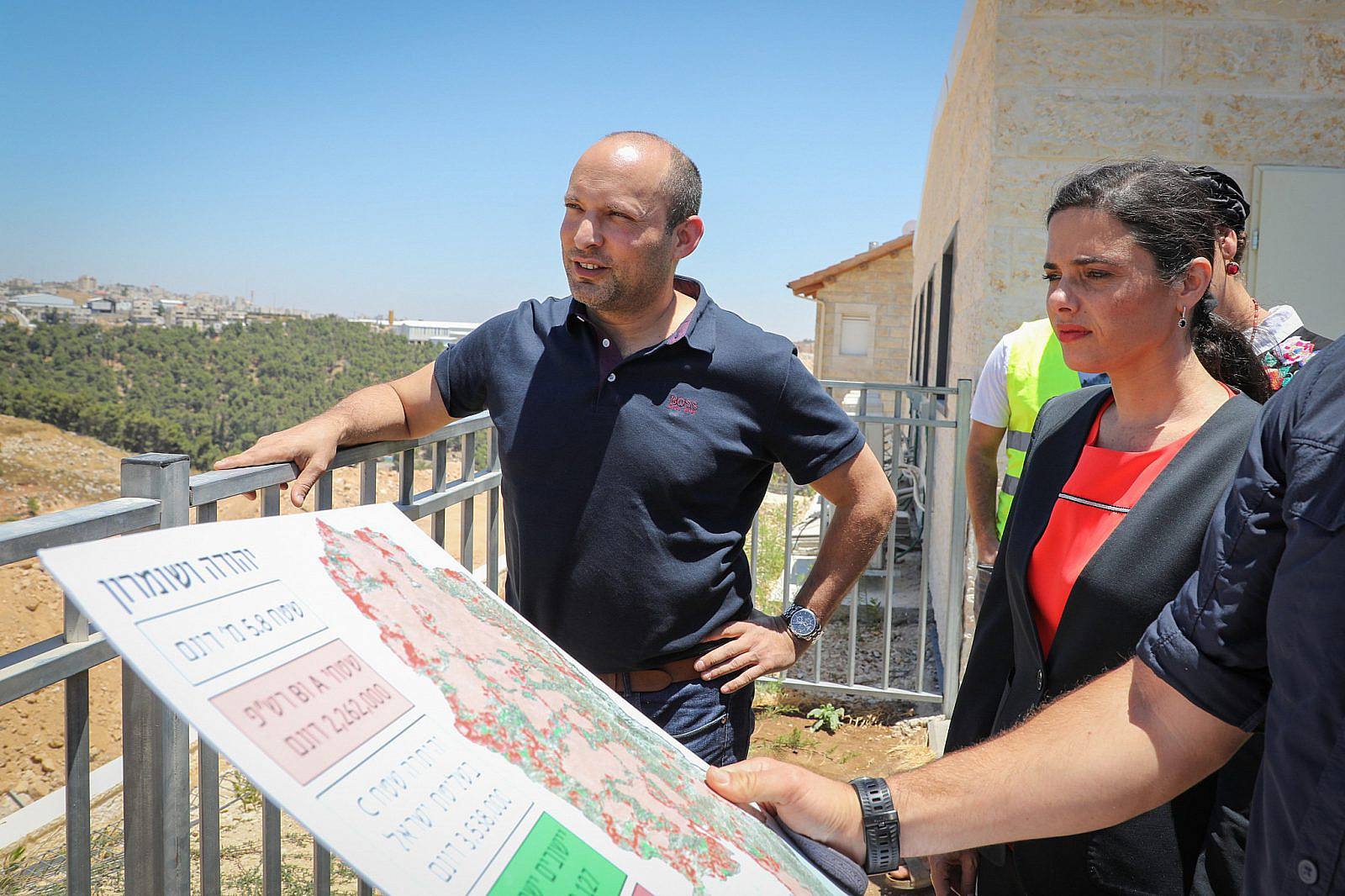
Bennett, with his high-tech credentials and pragmatic image, belonged to the part of the religious right with which the secular liberal camp could find common ground. And, crucially, they had common cause in the goal of dislodging the ultra-Orthodox parties from the positions of influence they had accumulated under Prime Minister Benjamin Netanyahu.
Smotrich, on the other hand, continued to be portrayed by his liberal critics as a “dangerous fundamentalist” on the fringes of religious Zionism, belonging to a separate “messianic” and irrational right, and they failed to grasp the significance of the secularized language of his political program.
This was in part because at the time Smotrich’s Decisive Plan was published in 2017, “conflict management” remained the consensus across Israel’s political establishment. And Smotrich appeared to be an outlier in proposing an alternative: to take radical measures that would permanently prevent Palestinians from achieving their national rights.
Yet elements of his vision continued to gain traction even under Bennett’s “Government of Change.” Over the course of these 18 months, from June 2021 through December 2022, settlement construction and Palestinian home demolitions in the West Bank continued apace, while Israel forces killed more Palestinians in the occupied territory than during the final year of the previous Netanyahu government.
During these years, Israeli politicians’ rhetoric also grew more violent — with explicit calls to enact a second Nakba against the Palestinians. In May 2022, Israel Katz, then an opposition Knesset member and now defense minister, warned Palestinians that they should “remember our independence war and your Nakba,” in response to students waving Palestinian flags to commemorate Nakba Day. Yoav Galant, who would become a prominent figure in the liberal camp during the judicial reform protests, similarly threatened that if the Arabs repeated the “mistake” of 1948, the Jews “would take their hands out of their pockets … and the price would be very heavy.”
As Meron Rapoport and Ameer Fakhoury wrote at the time, the Nakba went from a catastrophe long denied to a course of action repeatedly identified as a practical possibility — aligning with Smotrich’s prior call for decisive violent action. But far from opposing this shift, senior officials in the “Government of Change” joined in delegitimizing of Palestinian national aspirations, branding their expressions as “terrorism” and endorsing the use of violent measures to suppress them.

New alliances, weak opposition
The November 2022 elections brought to power a new, full-fledged right-wing coalition built on an alliance between Netanyahu, Smotrich, and Itamar Ben Gvir. It represented a convergence between the Ashkenazi religious-Zionist elite and lower-middle class Mizrahi voters, whose political interests had not always aligned — and who, at the local level, are often hostile toward one another.
For example, the Garin Torani — a network of religious-Zionist settler communities seeking to Judaize Israeli cities with relatively large Palestinian populations, many of them established in former development towns where Mizrahim were settled — have faced major criticism from longtime residents.
Yet the alliance reflected how the interests of the settlers and those whom sociologist Yagil Levy has described as “blue-collar combatants” could broadly overlap, not only on Israel’s policies in the West Bank but also on internal domestic issues.
Ben Gvir’s promise to restore “governance” sought to apply the logic of settler-led policing in the West Bank to Israeli civilian life, while portraying Palestinian citizens of Israel as a “security problem.” This discourse appealed particularly to small business owner voters facing crime and protection rackets, while Smotrich drew on the more affluent, established religious-Zionist electorate.
The liberal opposition offered no competing narrative of the problem. It simply contrasted Ben Gvir’s gang-like violence with the supposedly measured and professional approach of the security establishment.
As I argued in +972 and Local Call after the election, the Smotrich-Ben Gvir coalition bore a resemblance to the rise of Andrew Jackson in the United States during the 1830s. Established American elites, having benefited from the initial dispossession of indigenous populations, had consolidated their position and entered into various limited legal arrangements with those populations. Less privileged groups within settler society, often in more direct conflict with indigenous communities, demanded further expansion and challenged the institutions — foremost among them the courts responsible for the treaties with the indigenous populations — that constrained them.

These groups presented their struggle for continued expansion as democratization, as a victory of the common people over the aristocratic establishment. In practice, they sought a greater share of the supremacy enjoyed by settler society.
With this history in mind, the new Israeli government’s immediate assault on the judiciary was hardly coincidental. Israeli courts had played a key role in legitimizing the dispossession of Palestinians and establishing Jewish property rights for Jewish settler society on stolen land. Yet they nonetheless created limited protections for Palestinians, imposing some constraints on territorial expansion — such as the court’s decision in 2020 to strike down the 2017 Regularization Law, which allowed Israel to expropriate private Palestinian lands in the West Bank for settlements, or its insistence on bureaucratic processes that tend to slow down the pace of expropriation.
The right sought to weaken these protections. The liberal camp, meanwhile, after years of depoliticization, responded to the judicial overhaul with a mass protest movement that returned questions of the independence of the judiciary and the separation of powers to the center of the public debate. But the movement largely ignored the political objectives that weakening the judiciary was intended to serve, particularly the removal of the few legal obstacles to settlement expansion.
With the exception of fringe groups such as the Anti-Occupation Bloc and the Mizrahi-Civic Collective, protestors embraced the Supreme Court as a focal point of their cultural identity, epitomized by the peculiar slogan “I love Bagatz,” the Hebrew acronym for the High Court of Justice.
Another slogan, “Bagatz Shakhpatz” — roughly “The High Court is a shield” — made the movement’s underlying assumptions even clearer. It lauded the court’s role in shielding Israeli soldiers from prosecution at The Hague. Where the right opposed the court for restricting the use of force, the liberal camp defended it for legitimizing that force.
The movement courted the participation of Palestinian citizens of Israel in the demonstrations, just as it courted the Histadrut labor federation and organized workers. Such alliances held genuine potential for political change. But Palestinians were invited to participate on terms established by the liberal Jewish majority, without challenging the political consensus that made them second-class citizens or which subjected their brethren in the West Bank and Gaza to occupation and siege.
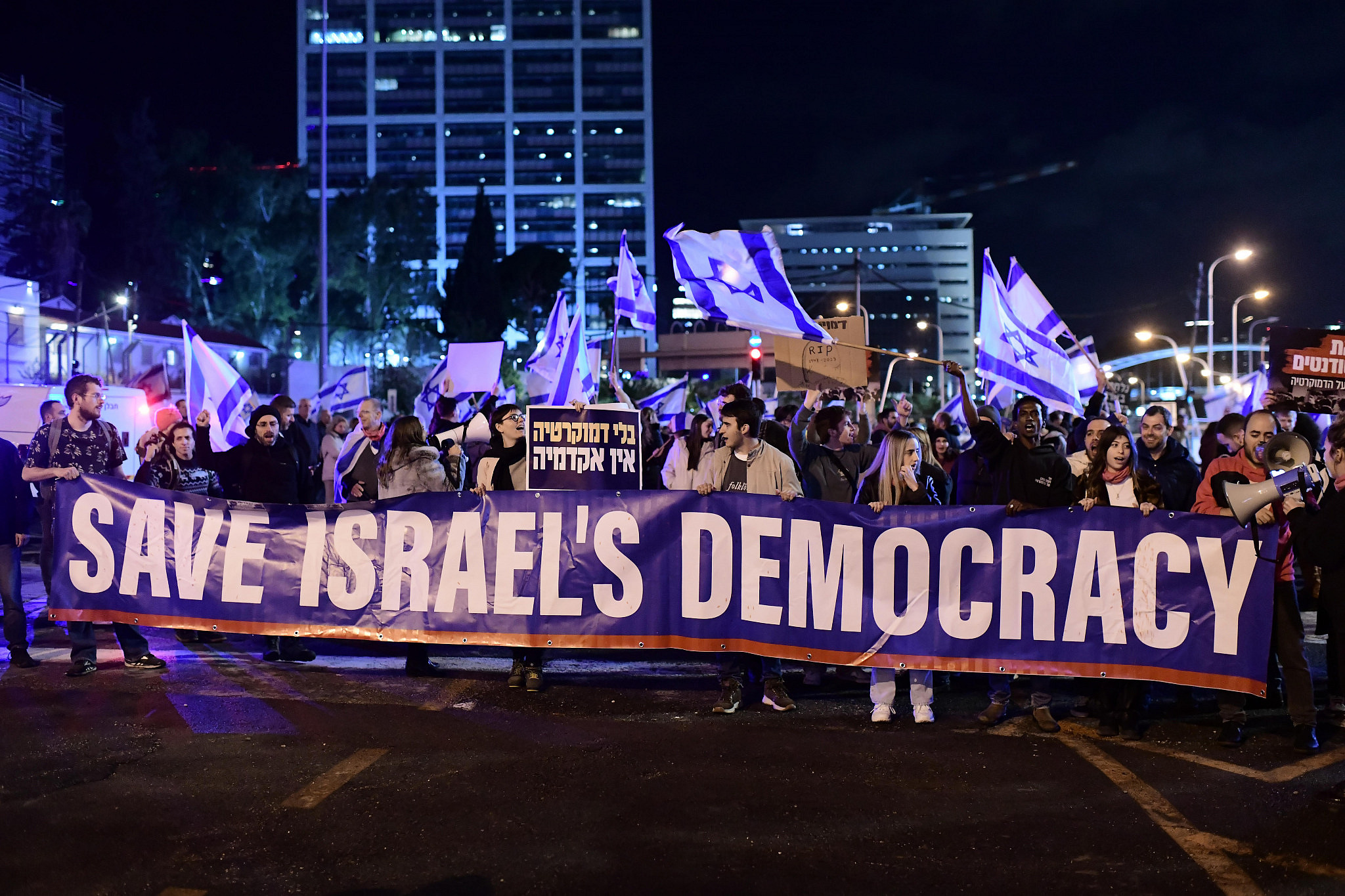
The limits of the movement were on full display during Israel’s May and July 2023 offensives on Gaza and Jenin respectively, when protest leaders immediately fell in line and canceled demonstrations in solidarity with the military campaign.
An even more revealing expression came in September 2023, when Shira Eting, a fighter pilot and leader of the protest group Brothers and Sisters in Arms, told CBS’s 60 Minutes: “If you want pilots to be able to fly and shoot bombs and missiles into houses knowing they might be killing children, they must have the strongest confidence in the people making those decisions.”
Eting’s statement captured the boundaries of the liberal camp’s political imagination. The legitimacy of bombing homes and killing children was taken for granted; what mattered was the identity and credibility of those authorizing such attacks. Once again, the dividing line ran between the unruly violence of the right and the institutional, respectable violence of the center-left.
‘We must now be ruthless’
This was the state of the Israeli political debate on the eve of October 7. After spending some two decades helping to marginalize the occupation and siege of Gaza as political issues, the Israeli liberal camp concentrated its energies on defending the judicial system. In doing so, it helped reinforce the legitimacy of the very forms of state violence that the right aimed to expand.
Meanwhile, with expanded control over West Bank civilian affairs through his special ministerial role in the Defense Ministry, Smotrich had begun constructing the institutional foundations for implementing his plan. Throughout the first half of 2023, as his allies advanced the judicial overhaul, the West Bank’s new overlord began expediting infrastructure plans with the aim of doubling the settler population in the territory from 500,000 to 1 million.
After the unprecedented Hamas attacks on October 7, Smotrich immediately recognized the disaster as an opportunity. At the first cabinet meeting that day, he declared: “We must now be ruthless; we must not show too much consideration for the captives.”
And in the months since, he has taken dramatic steps to put his Decisive Plan into practice and advance Israel’s annexation of the West Bank — from transferring powers over the territory out of the military and into civilian administration, to expanding Israeli law enforcement in areas nominally controlled by the Palestinian Authority, and opening up sales of Palestinian land to Israelis and foreigners.

The liberal camp, meanwhile, argued that Israel had no choice but to respond to the October 7 attacks with brutal and indiscriminate force, and joined the war in masses without questioning its goals. The trust that Eting had described as essential to authorizing attacks that would kill children was no longer treated as a necessary condition for carrying them out.
And although they called for the immediate return of the hostages, they refrained from articulating the way in which they expected this demand to be fulfilled. Only gradually did the demand for a comprehensive hostage deal, which would also entail halting the destruction of Gaza, become the liberal camp’s central rallying cry — something the military establishment, held in such high esteem by Israeli liberals, refused to consider when it had the chance in the war’s opening days.
Alongside its support for the war, the liberal camp developed an emotional and intellectual framework for justifying and participating in the genocide. Where the right celebrated cruelty as a desired political response and invoked the mystical language of war as “a time of miracles,” liberal celebrities and public figures adopted a more measured emotional discourse. They characterized the desire for revenge as instinctive responses to the atrocities of October 7, emphasizing their inability to feel empathy for Palestinians and rejecting attempts to contextualize Hamas’s violence.
Israeli intellectuals such as Eva Illouz and Tomer Persico devoted considerable energy to criticizing what they saw as the failure of the “global left,” taking particular aim at university campus protests in the United States. While the genocide continued in full force, they characterized the identification of Zionism and Israeli rule over Palestinians with colonialism as antisemitic, while rejecting comparisons between the violence of October 7 and other instances of extreme violence in colonial contexts. Portraying October 7 as an event devoid of historical context, and therefore as an attack directed against Jews qua Jews, helped legitimize Gaza’s destruction.
But the most striking institutional expression of this liberal mobilization was the appointment of former Supreme Court President Aharon Barak to the panel hearing South Africa’s genocide case against Israel at the International Court of Justice.
Barak, whose rulings had helped construct the legal framework that enabled the continuation of the occupation while maintaining its supposed “temporary” character, had become a target of the far-right because of his identification with the autonomy of the judiciary and other liberal values. Yet in his dissenting opinion at The Hague, he portrayed Israel as a kind of civilized victim: a state representing both the ultimate victims of European history and the European values supposedly under threat by the “barbarians.”

This language of justifiable violence continued to define the liberal camp’s boundaries with what it deemed the “messianic” right. While supporting or rationalizing Gaza’s destruction in the name of achieving “permanent security,” liberals rejected calls to resettle the Strip. More recently, particularly over the past year, parts of the liberal camp have turned their attention to the religious-Zionist right’s project of establishing settler farm outposts and the ethnic cleansing of Palestinian communities in the West Bank.
Drawing this line signaled an initial awakening, a shift toward recognizing the Palestinian question as a central political issue. But much of the criticism focused on the “Wild West” violence of hilltop youth; for the most part, it has not developed into a more principled critique of Israeli expansionism or the use of military force.
Charting a new political horizon
Three years after October 7, and in the run-up to the next Israeli elections, Smotrich’s 2017 “Decisive Plan” still defines the horizon of Israeli politics. While Israeli liberals occasionally question the “messianic” right’s tactics or the legitimacy of its extralegal violence, they don’t challenge the fundamental assumptions of the right’s political program. Indeed, nearly all Israeli candidates — including the opposition — now agree with Smotrich in opposing the creation of an independent Palestinian state.
The judiciary remains the target of the government’s assault, even as it continues to legitimize the policies of the right and confer on them a stamp of liberal legality. Having helped sustain the occupation and legitimize genocide in Gaza, it is now eroding the few remaining protections still available to Palestinians in Israel, including the ability to choose their political representatives.
Israel’s liberal elite also remains steadfast in its support for a permanent military posture, after enthusiastically backing Israel’s attacks on Lebanon and Iran. This is part of why since the October 2025 “ceasefire” — which Israel has repeatedly violated, killing thousands of Palestinians — the demand to conscript ultra-Orthodox men has become a central focus of liberal political mobilization.

This has prevented the liberal camp from exploiting the growing tensions between ultra-Orthodox parties and religious Zionists to forge new political alliances around demilitarization.
One such opportunity emerged during the vote on the death penalty bill. The legislation was opposed by nearly all politicians that make up the liberal opposition, along with United Torah Judaism (UTJ), which opposed it due to an ongoing tradition of refraining from death penalties and from dealing with “dinei nafshot” (laws that have direct implications for human lives). Shas, which has moved closer to Kahanist positions since the death of Rabbi Ovadia Yosef, also voted in favor.
The vote could have been a defining moment for the liberal camp to redraw the boundaries of legitimate political partnership — to declare the right-wing opposition party Yisrael Beitenu, which supported the bill, as a non-legitimate partner and work to build a coalition with UTJ. Instead, it exposed how those boundaries had not changed at all: For liberals, compulsory military conscription remains nonnegotiable.
The same pattern is evident in the liberal camp’s treatment of Palestinians with Israeli citizenship. It continues to pit “good” and “bad” Palestinian citizens against each other, accepting Mansour Abbas and Ra’am as potential partners on condition that they acknowledge their subordination within the limits of the Jewish nation-state, while ignoring or even delegitimizing the Joint List.
This delegitimization reached a troubling peak when Israel’s left-most Zionist party, The Democrats, joined the Jewish Power Party in supporting the disqualification of Balad chairman Sami Abu Shehadeh from running for the Knesset. Then the High Court heard the case and Supreme Court President Yitzhak Amit recommended that he withdraw his candidacy voluntarily to avoid a ruling — a recommendation Abu Shehadeh accepted.
Most read on +972
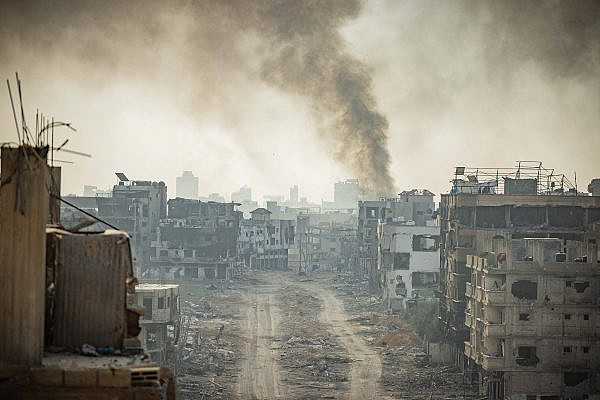


All of this reveals the limits of the liberal camp’s so-called opposition to the Israeli right. To chart a different political horizon, we must reject not only the right-wing politicians but also their vision of ongoing colonialism and genocide that has gained a wide consensus. The only alternative is clear: a binational framework based on the equal rights of Palestinians and Jews, Jewish-Israeli accountability, and Palestinians’ right of return.
A version of this article was first published in Hebrew on Local Call. Read it here.